Every traveler dreams of visiting places that leave a lasting impression—ancient civilizations, breathtaking landscapes, magnificent temples, historic cities, and natural wonders that tell the story of our planet. Many of these incredible destinations have earned a place on the UNESCO World Heritage List because of their outstanding cultural or natural importance.
The UNESCO World Heritage Convention was established in 1972 to identify and protect places that are considered valuable to all humanity. Today, there are more than 1,200 UNESCO World Heritage Sites across over 160 countries. They include world-famous landmarks like the Great Wall of China and Machu Picchu, as well as many hidden gems that most travelers have never heard of.
UNESCO World Heritage Sites are places recognized by the United Nations Educational, Scientific and Cultural Organization (UNESCO) for their Outstanding Universal Value. This means they are considered important to everyone because of their cultural, historical, scientific, or natural significance. These sites are protected to preserve them for future generations, support education, promote responsible tourism, protect wildlife and ecosystems, and encourage countries to work together to conserve them.
Becoming a UNESCO World Heritage Site is not easy. First, a place is added to a country’s Tentative List. It is then officially nominated with detailed information about why it deserves recognition and how it will be protected. International experts review the nomination, and the UNESCO World Heritage Committee makes the final decision. A site must meet at least one of UNESCO’s ten selection criteria to be added to the list.
UNESCO World Heritage Sites fall into three categories. Cultural Sites include monuments, temples, historic cities, and archaeological sites created by people. Natural Sites protect remarkable landscapes, geological formations, national parks, and wildlife habitats. Mixed Sites are recognized for both their cultural and natural importance.
Together, these sites represent our shared global heritage and remind us why it’s so important to protect the world’s history, cultures, and natural wonders for future generations.
Whether you’re planning your next adventure or simply adding new destinations to your travel bucket list, these 25 Cultural UNESCO World Heritage Sites are among the most amazing places you can visit.
Let’s begin the journey!
1. Angkor
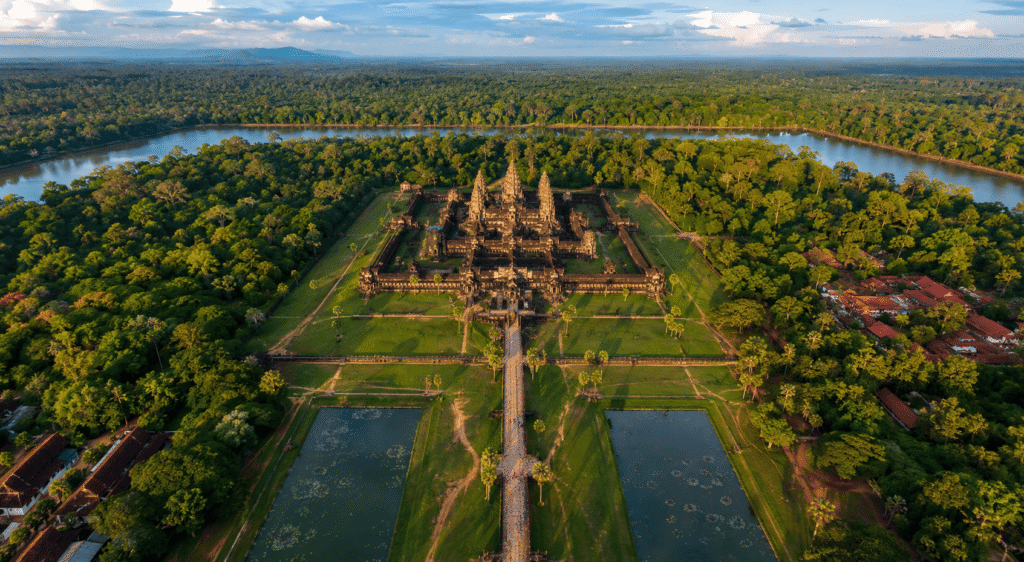
Angkor is one of the world’s greatest archaeological sites, covering more than 154 square miles (400 square kilometers) in northwestern Cambodia. The complex contains the remains of hundreds of temples, ancient cities, reservoirs, canals, roads, and bridges built between the 9th and 15th centuries. At its peak, Angkor was one of the largest and most advanced cities in the world, with an estimated population of 700,000 to over one million people.
The name “Angkor” comes from the Sanskrit word Nagara, meaning “city.” Angkor is located in Siem Reap Province, Cambodia, about 4 miles (6 km) north of the city of Siem Reap, making it easily accessible for visitors.
Why Is Angkor Famous?
Angkor is famous for its incredible history, breathtaking architecture, and cultural importance. It is home to the world’s largest religious monument, Angkor Wat, along with hundreds of other ancient temples. Visitors come to admire its remarkable Khmer architecture, detailed stone carvings, advanced water management system, rich Hindu and Buddhist heritage, and unforgettable sunrise and sunset views. Today, it is one of the most popular tourist destinations in Southeast Asia.
History of Angkor
Early Beginnings (802 AD):
The Khmer Empire officially began in 802 AD when Jayavarman II declared himself the Devaraja, or “god-king.” This marked the beginning of one of Southeast Asia’s greatest civilizations.
Golden Age (9th–13th Century):
During its golden age, the Khmer Empire expanded across much of present-day Cambodia, Thailand, Laos, Vietnam, and parts of Myanmar. Powerful kings built magnificent temples, reservoirs, roads, and cities, turning Angkor into one of the largest urban centers in the world.
Construction of Angkor Wat (12th Century):
The empire’s most famous monument, Angkor Wat, was built between 1113 and 1150 AD by King Suryavarman II. It was originally dedicated to the Hindu god Vishnu before later becoming a Buddhist temple.
Buddhist Period:
During the reign of Jayavarman VII, Buddhism became the dominant religion of the Khmer Empire. Many Buddhist temples were constructed, including the famous Bayon.
Decline:
By the 15th century, Angkor gradually declined due to several factors, including wars with neighboring kingdoms, political instability, damage to its water management system, and long periods of drought. Eventually, the royal court moved south to present-day Phnom Penh. Although some temples remained active places of worship, much of the city was slowly reclaimed by the surrounding jungle.
UNESCO World Heritage Site
Angkor was designated a UNESCO World Heritage Site in 1992 because of its outstanding cultural significance, remarkable architecture, and historical importance. Today, it is carefully protected and preserved for future generations.
Angkor Wat
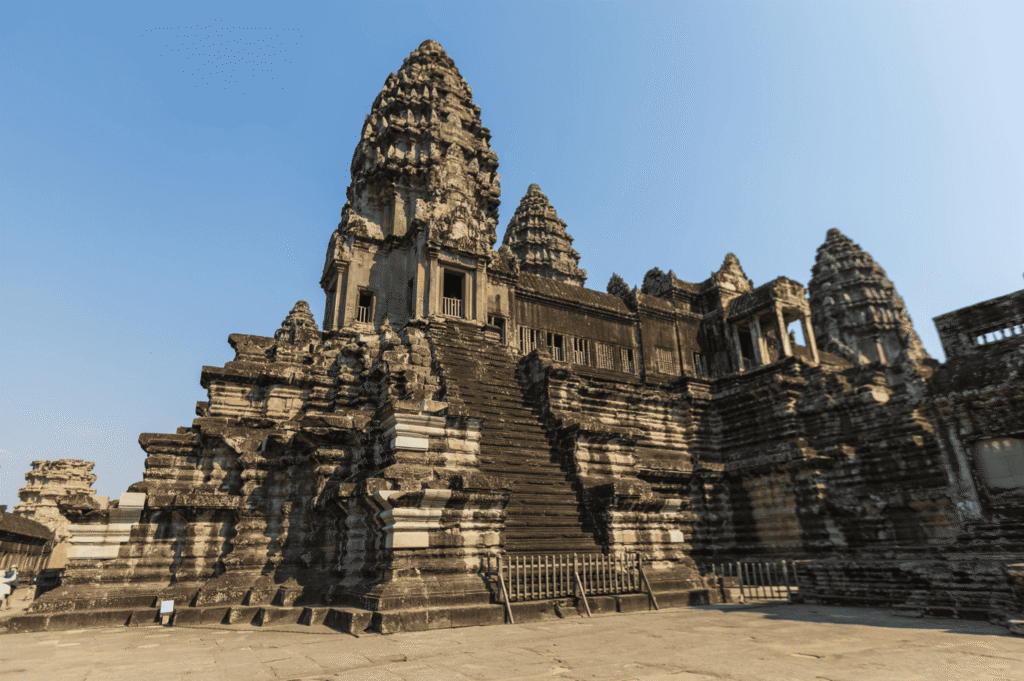
Angkor Wat is the most famous temple within the Angkor Archaeological Park and the largest religious monument in the world. Built in the 12th century, it covers approximately 402 acres (162 hectares) and is surrounded by a moat about 620 feet (190 meters ) wide.
The temple features five lotus-shaped towers representing Mount Meru, the sacred mountain in Hindu mythology. Built mainly from sandstone, its walls are covered with thousands of detailed carvings showing battles, mythology, religious stories, and scenes from everyday life.
Other Major Temples of Angkor
A. Bayon:
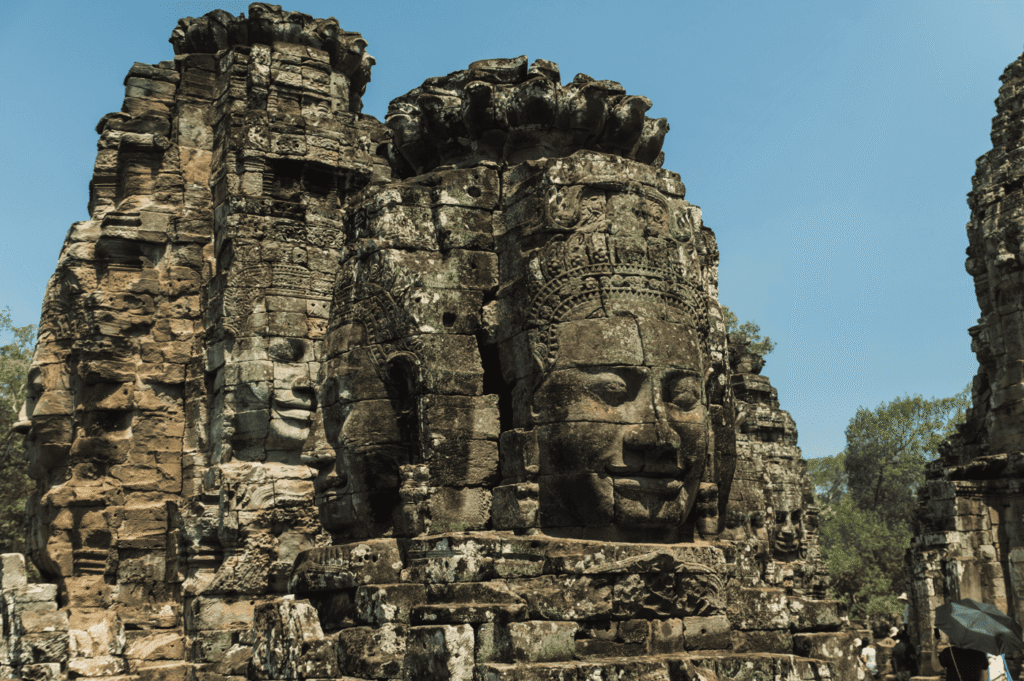
Famous for its more than 200 peaceful stone faces carved into its towers.
B. Ta Prohm:
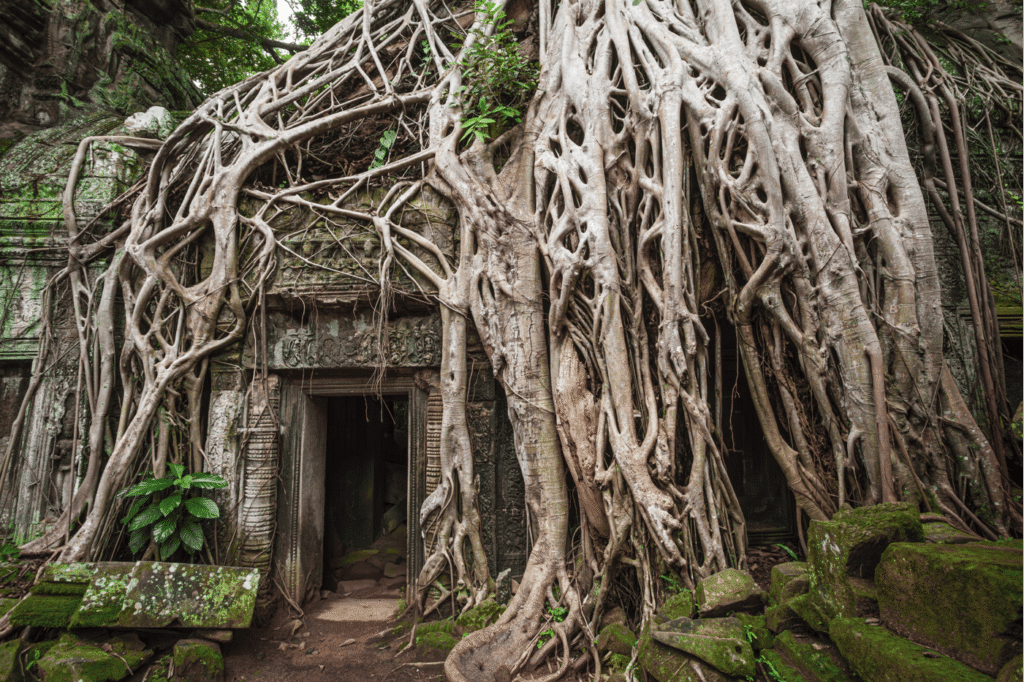
Known for giant tree roots growing over the temple ruins. It became world-famous after appearing in the film Lara Croft: Tomb Raider.
C. Angkor Thom:
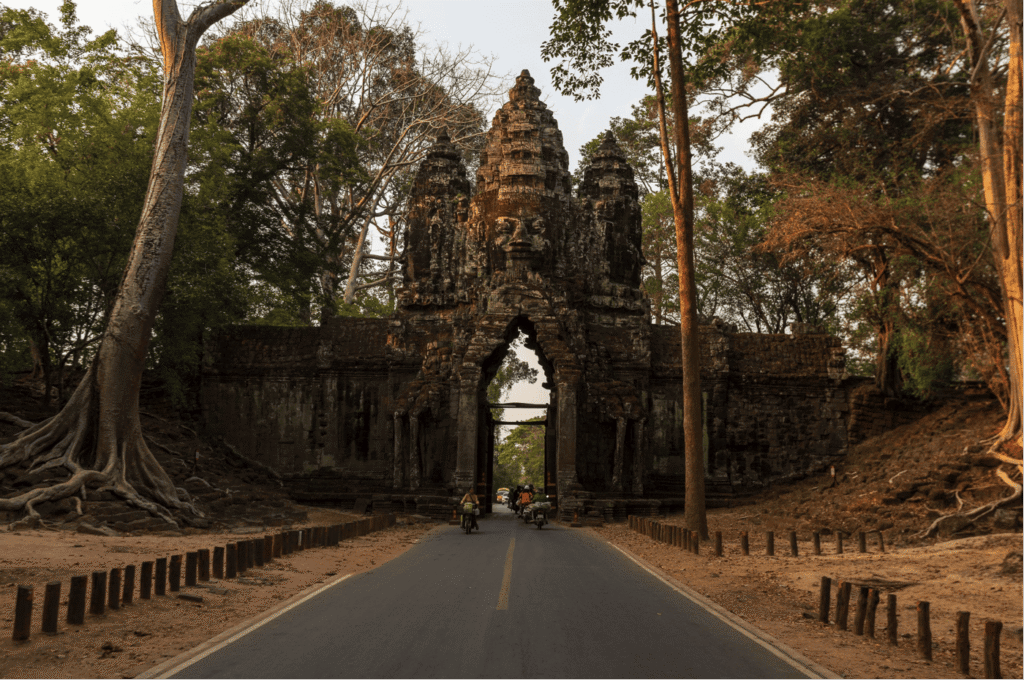
A massive walled city built by Jayavarman VII that served as the final capital of the Khmer Empire.
D. Banteay Srei:
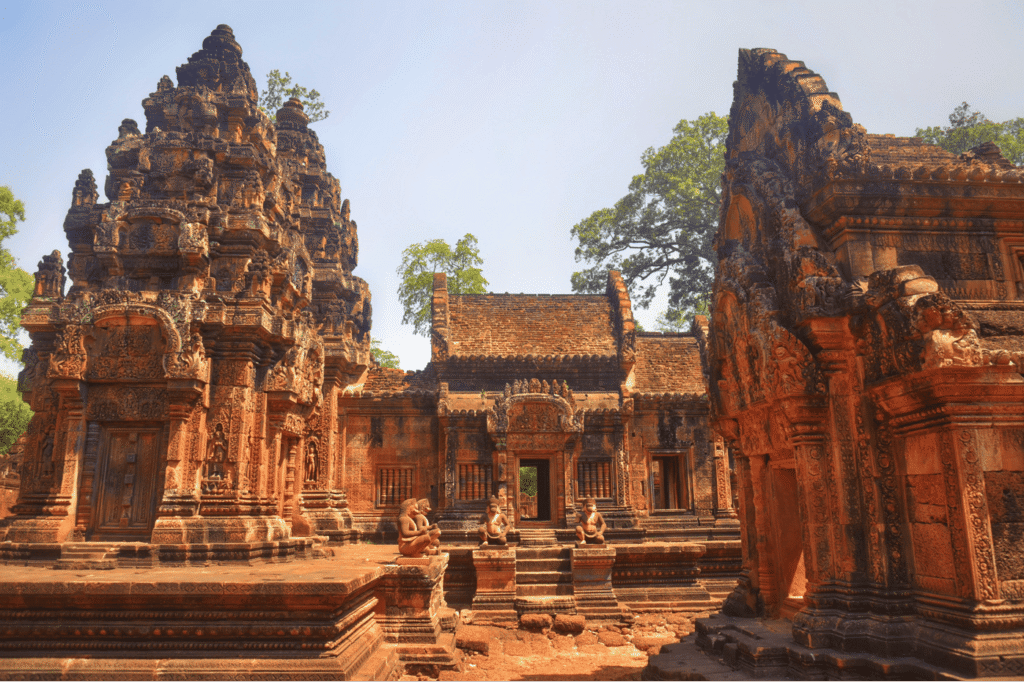
Renowned for its beautiful pink sandstone and some of the finest carvings in Khmer architecture.
E. Preah Khan:
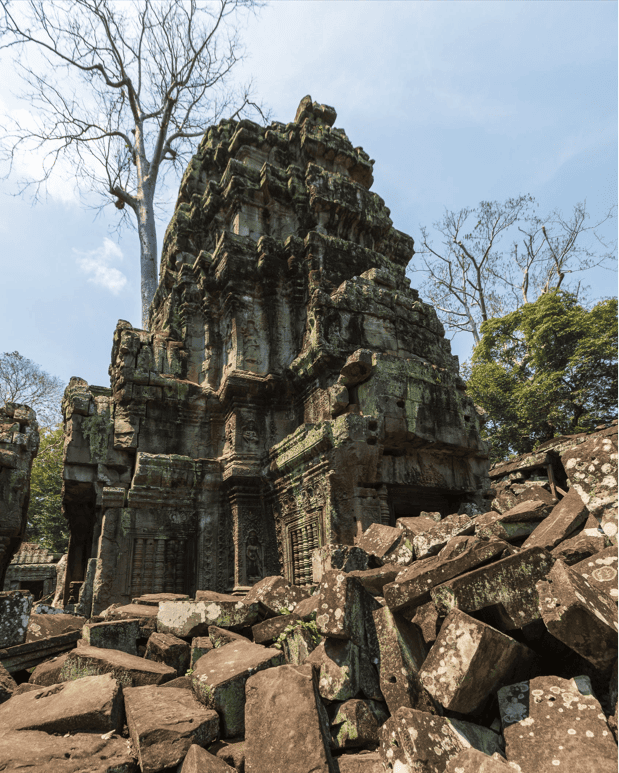
A vast temple complex that once served as a monastery, university, and royal residence.
Religion
Angkor’s religious history reflects centuries of changing beliefs. It was originally centered on Hinduism, but later Buddhism became the dominant religion. Today, many temples remain active places of Theravada Buddhist worship while still preserving their beautiful Hindu artwork and symbolism.
Advanced Water Engineering
One of Angkor’s greatest achievements was its advanced water management system. Khmer engineers built enormous reservoirs (barays), canals, dams, moats, and spillways to control seasonal floods and store water for farming. This sophisticated system helped support one of the world’s largest ancient cities.
Art and Stone Carvings
The temples are decorated with thousands of intricate carvings that depict kings, warriors, celestial dancers (Apsaras), animals, flowers, religious stories, and scenes from everyday life in the Khmer Empire. These carvings provide valuable insights into the culture and beliefs of ancient Cambodia.
Interesting Facts About Angkor
- Angkor Wat appears on the national flag of Cambodia.
- The archaeological park contains hundreds of monuments, although only some are open to visitors.
- Many of the sandstone blocks used to build the temples were transported from quarries located more than 25 miles (40 km ) away.
- Angkor beautifully blends Hindu and Buddhist traditions, reflecting centuries of religious change.
- Modern LiDAR (Light Detection and Ranging) technology has uncovered hidden roads, neighborhoods, canals, and other structures beneath the surrounding forest, revealing that Angkor was once a vast and highly organized ancient city.
2. Pyramids of Giza
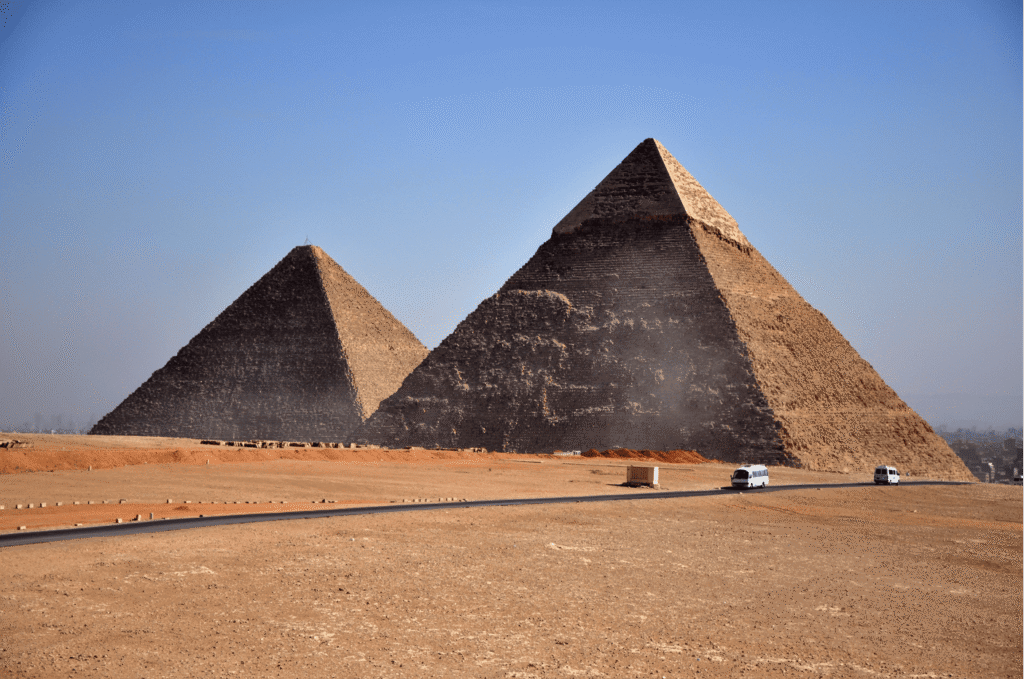
Pyramids of Giza are among the most famous and recognizable monuments in the world. Located on the Giza Plateau near Cairo, Egypt, they were built more than 4,500 years ago as royal tombs for ancient Egyptian pharaohs. They are the last surviving Wonder of the Ancient World and remain one of humanity’s greatest architectural and engineering achievements. The Giza Pyramid Complex covers approximately 6.2 square miles (16 square kilometers) on the western bank of the Nile River. The complex includes the three main pyramids, the Great Sphinx, six smaller queens’ pyramids, temples, causeways, cemeteries (mastabas), workers’ villages, and boat pits containing ancient solar boats. The pyramids were built during Egypt’s Fourth Dynasty of the Old Kingdom.
Where Are the Pyramids of Giza?
The Pyramids of Giza are located in Giza Governorate, Egypt, on the outskirts of the city of Giza. They are approximately 9–12 miles (15–20 km) southwest of central Cairo, making them one of Egypt’s most accessible and popular tourist attractions.
Why Are the Pyramids of Giza Famous?
The Pyramids of Giza are famous for several reasons. They are the last surviving Wonder of the Ancient World, the largest pyramids ever built in Egypt, and among the oldest man-made monuments still standing. Built over 4,500 years ago using millions of massive stone blocks, they showcase the incredible engineering skills of ancient Egypt. The complex is also home to the iconic Great Sphinx and attracts millions of visitors from around the world every year.
History of the Pyramids
A. The Old Kingdom (c. 2686–2181 BC)
The pyramids were built during Egypt’s Old Kingdom, often called the “Age of the Pyramids.” During this period, powerful pharaohs commissioned monumental tombs to prepare for the afterlife.
B. Construction of the Great Pyramid
The Great Pyramid of Giza was built for Pharaoh Khufu between 2580 and 2560 BC. When completed, it stood about 481 feet (146.6 meters) tall, making it the tallest human-made structure in the world for nearly 3,800 years. Today, it stands at approximately 455 feet (138.8 meters) because its original limestone casing stones and capstone have been lost.
C. The Other Two Great Pyramids
Pyramid of Khafre
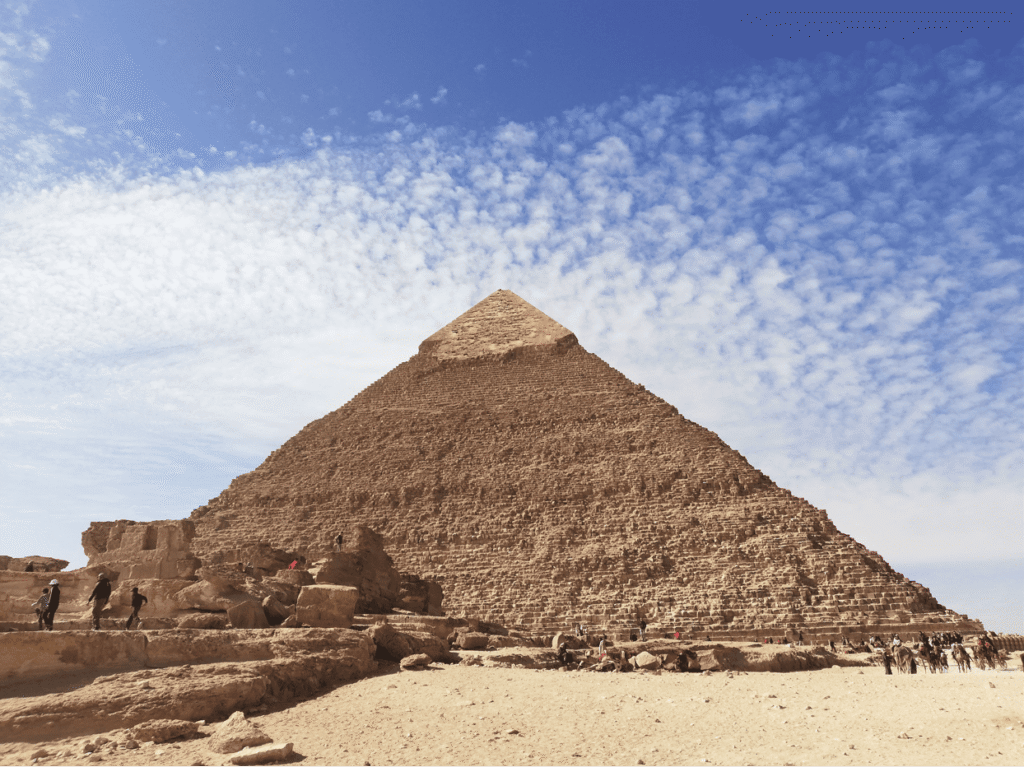
Built for Pharaoh Khafre, this pyramid appears taller than the Great Pyramid because it stands on higher ground and still retains some of its original limestone casing near the top.
Pyramid of Menkaure
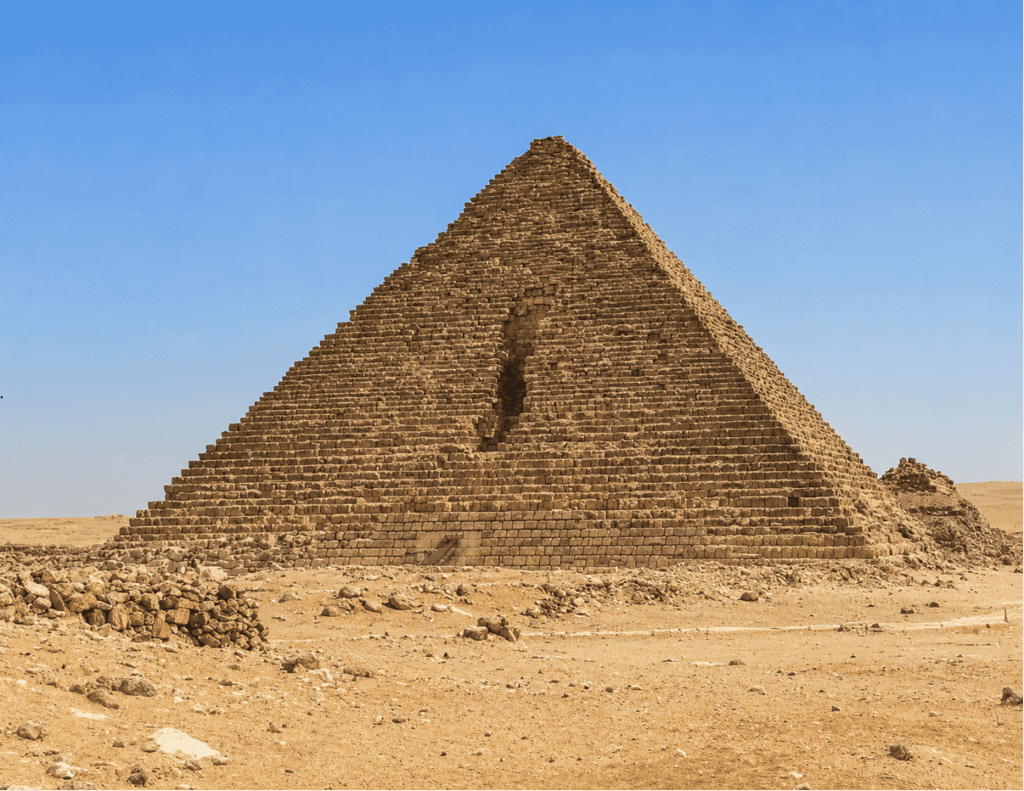
Built for Pharaoh Menkaure, it is the smallest of the three main pyramids but remains an impressive example of ancient Egyptian architecture.
UNESCO World Heritage Site
The Memphis and Its Necropolis – the Pyramid Fields from Giza to Dahshur were designated a UNESCO World Heritage Site in 1979. The Giza pyramids are the most famous part of this vast archaeological landscape.
A. The Great Pyramid of Giza
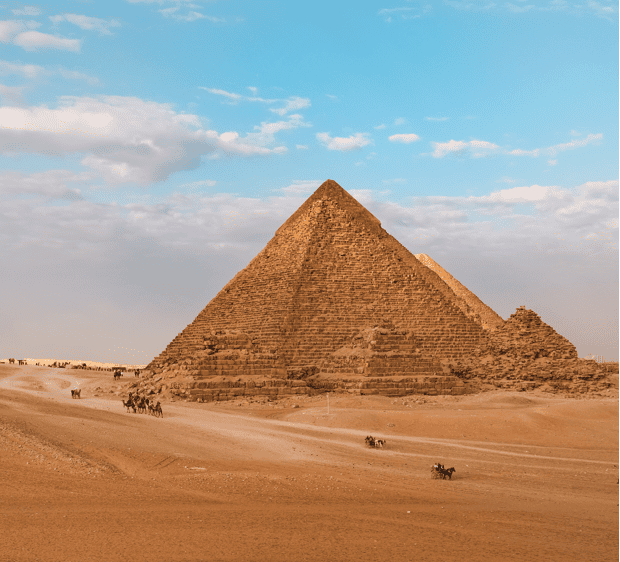
Great Pyramid of Giza is the largest and oldest pyramid in the complex. Built around 2580–2560 BC, it originally stood 481 feet (146.6 meters) tall and now measures about 138.8 meters (455 feet).
Each side of its square base measures approximately 756 feet (230.4 meters). The pyramid was constructed using an estimated 2.3 million stone blocks, with an average weight of around 2.5 tonnes, although some blocks are much heavier.
Originally, the pyramid was covered with smooth white limestone casing stones that reflected sunlight, making it shine brightly from a distance. Inside are several chambers and passageways, including the King’s Chamber, Queen’s Chamber, and the impressive Grand Gallery.
B. The Great Sphinx
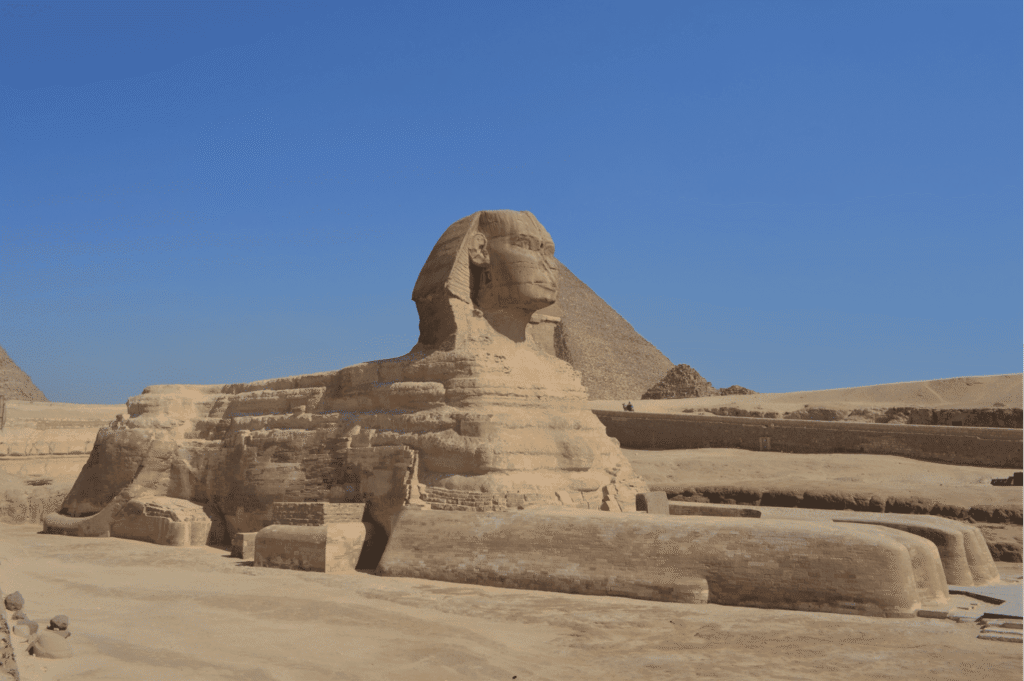
The Great Sphinx of Giza is a massive limestone statue with the body of a lion and the head of a human. It is widely believed to represent Pharaoh Khafre.
The statue measures about 240 feet (73 meters) long and 66 feet (20 meters) high, making it one of the world’s largest monolithic statues. It was carved directly from natural limestone bedrock. Although many legends surround its missing nose, historians believe it disappeared centuries after the monument was built.
How Were the Pyramids Built?
Although researchers continue to study the construction methods, most evidence suggests that tens of thousands of skilled workers and laborers built the pyramids over several decades.
Stone blocks were quarried locally and transported using sledges, boats, and ramps. Workers lived in nearby settlements where they received food, housing, and medical care. The Great Pyramid is believed to have taken about 20–30 years to complete. Despite popular myths, there is no credible archaeological evidence that aliens or supernatural forces built the pyramids.
Architecture
The pyramids are remarkable for their precision and engineering. They are almost perfectly aligned with the four cardinal directions—north, south, east, and west—and have square bases with very little variation in side length. Built mainly from limestone and granite, they contain carefully designed chambers, corridors, and structural features that have survived for thousands of years.
Religion and Beliefs
Ancient Egyptians believed that death marked the beginning of another life. The pyramids served as royal tombs, places for funerary rituals, symbols of divine kingship, and gateways to the afterlife. Pharaohs were buried with treasures, jewelry, food, furniture, and religious objects that they believed would help them in the next world.
Interesting Facts About the Pyramids of Giza
- The Great Pyramid of Giza is the only surviving Wonder of the Ancient World.
- It remained the tallest human-made structure on Earth for nearly 3,800 years.
- Its original polished limestone casing made the pyramid shine brilliantly in the sunlight.
- Besides the three main pyramids, the complex includes smaller pyramids, temples, cemeteries, workers’ villages, and ancient boat pits.
- Modern technologies, including laser scanning and muon imaging, continue to reveal hidden chambers and new details about the pyramids without causing any damage.
3. Acropolis of Athens
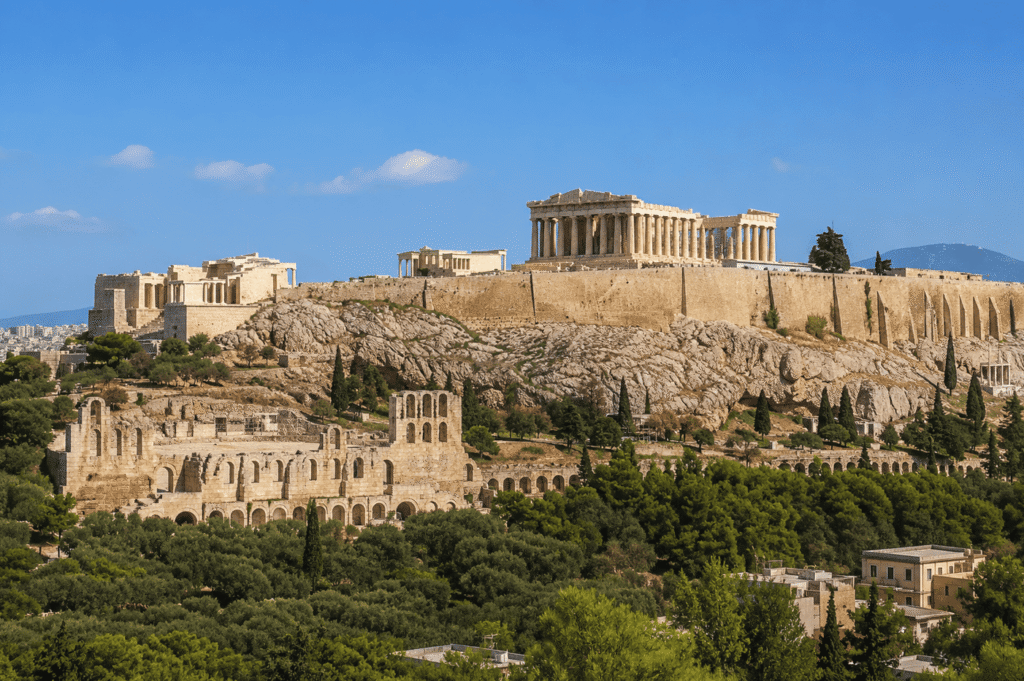
Acropolis of Athens is one of the world’s most important archaeological sites and a lasting symbol of ancient Greek civilization. Perched on a rocky hill overlooking modern Athens, it served as the religious, political, and cultural center of the ancient city. The site is home to the iconic Parthenon, one of the greatest masterpieces of classical architecture and a powerful symbol of democracy, philosophy, and Western civilization.
What is the Acropolis of Athens?
Located in Athens, in the Attica region of Greece, the Acropolis is an ancient fortified citadel built on a limestone hill that rises about 512 feet (156 meters) above sea level. The word Acropolis comes from the Greek words akron (“highest point”) and polis (“city”), meaning “high city.”
The site is home to several remarkable temples, sanctuaries, monuments, and gateways, most of which were built during the 5th century BC, often referred to as the Golden Age of Athens. Today, the Acropolis dominates the city’s skyline and remains one of Greece’s most recognizable landmarks.
Why is the Acropolis famous?
Acropolis is famous for being one of the greatest achievements of ancient Greek civilization. It is home to the world-renowned Parthenon and represents the birthplace of democracy and classical philosophy. Its remarkable architecture and sculptures have influenced buildings around the world for more than 2,400 years, making it one of Europe’s most visited archaeological sites.
History of the Acropolis
Early Settlement:
Evidence suggests that people lived on the Acropolis hill as early as the Neolithic period (around 4000 BC). During the Mycenaean civilization (c. 1600–1100 BC), it became a heavily fortified royal citadel.
The Persian Invasion:
In 480 BC, Persian forces led by Xerxes I captured Athens and destroyed many of the buildings on the Acropolis. This devastation inspired the Athenians to rebuild the site on an even grander scale.
The Golden Age of Athens:
Under the leadership of Pericles during the 5th century BC, the Acropolis was transformed into a magnificent religious and cultural center. Many of its most famous monuments, including the Parthenon, were constructed between 447 BC and 406 BC.
Later History:
Over the centuries, the Acropolis served many different purposes. It functioned as a pagan sanctuary, a Christian church, a Byzantine religious center, a Roman Catholic cathedral, an Ottoman mosque, and even a military fortress. Despite wars, earthquakes, and centuries of damage, much of the site has survived.
UNESCO World Heritage Site
Acropolis of Athens was designated a UNESCO World Heritage Site in 1987 for its outstanding universal value as a masterpiece of classical art and architecture. Today, it remains one of the world’s most treasured cultural landmarks.
The Parthenon
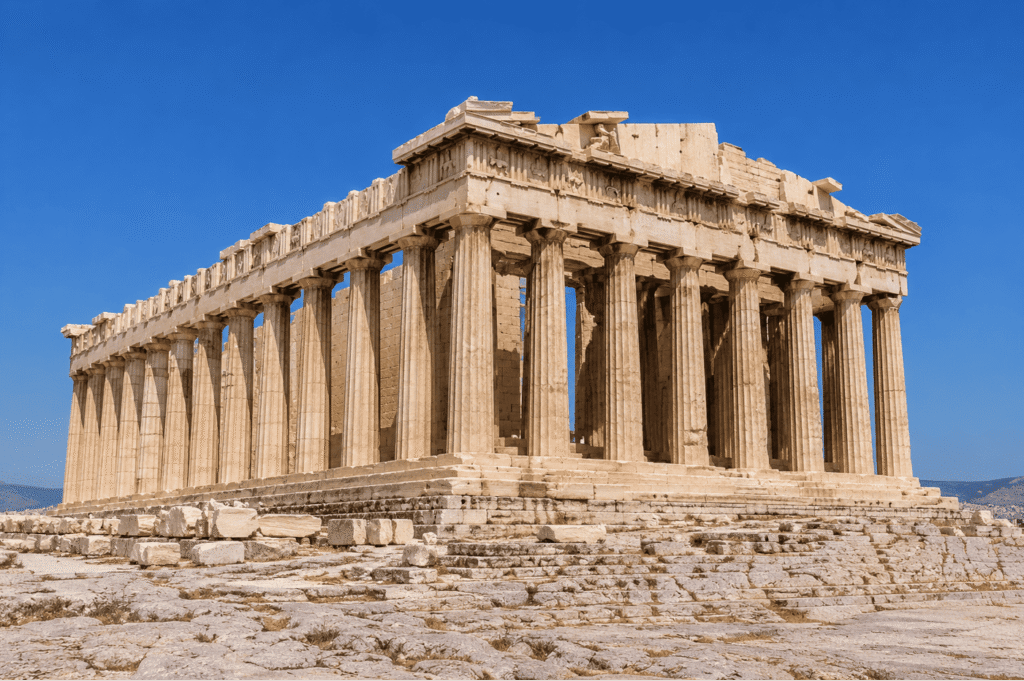
The Parthenon is the most famous structure on the Acropolis and was dedicated to Athena, the patron goddess of Athens. Built between 447 and 432 BC, it was designed by the architects Ictinus and Callicrates, while its sculptural decoration was supervised by the renowned sculptor Phidias.
Constructed primarily from Pentelic marble, the Parthenon is widely regarded as the finest example of Doric architecture. It once housed a colossal gold-and-ivory statue of Athena created by Phidias.
Other Major Monuments
A. Erechtheion
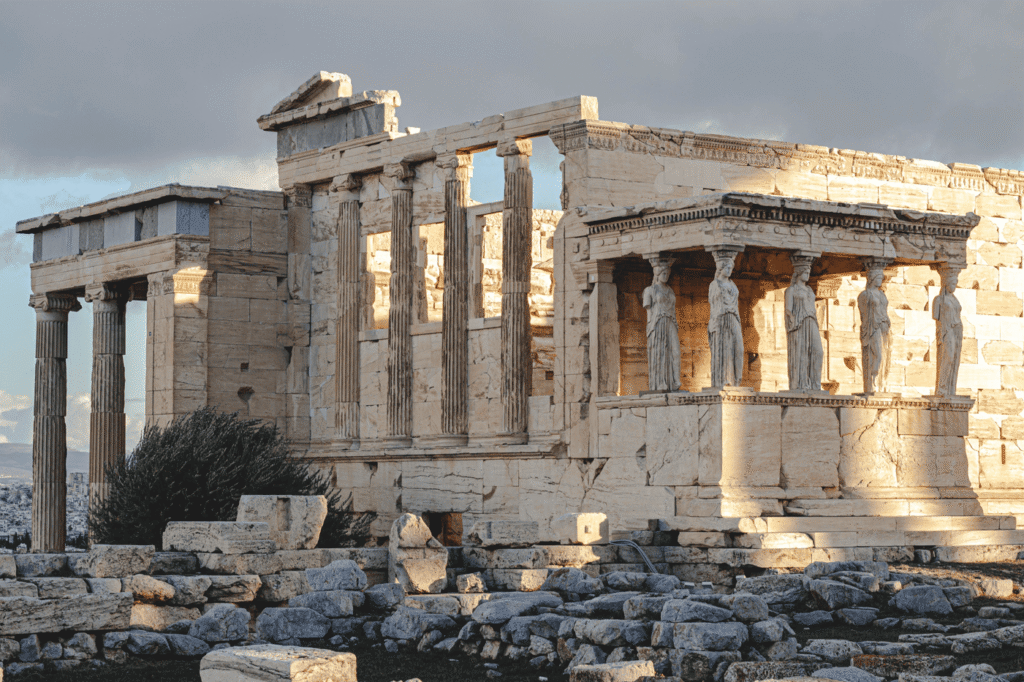
Famous for the Porch of the Caryatids, where six beautifully sculpted female figures serve as supporting columns.
B. Temple of Athena Nike
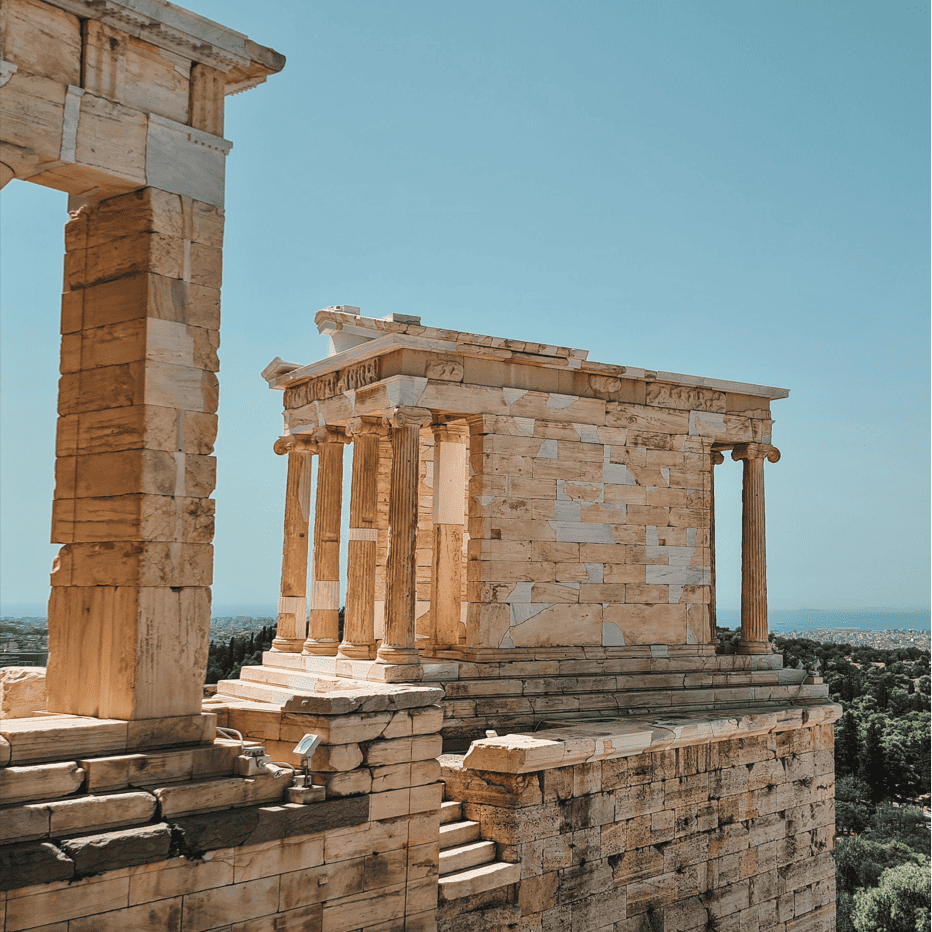
A small but elegant Ionic temple dedicated to Athena as the goddess of victory.
C. Propylaea
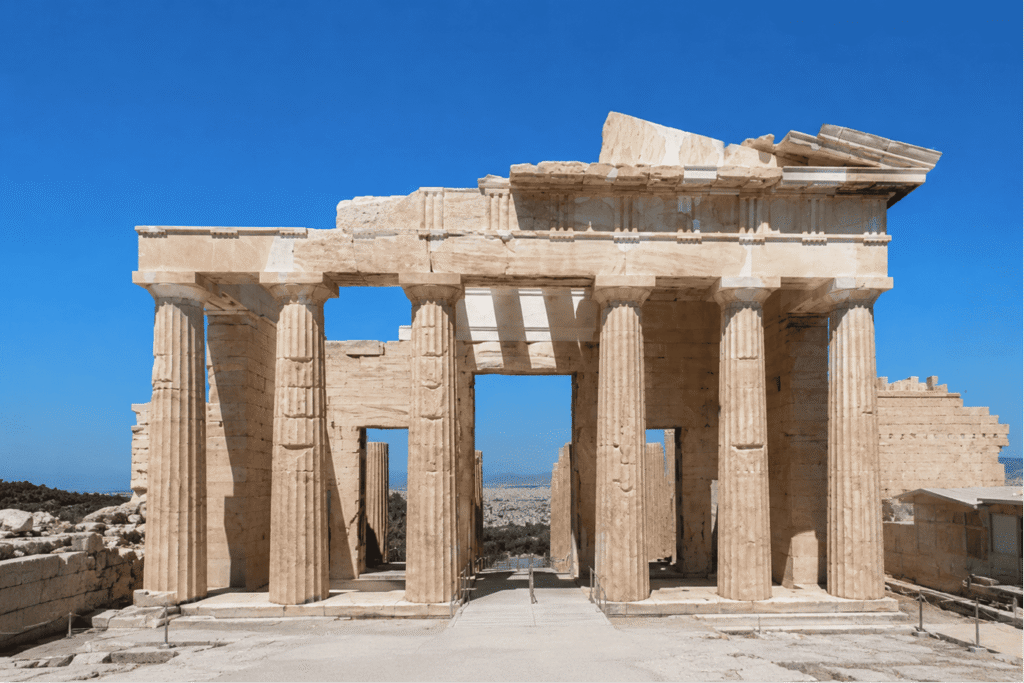
The grand ceremonial gateway that serves as the monumental entrance to the Acropolis.
D. Theatre of Dionysus
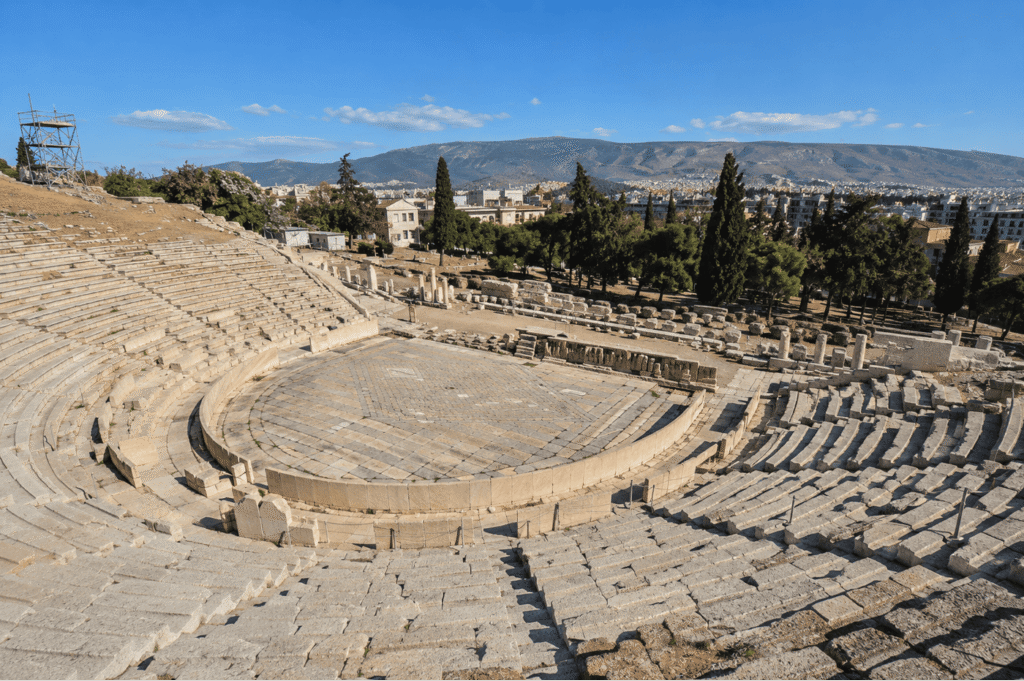
Located on the southern slope of the hill, it is considered one of the world’s earliest theatres and the birthplace of Greek drama.
Architecture
Acropolis is celebrated for its architectural brilliance and precision. Its monuments combine Doric and Ionic styles and were built primarily from Pentelic marble. Elegant columns, intricately sculpted pediments, decorative friezes, and subtle optical refinements were carefully designed to make the buildings appear perfectly proportioned to the human eye. These innovations have inspired countless museums, public buildings, and government structures across the globe.
Religion and Mythology
The Acropolis was the most sacred site in ancient Athens and was primarily dedicated to Athena, the goddess of wisdom, warfare, and craftsmanship. It also honored Poseidon and several other Greek gods and heroes.
According to Greek mythology, Athena and Poseidon competed to become the city’s patron deity. Poseidon offered a saltwater spring, while Athena gifted the people an olive tree, symbolizing peace and prosperity. The citizens chose Athena’s gift, and the city was named Athens in her honor.
Art and Sculpture
The Acropolis once displayed some of the finest sculptures of the ancient world. These included marble statues of gods and heroes, detailed relief carvings, decorative friezes depicting religious festivals, and monumental pediments illustrating scenes from Greek mythology.
Today, many of the original sculptures are preserved in the nearby Acropolis Museum, where they are protected from weathering and pollution, while replicas remain on the monuments themselves.
4. Town of Luang Prabang
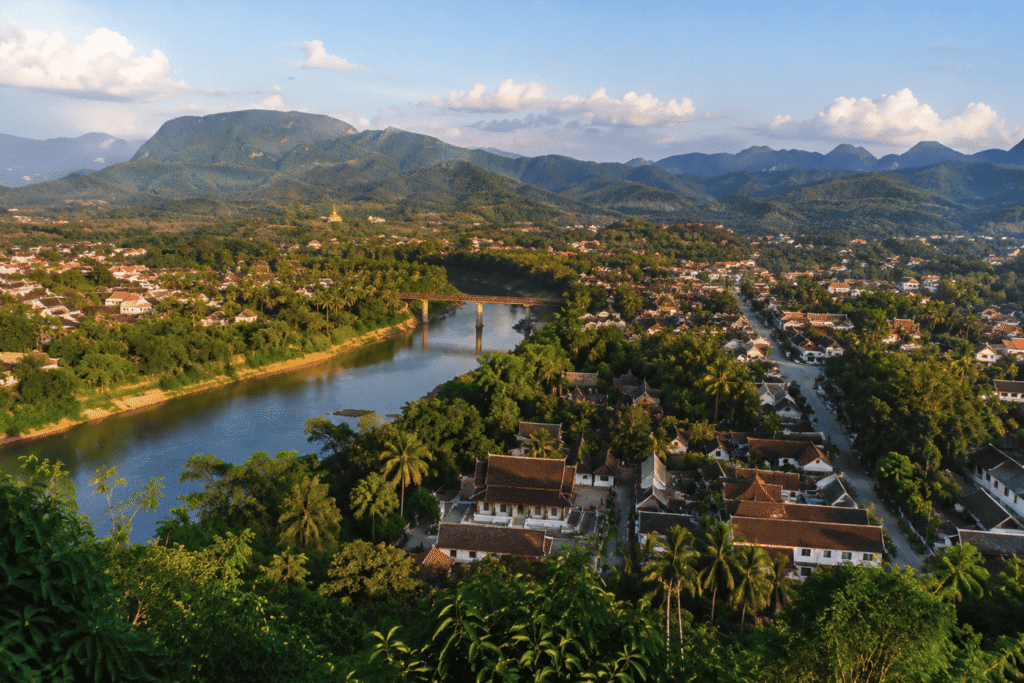
Town of Luang Prabang is one of Southeast Asia’s most charming and well-preserved historic cities. Nestled between the Mekong and Nam Khan rivers in northern Laos, it is renowned for its golden Buddhist temples, elegant French colonial architecture, peaceful atmosphere, and rich cultural heritage. Once the royal capital of Laos, Luang Prabang remains the country’s spiritual and cultural heart.
What is the Town of Luang Prabang?
Located on a peninsula where the Mekong and Nam Khan rivers meet, Luang Prabang is a historic city celebrated for its unique blend of traditional Lao architecture and European colonial influences. The town is filled with ancient Buddhist temples, royal palaces, French colonial villas, traditional wooden houses, tree-lined streets, and colorful local markets. Its relaxed atmosphere and beautifully preserved heritage make it one of the most picturesque destinations in Southeast Asia.
Why is Luang Prabang Famous?
Luang Prabang is famous for its rich history and remarkable cultural heritage. It served as the royal capital of Laos until 1975 and is home to dozens of beautifully preserved Buddhist temples. The town is known for its harmonious mix of traditional Lao and French colonial architecture, its daily Buddhist alms-giving ceremony, and its proximity to breathtaking waterfalls, caves, and mountain scenery. Today, it is recognized as one of Southeast Asia’s best-preserved historic towns.
History of Luang Prabang
Early History:
Originally known as Muang Sua, the city has been inhabited for more than a thousand years. Thanks to its strategic location along regional trade routes, it developed into an important political, cultural, and religious center.
Capital of the Lan Xang Kingdom:
In 1353, King Fa Ngum established the powerful Lan Xang Kingdom and made Luang Prabang its capital. During this period, the city flourished as the kingdom’s political, religious, and cultural center.
Royal Capital:
Although the administrative capital was later moved to Vientiane, Luang Prabang remained the royal residence and spiritual heart of Laos for centuries. It continued to serve as the home of the Lao monarchy until the monarchy was abolished in 1975.
French Colonial Period:
During the late 19th and early 20th centuries, Laos became part of French Indochina. French influence introduced elegant colonial buildings, tree-lined streets, and thoughtful urban planning that blended seamlessly with traditional Lao architecture.
UNESCO World Heritage Site
Town of Luang Prabang was inscribed as a UNESCO World Heritage Site in 1995 for its exceptional preservation and unique fusion of traditional Lao and French colonial architecture. The town is considered one of the finest examples of a historic city where cultural traditions and architectural heritage have been carefully protected.
Major Attractions
A. Wat Xieng Thong
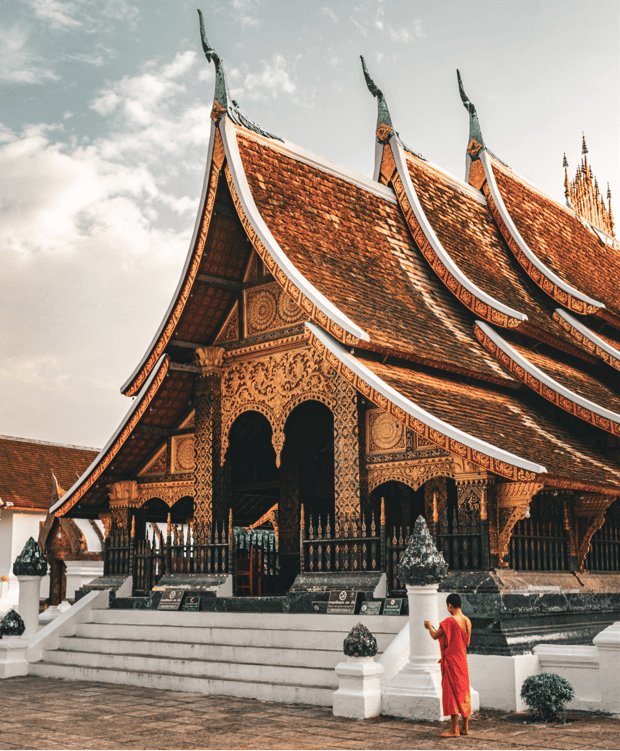
Built in the 16th century, this is Luang Prabang’s most celebrated temple. It is admired for its sweeping roofs, intricate mosaics, and classic Lao architecture.
B. Royal Palace Museum
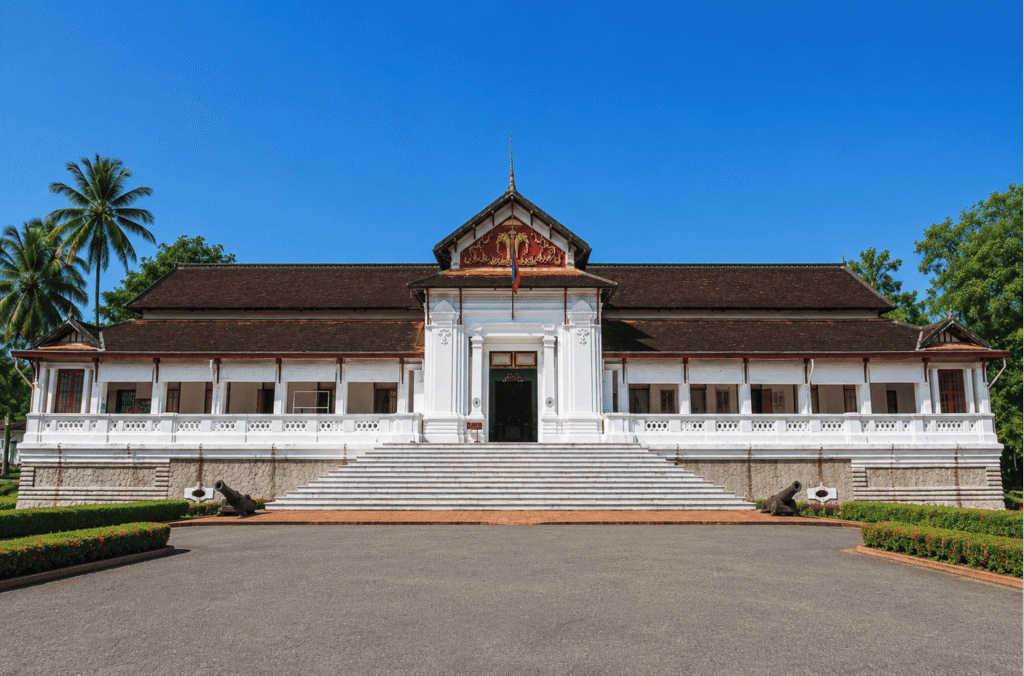
Originally constructed in 1904 for the Lao royal family, the palace now houses royal artifacts, religious treasures, and historical exhibits that offer insight into the country’s past.
C. Mount Phousi
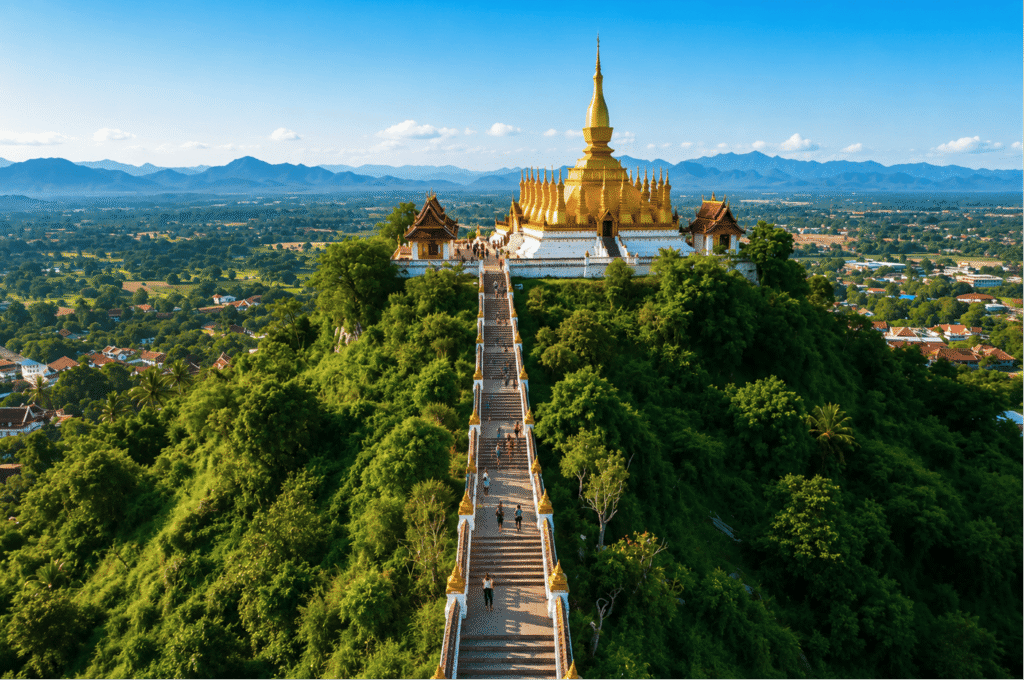
This sacred hill in the heart of the town offers spectacular panoramic views of Luang Prabang and the surrounding rivers, especially during sunrise and sunset.
D. Kuang Si Falls
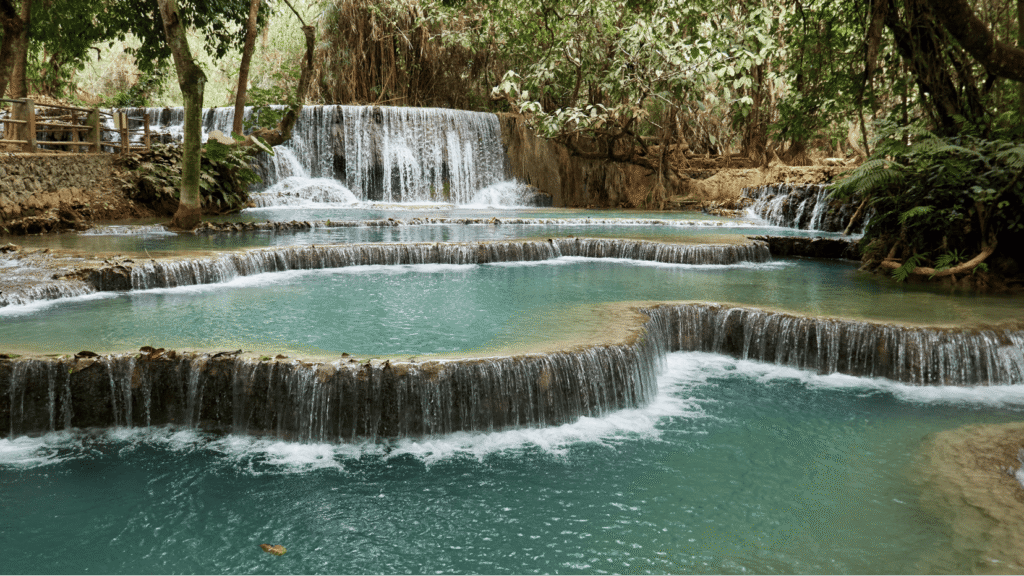
Located about 19 miles (30 kilometers) from the town, these stunning multi-tiered waterfalls are famous for their crystal-clear turquoise pools and lush jungle surroundings.
E. Pak Ou Caves
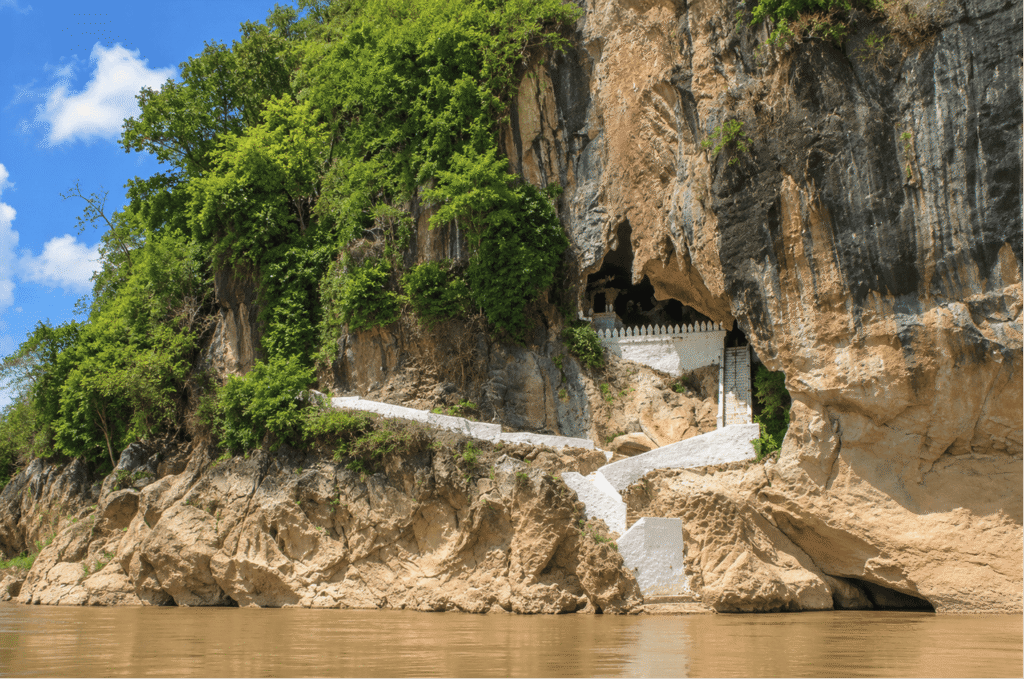
Situated along the Mekong River, these limestone caves contain thousands of Buddha statues that have been placed there by pilgrims over many centuries.
Religion and Culture
Buddhism plays a central role in everyday life in Luang Prabang. The town is home to more than 30 Buddhist temples, where monks study, meditate, and take part in religious ceremonies.
One of its most iconic traditions is the morning alms-giving ceremony, known as Tak Bat. At dawn each day, long lines of monks walk silently through the streets while local residents respectfully offer them food. Visitors are welcome to observe this beautiful tradition but are encouraged to do so quietly and respectfully without interrupting the ceremony.
Architecture
The town is admired for its harmonious blend of architectural styles. Traditional Lao wooden houses stand alongside elegant French colonial villas, while Buddhist monasteries feature graceful multi-tiered roofs, decorative gilded carvings, colorful mosaics, wooden shutters, and charming balconies. Together, these elements create the city’s distinctive and timeless character.
Nature Around Luang Prabang
The region surrounding Luang Prabang is rich in natural beauty. Visitors can explore mountain landscapes, dense forests, river valleys, limestone caves, and spectacular waterfalls while enjoying the area’s diverse birdlife and wildlife. Popular outdoor activities include hiking, cycling, kayaking, river cruises, and exploring the countryside, making the town an excellent destination for both culture and nature lovers.
5. Chichén Itzá
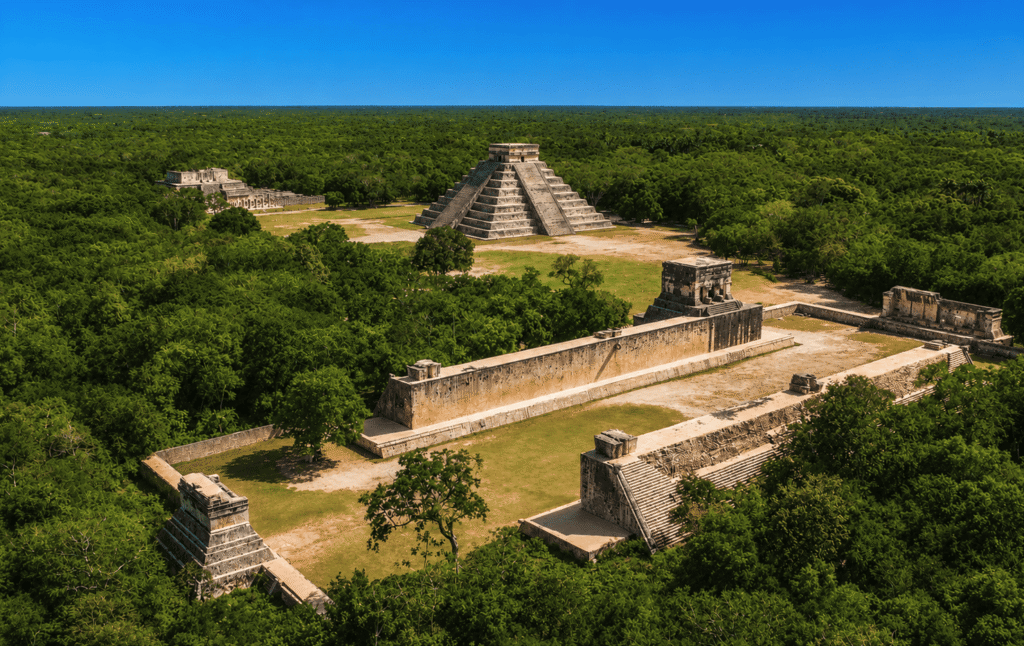
Chichén Itzá is one of the world’s most remarkable archaeological sites and the most famous city of the ancient Maya civilization. Located on Mexico’s Yucatán Peninsula, it flourished between the 7th and 13th centuries AD as a major political, religious, economic, and scientific center. Renowned for its monumental pyramids, advanced astronomical knowledge, and impressive engineering, it is both a UNESCO World Heritage Site and one of the New Seven Wonders of the World.
What is Chichén Itzá?
Chichén Itzá is a vast pre-Columbian archaeological city built by the Maya people. At its peak, it was one of the largest and most influential urban centers in Mesoamerica, serving as a hub for religion, trade, politics, astronomy, and culture.
The archaeological site covers approximately 2 square miles (5 square kilometers), although the ancient city and its surrounding settlements once extended much farther. The name Chichén Itzá is commonly translated as “At the mouth of the well of the Itza,” referring to the nearby natural sinkholes, known as cenotes, which provided the city with a reliable source of fresh water.
Why is Chichén Itzá Famous?
Chichén Itzá is famous for being one of the greatest cities of the ancient Maya civilization. It is home to the iconic Pyramid of El Castillo, showcases the Maya’s remarkable knowledge of astronomy and mathematics, and contains the largest known ancient ball court in Mesoamerica. As both a UNESCO World Heritage Site and one of the New Seven Wonders of the World, it attracts more than two million visitors every year.
History of Chichén Itzá
Early Settlement:
The earliest settlements date back to around the 6th century AD. Thanks to its strategic location and dependable water supply from nearby cenotes, the city quickly developed into an important regional center.
Rise to Power:
Between the 9th and 12th centuries AD, Chichén Itzá became one of the most powerful cities in Mesoamerica. It served as a center for government, religion, commerce, science, education, and military power. Extensive trade routes connected the city with many parts of present-day Mexico and Central America.
Cultural Influence:
The city’s architecture reflects a unique blend of traditional Maya culture and influences from central Mexico, giving Chichén Itzá a distinctive architectural style unlike that of other Maya cities.
Decline:
By the 13th century, the city’s influence gradually declined. Historians believe political instability, changing trade routes, environmental challenges, and the rise of rival cities all contributed to its downfall. Even after losing its political importance, it remained a major pilgrimage site for the Maya.
UNESCO World Heritage Site
The Pre-Hispanic City of Chichén Itzá was inscribed as a UNESCO World Heritage Site in 1988 because of its outstanding cultural significance and exceptional state of preservation. In 2007, it was also chosen as one of the New Seven Wonders of the World, further cementing its global importance.
El Castillo (Temple of Kukulcán)
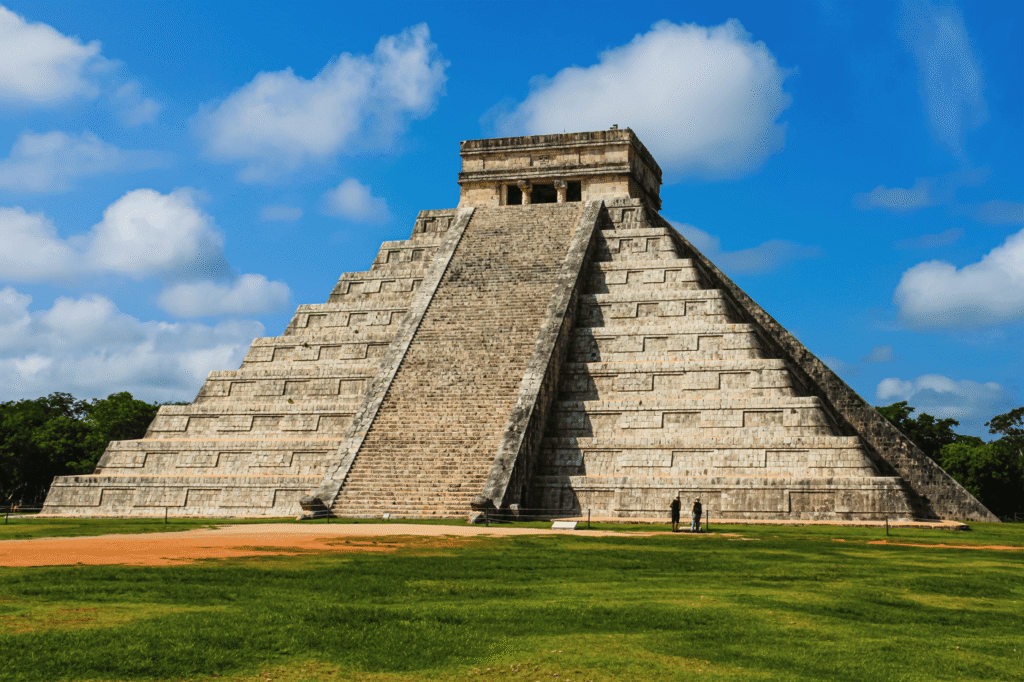
El Castillo is the most recognizable structure at Chichén Itzá. Dedicated to the feathered serpent deity Kukulcán, it is considered one of the finest examples of Maya engineering and architectural precision.
Standing about 98 feet (30 meters) tall, the pyramid was built between the 9th and 12th centuries AD. It has four staircases with 91 steps each, which, together with the summit platform, total 365 steps—representing the days of the solar year.
One of its most remarkable features occurs during the spring and autumn equinoxes, when sunlight creates the illusion of a serpent slithering down the pyramid’s staircase, symbolizing the descent of Kukulcán.
Other Major Structures
A. Great Ball Court
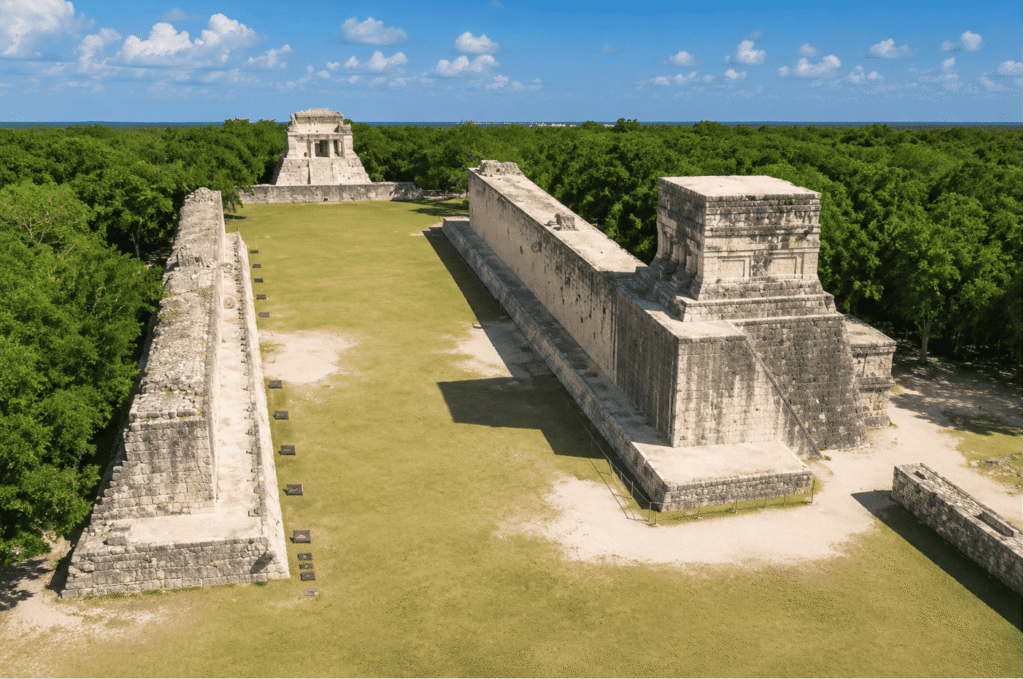
The largest known ancient ball court in Mesoamerica, measuring approximately 551 feet (168 meters) long and 230 feet (70 meters) wide. The ceremonial ball game played here held deep religious, political, and cultural significance.
B. Temple of the Warriors
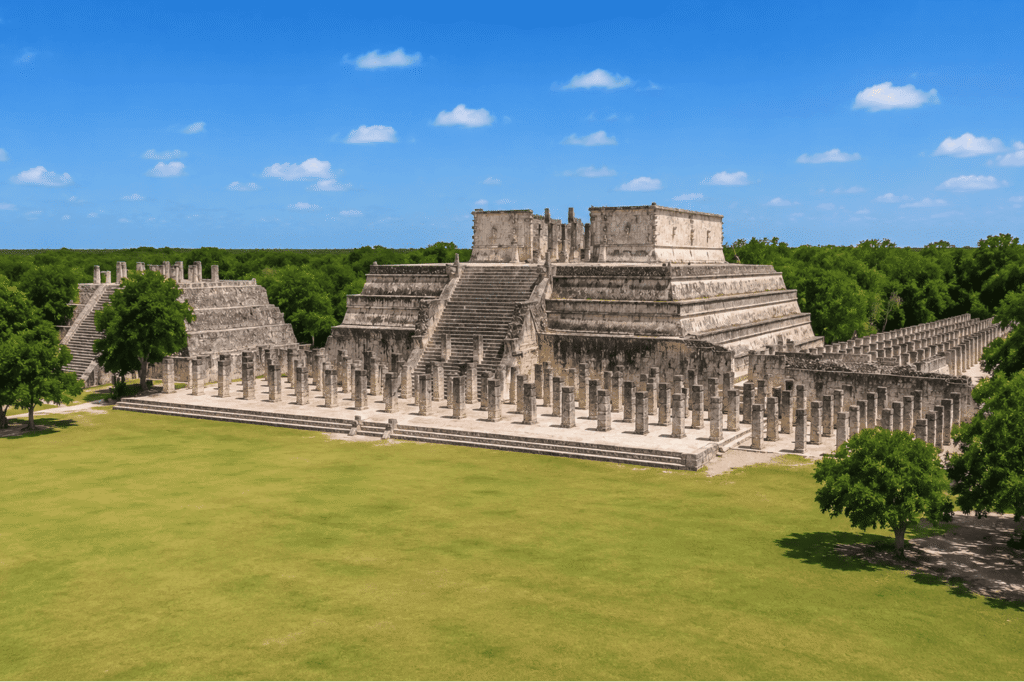
A magnificent stepped temple surrounded by hundreds of carved stone columns depicting warriors, reflecting the city’s military and religious traditions.
C. El Caracol
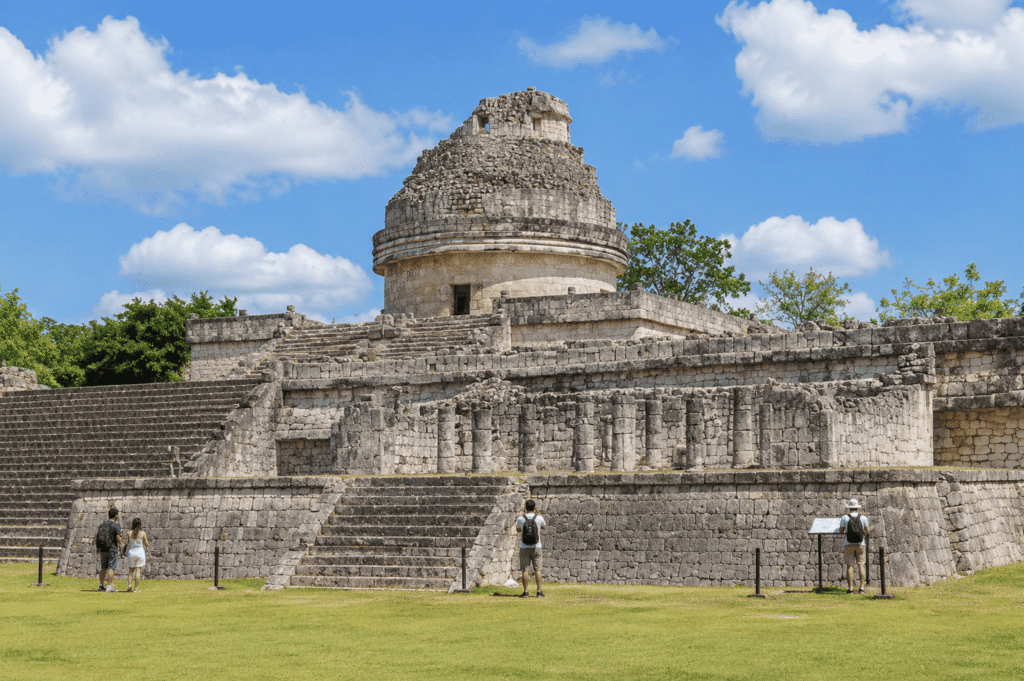
A circular observatory believed to have been used by Maya astronomers to track the movements of the Sun, Moon, Venus, and other celestial bodies.
D. Sacred Cenote
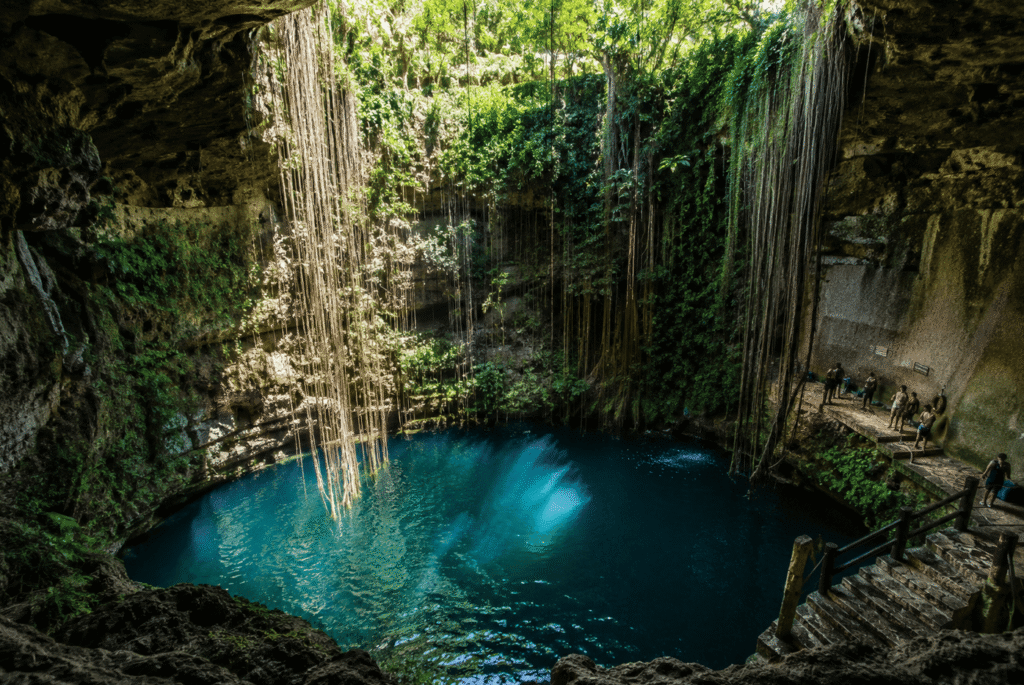
A natural limestone sinkhole where archaeologists discovered ceremonial offerings, including jade, gold, pottery, and human remains, highlighting its importance in Maya religious rituals.
Religion and Beliefs
Religion was at the heart of life in Chichén Itzá. The city’s people worshipped several Maya deities, including Kukulcán, the feathered serpent god, and Chaac, the god of rain and agriculture, along with many other gods associated with the sky, fertility, and the underworld.
Religious life revolved around festivals, offerings, agricultural ceremonies, and seasonal rituals, reflecting the Maya’s deep spiritual connection with nature and the cosmos.
Astronomy and Mathematics
The Maya were among the greatest astronomers and mathematicians of the ancient world, and Chichén Itzá stands as a testament to their scientific achievements.
They calculated the length of the solar year with remarkable accuracy, designed buildings that aligned with important celestial events, tracked the movements of Venus and other planets, and incorporated advanced mathematical principles into their architecture. These accomplishments continue to fascinate archaeologists, historians, and scientists today.
6. Colonial City of Santo Domingo
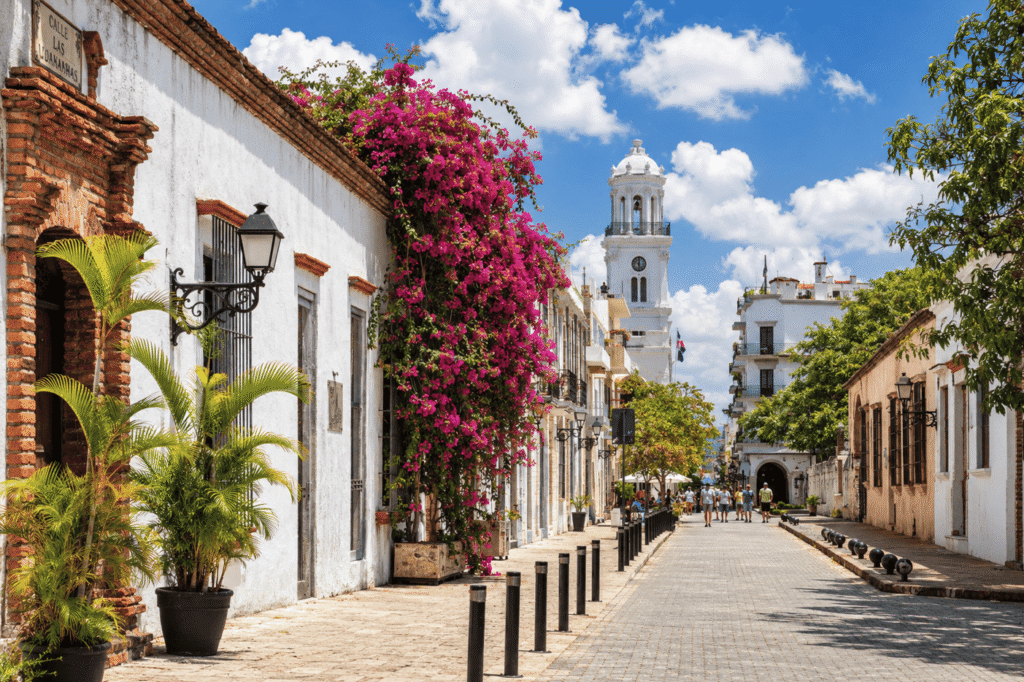
Colonial City of Santo Domingo is the oldest permanent European settlement in the Americas and the birthplace of many of the New World’s first institutions. Located on the southern coast of the Dominican Republic, it was founded at the end of the 15th century and became the administrative, political, religious, and cultural center of Spain’s colonial empire in the Americas. Today, its cobblestone streets, centuries-old churches, palaces, and fortifications offer a remarkable glimpse into the early history of European colonization in the Western Hemisphere.
What is the Colonial City of Santo Domingo?
Often known as the Zona Colonial, the Colonial City of Santo Domingo is the historic heart of the Dominican Republic’s capital. Established in 1498, it became the first permanent European colonial city in the Americas and served as Spain’s headquarters for exploring and governing much of the New World.
Within its historic streets are colonial churches, fortresses, government buildings, palaces, monasteries, museums, historic plazas, and beautifully preserved stone-paved roads. Many of these landmarks are more than 500 years old, making the district one of the most historically significant places in the Americas.
Why is it Famous?
Colonial City is famous for being the oldest permanent European settlement in the Americas and the first seat of Spanish colonial government in the New World. It is home to the first cathedral, castle, monastery, hospital, and university established by Europeans in the Americas. Its outstanding collection of Gothic, Renaissance, and Spanish colonial architecture has made it one of the Caribbean’s most important historic districts.
History of the Colonial City
Foundation:
The settlement was founded in 1498 by Bartholomew Columbus, the brother of Christopher Columbus. After a hurricane damaged the original settlement, Governor Nicolás de Ovando relocated the city to its present location on the western bank of the Ozama River in 1502.
Capital of Spain’s American Empire:
During the 16th century, Santo Domingo became the administrative center of Spain’s expanding empire in the Americas. From here, Spanish expeditions departed to explore and colonize territories across the Caribbean, Mexico, Central America, and South America. The city quickly developed into a major center for government, religion, trade, military operations, and education.
Later History:
As Spain shifted its attention toward wealthier colonies such as Mexico and Peru, Santo Domingo gradually lost much of its political influence. Despite this, the city remained continuously inhabited, allowing many of its colonial buildings and monuments to survive remarkably well into the present day.
UNESCO World Heritage Site
The Colonial City of Santo Domingo was inscribed as a UNESCO World Heritage Site in 1990 for its outstanding contribution to the history of European colonization in the Americas and the exceptional preservation of its colonial architecture.
Major Landmarks
A. Cathedral of Santa María la Menor
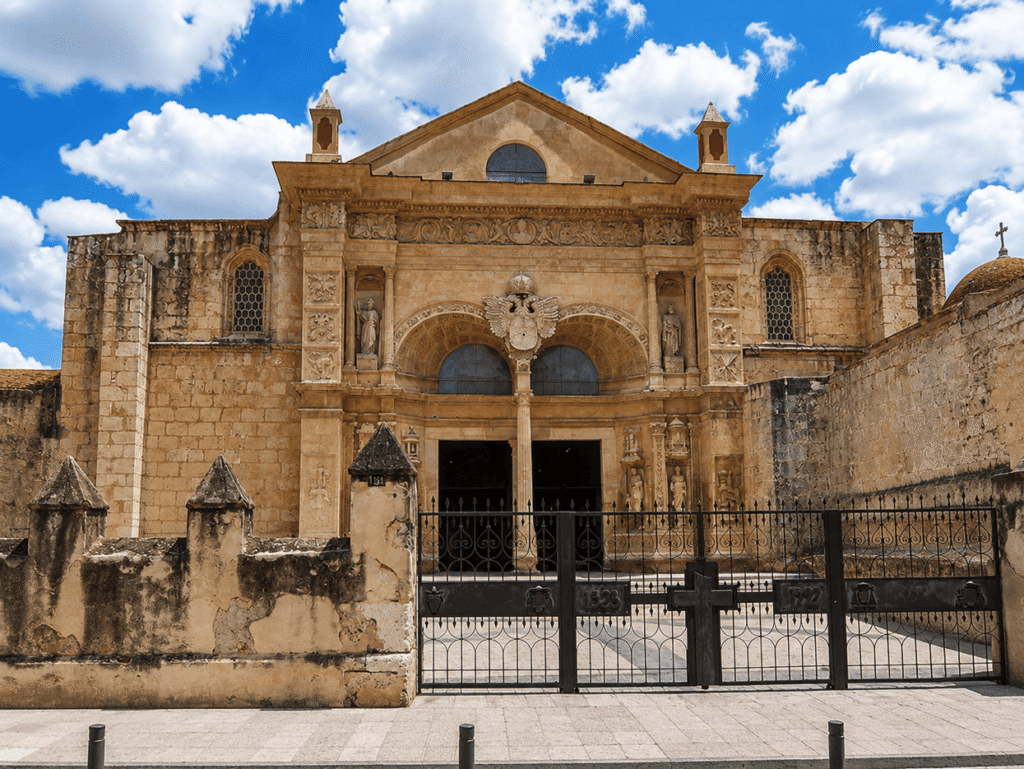
Also known as the Primada Cathedral of the Americas, this is the oldest cathedral in the Americas. Construction began in 1512 and was completed in 1540. Built primarily in the Gothic style with Renaissance influences, it continues to serve as an active cathedral today.
B. Alcázar de Colón
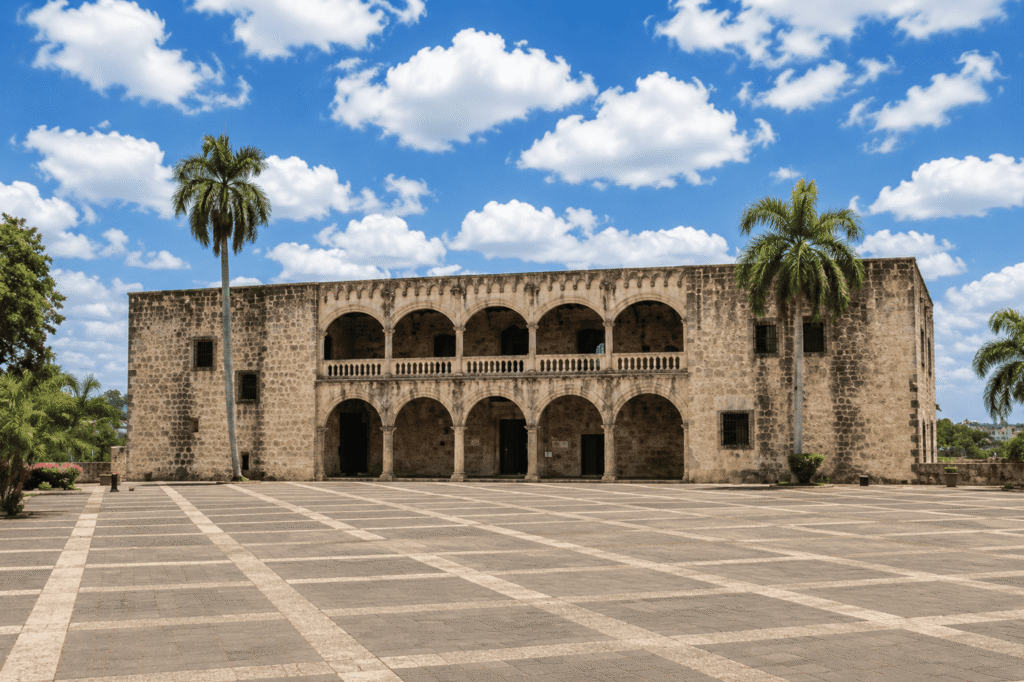
Built between 1510 and 1514, this impressive palace was the residence of Diego Columbus, the son of Christopher Columbus. Today, it functions as a museum showcasing colonial-era furniture, artwork, and historical artifacts.
C. Fortaleza Ozama
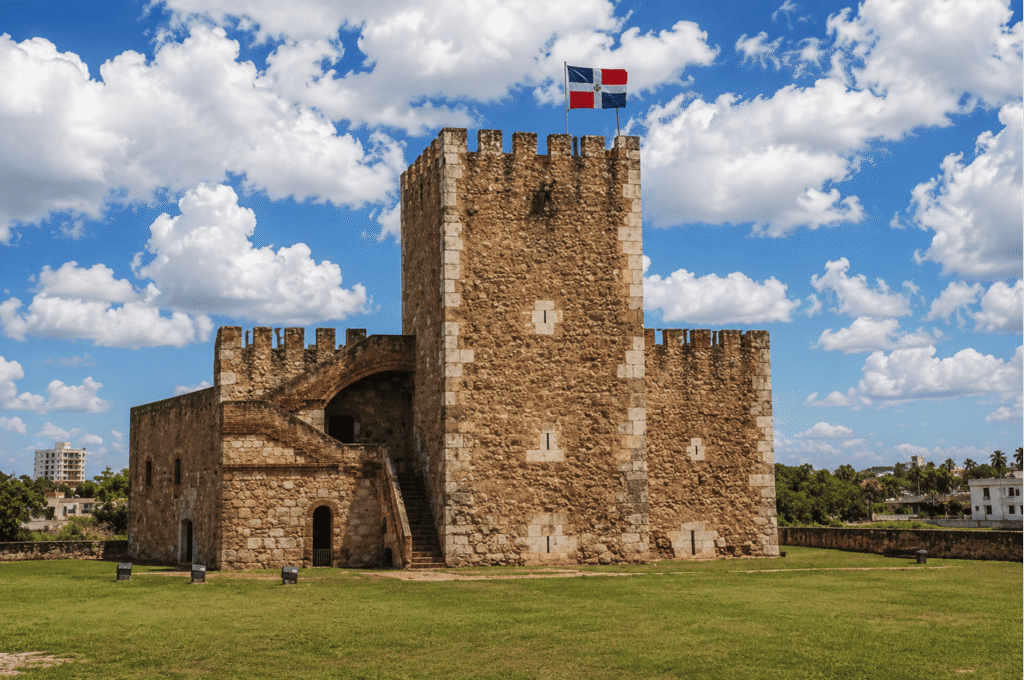
Completed in the early 16th century, Fortaleza Ozama is the oldest military fortress of European origin in the Americas. It was built to protect the city from pirates and invading forces.
D. Calle Las Damas
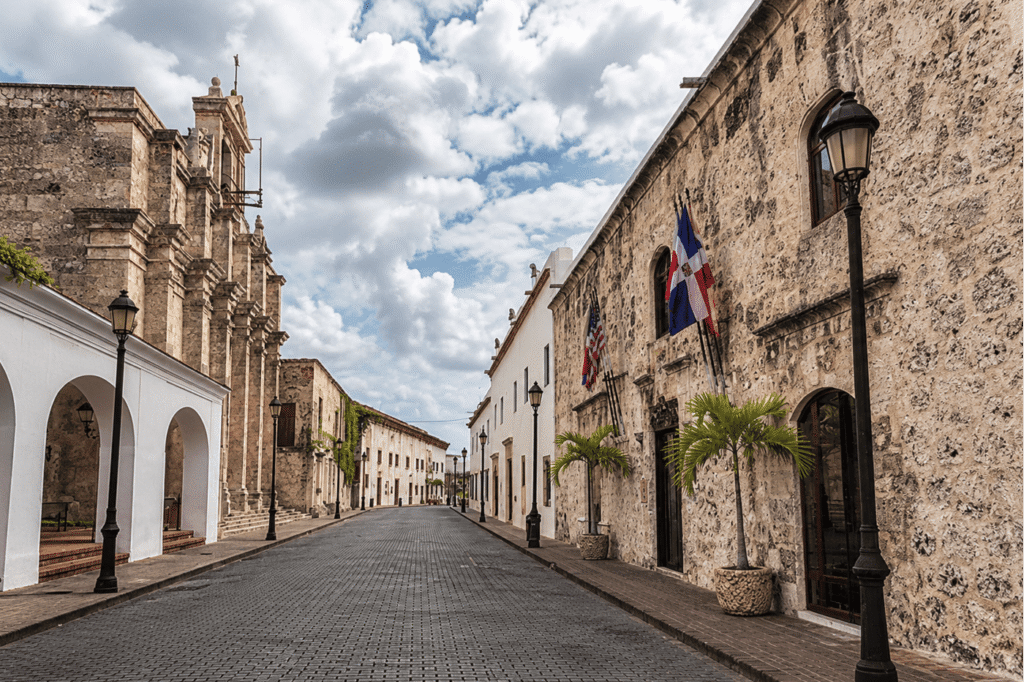
Recognized as the first paved street in the Americas, this historic avenue is lined with colonial mansions, museums, government buildings, and other significant landmarks.
E. Monasterio de San Francisco
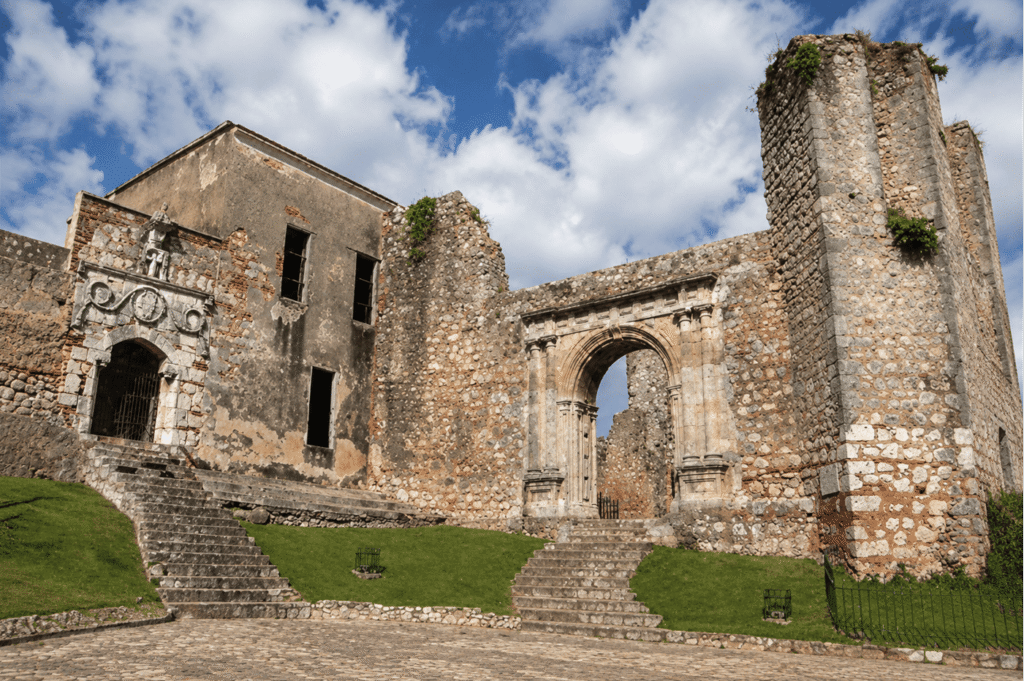
The ruins of one of the earliest monasteries built in the Americas, offering a fascinating glimpse into the city’s early religious history.
Architecture
Colonial City showcases a remarkable blend of Gothic, Renaissance, Baroque, Mudéjar, and Spanish Colonial architectural styles. Many buildings were constructed from coral limestone and feature elegant stone façades, arched doorways, interior courtyards, wrought-iron balconies, decorative churches, and charming cobblestone streets. Its carefully planned urban layout became a model for many later colonial cities established throughout the Americas.
Religion and Culture
Religion played a central role in the city’s development. Santo Domingo became the headquarters of the Catholic Church in the New World and was home to the first cathedral, early monasteries, religious schools, and missionary centers established by Europeans in the Americas.
Today, the Colonial City remains a lively cultural district where history blends with modern life. Visitors can explore museums, art galleries, historic landmarks, restaurants, lively plazas, traditional Dominican music, and festivals that celebrate the country’s rich heritage.
7. Historic Centre of Vienna
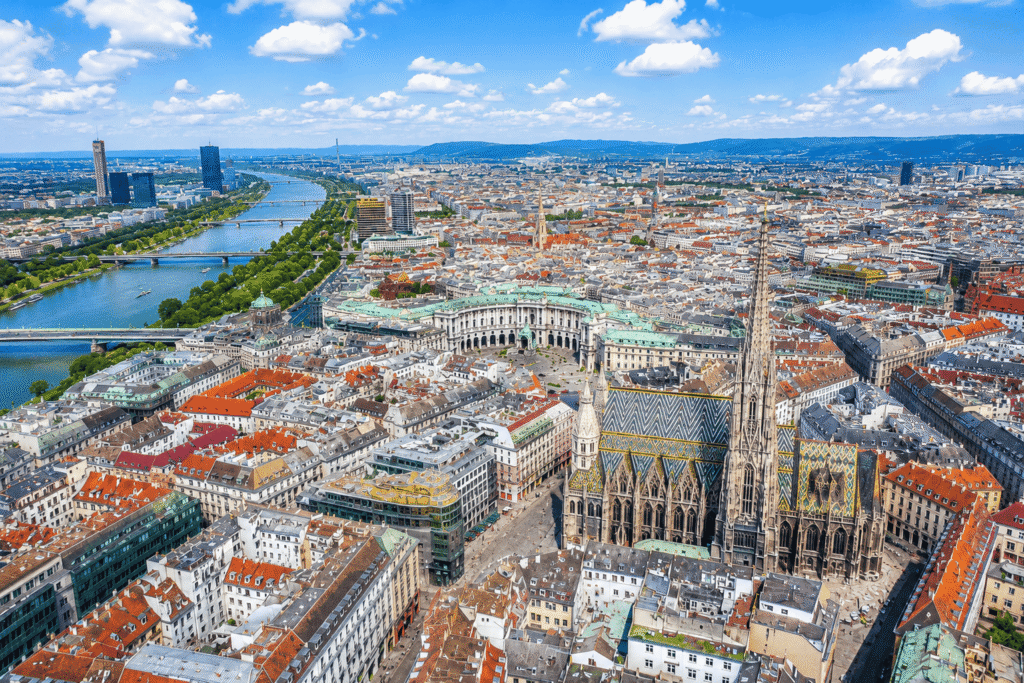
Historic Centre of Vienna is one of Europe’s most elegant and culturally significant historic districts. Located in the heart of Austria’s capital, it served as the political, cultural, and artistic center of the Habsburg monarchy for centuries. Renowned for its imperial palaces, magnificent churches, grand boulevards, and world-famous musical heritage, the historic center reflects more than a thousand years of European history and remains one of the continent’s most beautiful urban landscapes.
What is the Historic Centre of Vienna?
Historic Centre of Vienna is the city’s oldest district and is home to many of its most important historical landmarks. It preserves an extraordinary collection of medieval streets, Baroque palaces, Gothic churches, Renaissance buildings, classical monuments, elegant public squares, historic gardens, and renowned cultural institutions.
Together, these landmarks tell the story of Vienna’s transformation from a Roman military settlement into one of Europe’s greatest imperial capitals.
Why is it Famous?
Historic Centre of Vienna is famous for serving as the capital of the Habsburg Empire for centuries and for being one of the world’s greatest centers of classical music. It is celebrated for its magnificent palaces and churches, remarkable Gothic, Baroque, and Art Nouveau architecture, and its connection to legendary composers such as Wolfgang Amadeus Mozart, Ludwig van Beethoven, Joseph Haydn, Franz Schubert, and Johann Strauss II. Today, it remains one of Europe’s most visited and admired historic cities.
History of the Historic Centre
Roman Origins:
Vienna began as the Roman military camp of Vindobona around the 1st century AD. Its strategic location along the Danube River made it an important frontier settlement of the Roman Empire.
Medieval Vienna:
During the Middle Ages, the city expanded into a prosperous trading center protected by strong defensive walls. Many magnificent churches, monasteries, and civic buildings were constructed during this period.
Habsburg Era:
From the 13th century until 1918, Vienna served as the capital of the Habsburg monarchy and later the Austro-Hungarian Empire. It flourished as a center of politics, art, science, music, education, and architecture. Many of the city’s most famous palaces, museums, and public buildings date back to this golden era.
Modern Vienna:
After the collapse of the Austro-Hungarian Empire in 1918, Vienna became the capital of the Republic of Austria. Despite entering a new chapter in its history, the city carefully preserved its extraordinary architectural and cultural heritage.
UNESCO World Heritage Site
Historic Centre of Vienna was inscribed as a UNESCO World Heritage Site in 2001 in recognition of its outstanding architectural ensemble and its exceptional contribution to the history of music, art, and European culture.
Major Landmarks
A. St. Stephen’s Cathedral
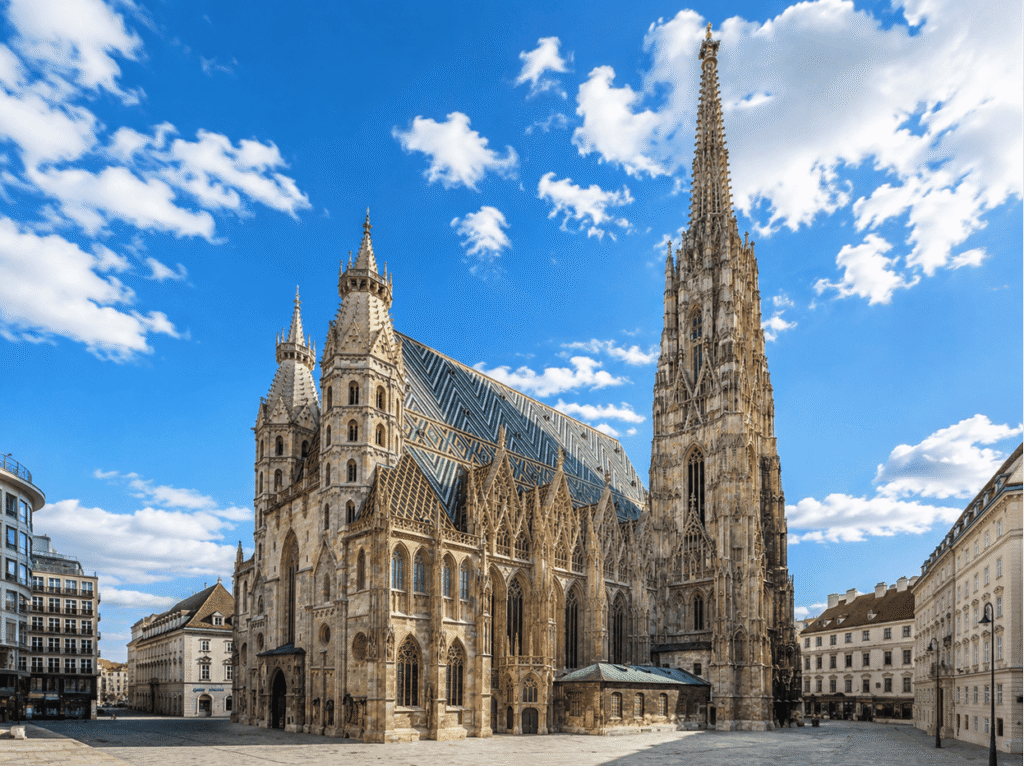
The city’s most iconic landmark, originally built in the 12th century, is famous for its colorful tiled roof, soaring Gothic spire, and beautifully decorated interior.
B. Hofburg Palace
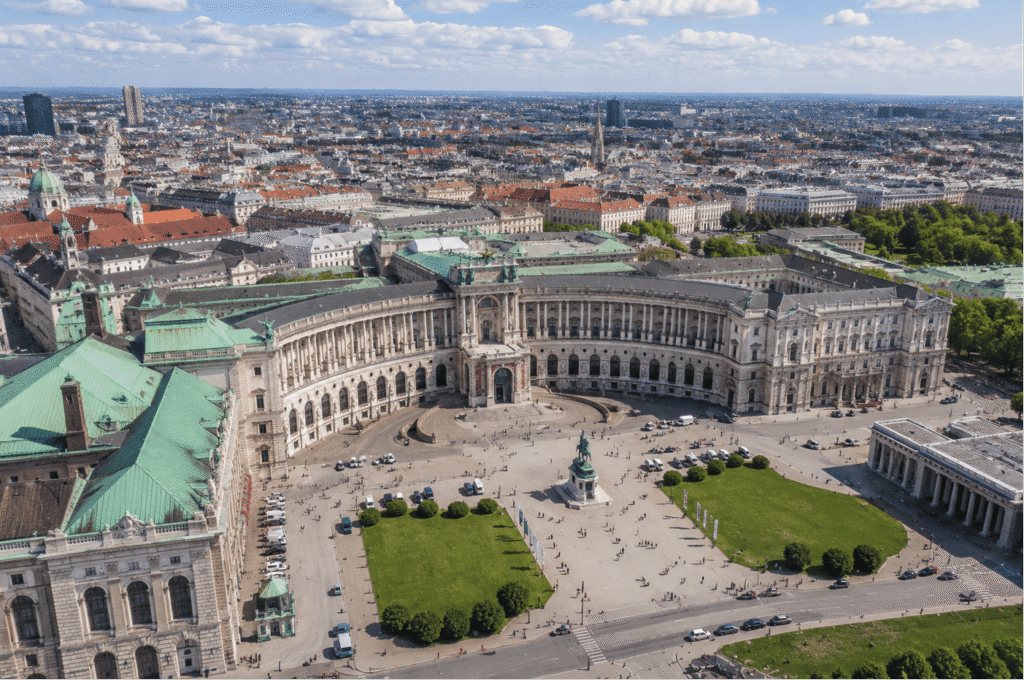
For more than 600 years, the Hofburg served as the principal residence of the Habsburg rulers. Today, it houses several museums, the Austrian National Library, and the offices of Austria’s president.
C. Vienna State Opera
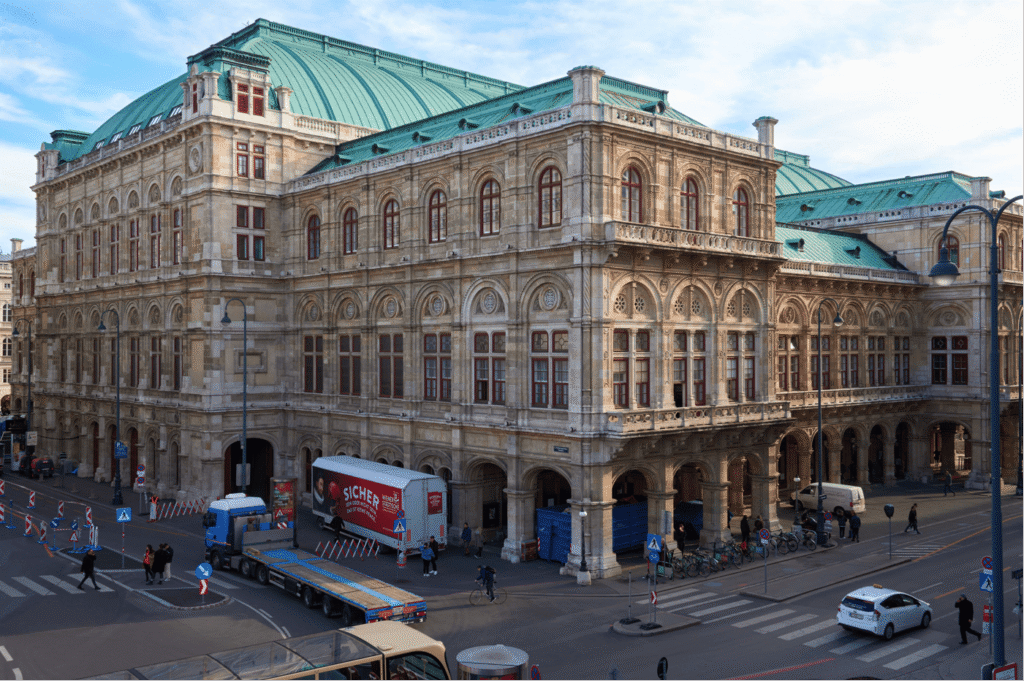
Opened in 1869, this world-renowned opera house is considered one of the finest in the world and hosts hundreds of performances every year.
D. Karlskirche
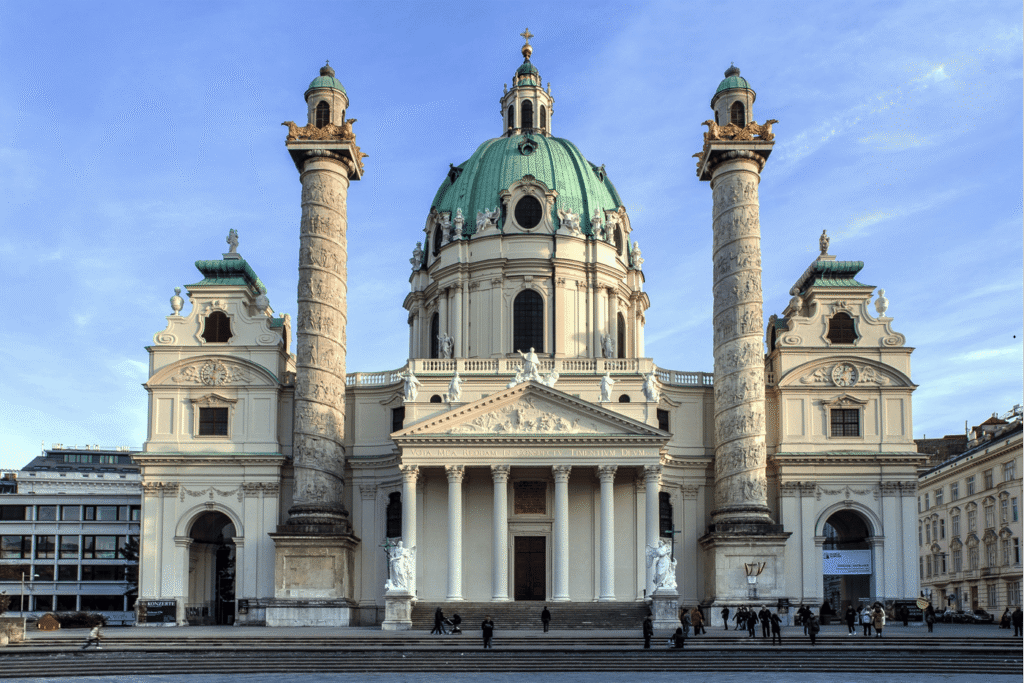
One of Europe’s greatest Baroque churches, Karlskirche is admired for its magnificent dome, towering columns, and richly decorated interior.
E. Belvedere Palace
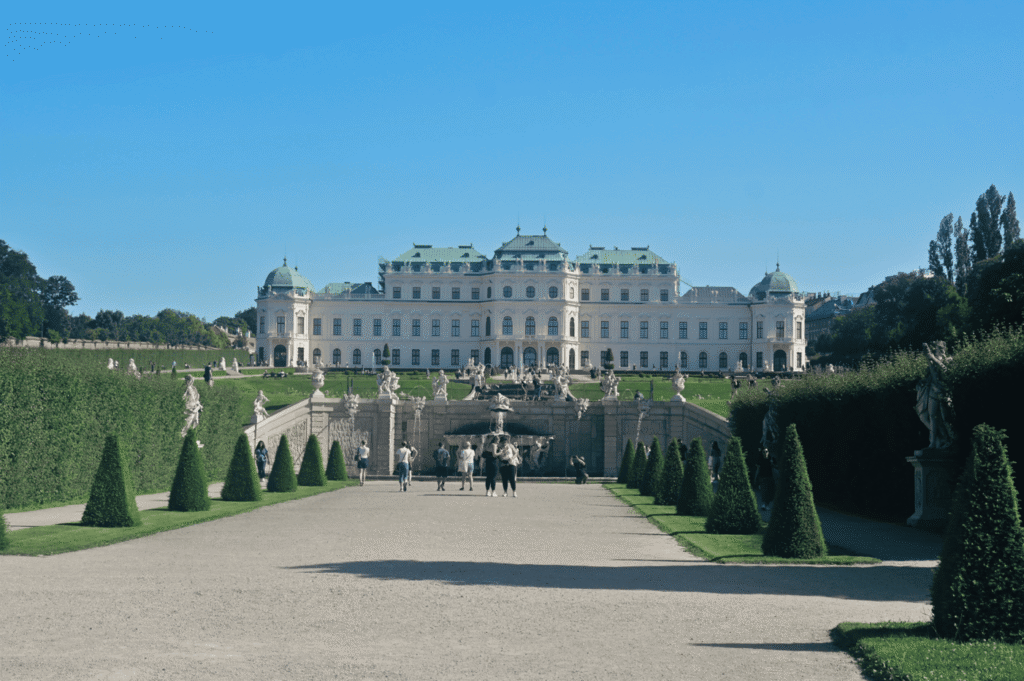
This stunning Baroque palace complex is famous for its beautifully landscaped gardens and exceptional art collections, including masterpieces by Gustav Klimt.
Architecture
Historic Centre of Vienna showcases an impressive blend of architectural styles spanning nearly two thousand years. Roman remains stand alongside medieval buildings, Gothic cathedrals, Renaissance landmarks, Baroque palaces, Neoclassical monuments, Historicist architecture, and elegant Art Nouveau designs.
Grand palaces, ornate churches, decorative façades, charming courtyards, monumental squares, and wide boulevards combine to create one of Europe’s most harmonious historic cityscapes.
Music and Culture
Vienna is often called the “City of Music” because of its extraordinary contribution to classical music. It was home to some of history’s greatest composers, including Wolfgang Amadeus Mozart, Ludwig van Beethoven, Joseph Haydn, Franz Schubert, and Johann Strauss II.
That rich musical tradition continues today through world-class orchestras, opera performances, concerts, and cultural festivals, ensuring that Vienna remains one of the world’s leading cultural capitals.
8. Hampi
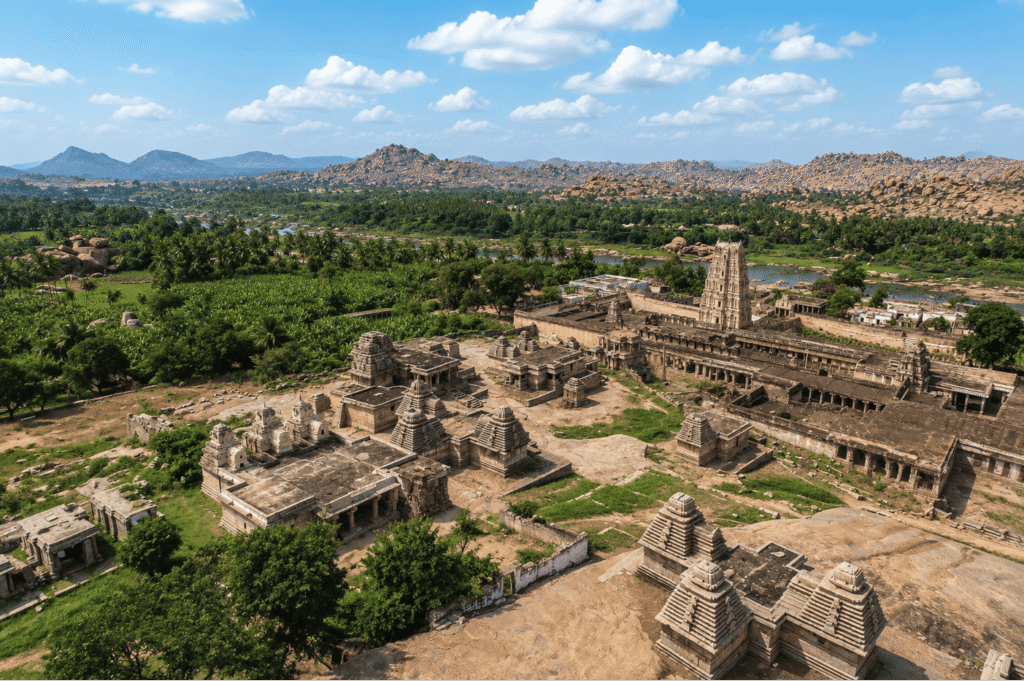
Group of Monuments at Hampi is one of India’s most spectacular archaeological sites and a lasting symbol of the grandeur of the Vijayanagara Empire. Located along the banks of the Tungabhadra River in Karnataka, Hampi was once the flourishing capital of one of the largest and wealthiest empires in South India. Today, its magnificent temples, royal complexes, bustling market ruins, and dramatic granite boulder landscape make it one of the world’s most remarkable cultural destinations.
What is Hampi?
Hampi is a vast archaeological complex covering approximately 16 square miles (41.8 square kilometers). The site contains more than 1,600 surviving monuments, including temples, palaces, royal enclosures, marketplaces, fortifications, stepwells, elephant stables, waterworks, pavilions, and sacred shrines.
Surrounded by towering granite hills and enormous boulder formations, the site offers a unique blend of natural beauty and architectural brilliance that is unmatched anywhere else in India.
Why is Hampi Famous?
Hampi is famous for serving as the capital of the Vijayanagara Empire, one of the most powerful kingdoms in South Indian history. It is home to one of India’s largest archaeological complexes and features magnificent Hindu temples, royal architecture, and the iconic Stone Chariot. Its extraordinary landscape of giant granite boulders, combined with centuries of history, has made it one of India’s most visited UNESCO World Heritage Sites.
History of Hampi
Early History:
The Hampi region has been inhabited since ancient times and is closely associated with the Hindu epic Ramayana. According to tradition, it is believed to be part of the ancient kingdom of Kishkindha, the legendary land of the monkey king Sugriva.
Rise of the Vijayanagara Empire:
In 1336, Harihara I and Bukka Raya I founded the Vijayanagara Empire and established Hampi as its capital. The city quickly grew into one of the world’s largest and wealthiest urban centers.
Golden Age:
During the reign of Krishnadevaraya (1509–1529), the city reached the height of its prosperity. It became a thriving center of trade, art, literature, architecture, education, and religious tolerance. Merchants from Persia, Portugal, Arabia, and many other regions visited its bustling markets, making it an important international trading hub.
Decline:
In 1565, following the Battle of Talikota, the Vijayanagara army was defeated by a coalition of the Deccan Sultanates. The victorious forces looted and destroyed much of the city, leading to its eventual abandonment. Despite the devastation, many magnificent stone monuments survived and continue to stand today.
UNESCO World Heritage Site
Hampi was inscribed as a UNESCO World Heritage Site in 1986 in recognition of its exceptional testimony to the Vijayanagara civilization and its outstanding architectural and artistic achievements.
Major Monuments
A. Virupaksha Temple
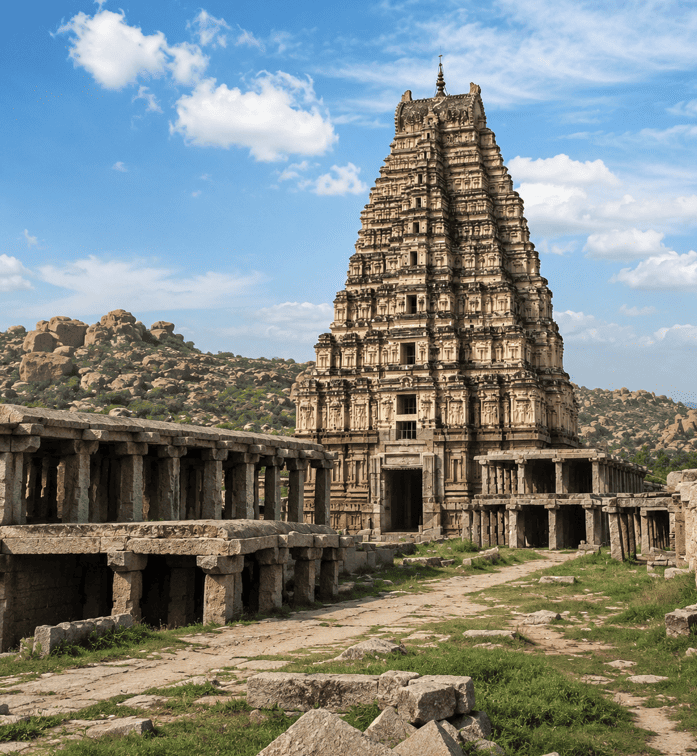
One of India’s oldest continuously functioning temples, Virupaksha Temple is dedicated to Lord Shiva. Parts of the temple date back to the 7th century, and it remains an active place of worship today.
B. Vijaya Vittala Temple
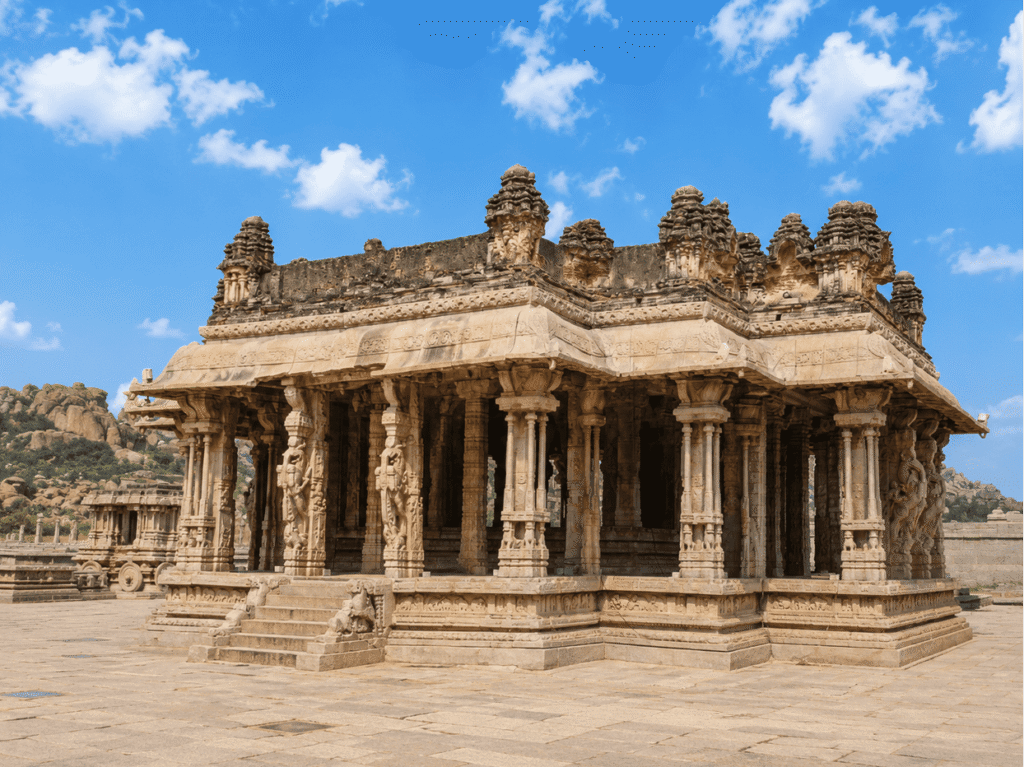
The most celebrated monument in Hampi, this magnificent temple is renowned for its extraordinary architecture, famous musical pillars, and the iconic Stone Chariot—one of India’s most recognizable heritage monuments.
C. Lotus Mahal
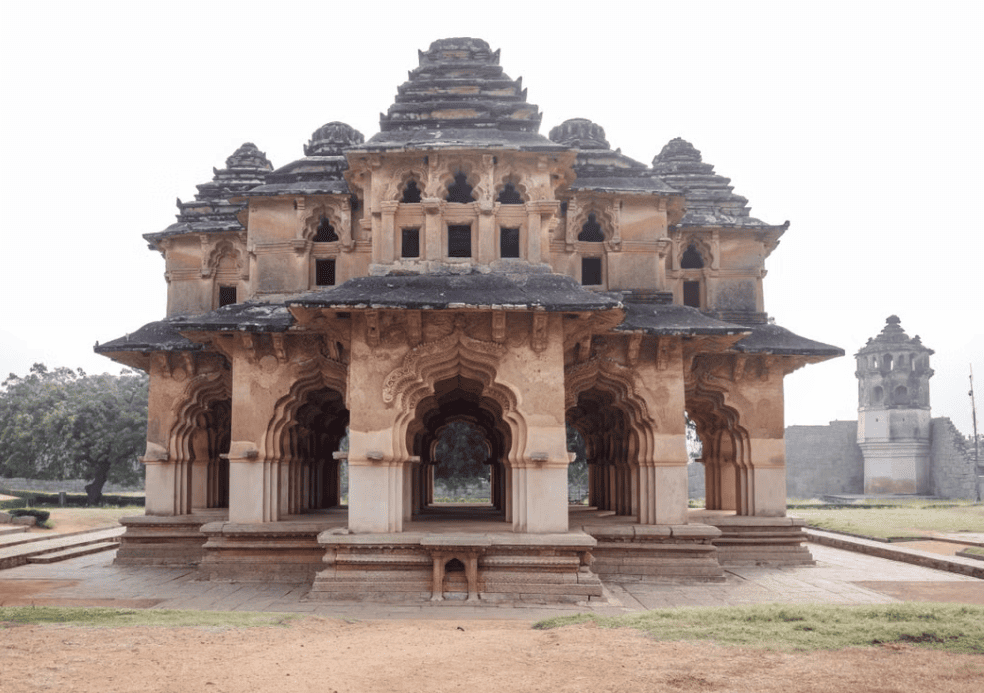
An elegant pavilion that beautifully combines Hindu and Indo-Islamic architectural styles. It is believed to have served as a royal leisure retreat for the women of the palace.
D. Elephant Stables
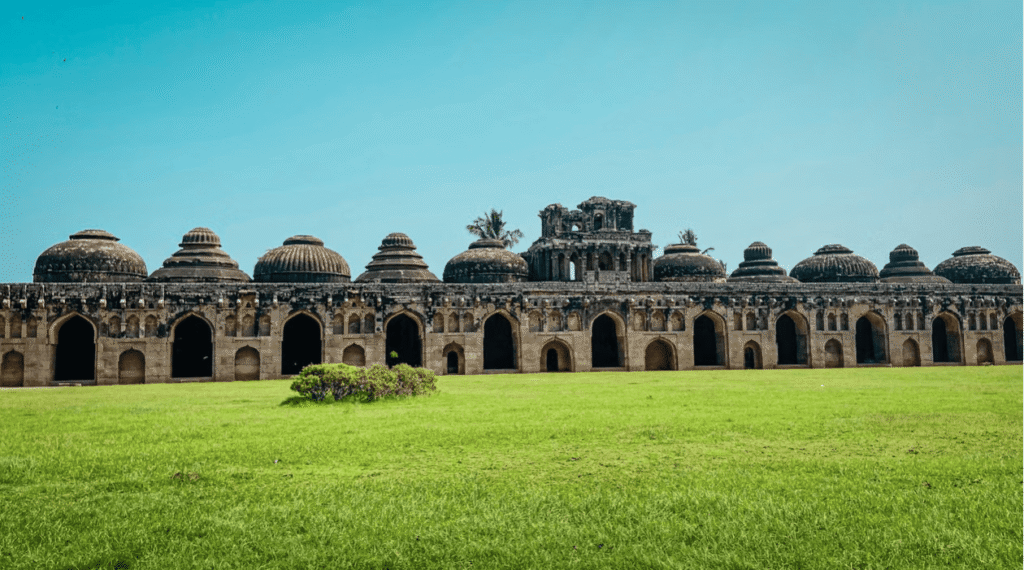
This impressive structure once housed the royal elephants of the Vijayanagara Empire and is admired for its symmetrical design and distinctive domes.
E. Hazara Rama Temple
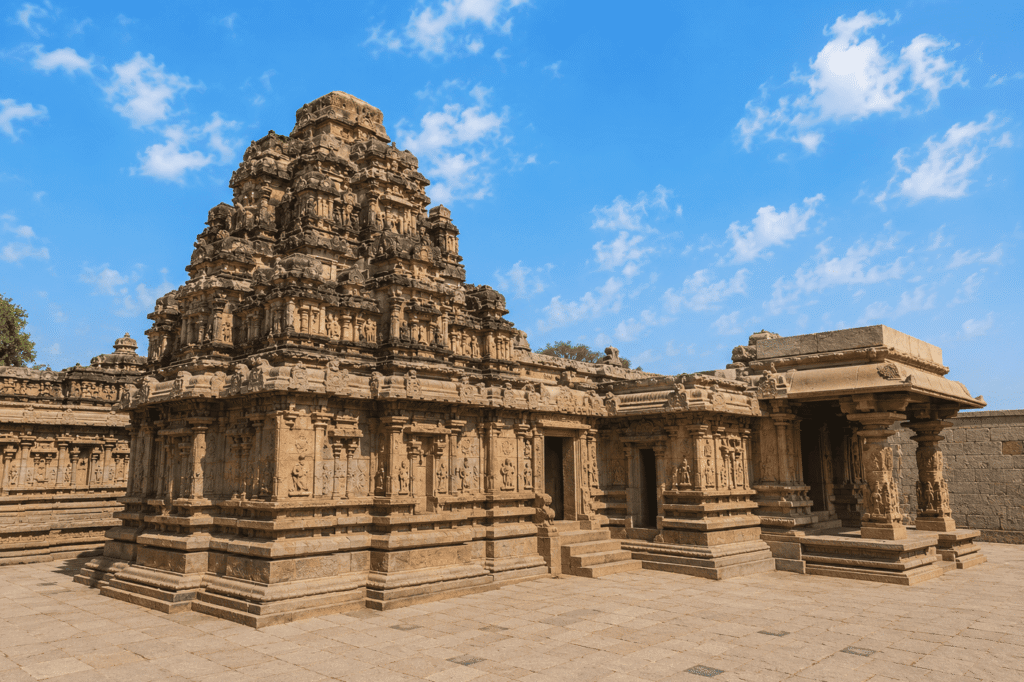
Known for its intricate stone carvings, this temple features detailed panels depicting scenes from the Ramayana, royal processions, and everyday life during the Vijayanagara period.
Architecture
Hampi showcases the finest achievements of Vijayanagara architecture. Its monuments are characterized by massive granite construction, towering temple gateways (gopurams), intricately carved stone sculptures, pillared halls, ornate pavilions, stepwells, royal courtyards, and sophisticated water management systems.
One of the site’s most remarkable features is the way its builders seamlessly integrated natural granite boulders and rocky hills into the design of temples, palaces, and fortifications, creating a landscape unlike any other.
Religion and Culture
Hampi was one of the most important centers of Hinduism in medieval India and continues to be a major pilgrimage destination. Many of its temples are dedicated to Shiva, Vishnu, Rama, and other Hindu deities.
Today, the region’s rich cultural heritage is celebrated during the annual Hampi Utsav, which features traditional music, classical dance performances, cultural exhibitions, and historical reenactments that bring the grandeur of the Vijayanagara Empire back to life.
9. Medina of Marrakesh
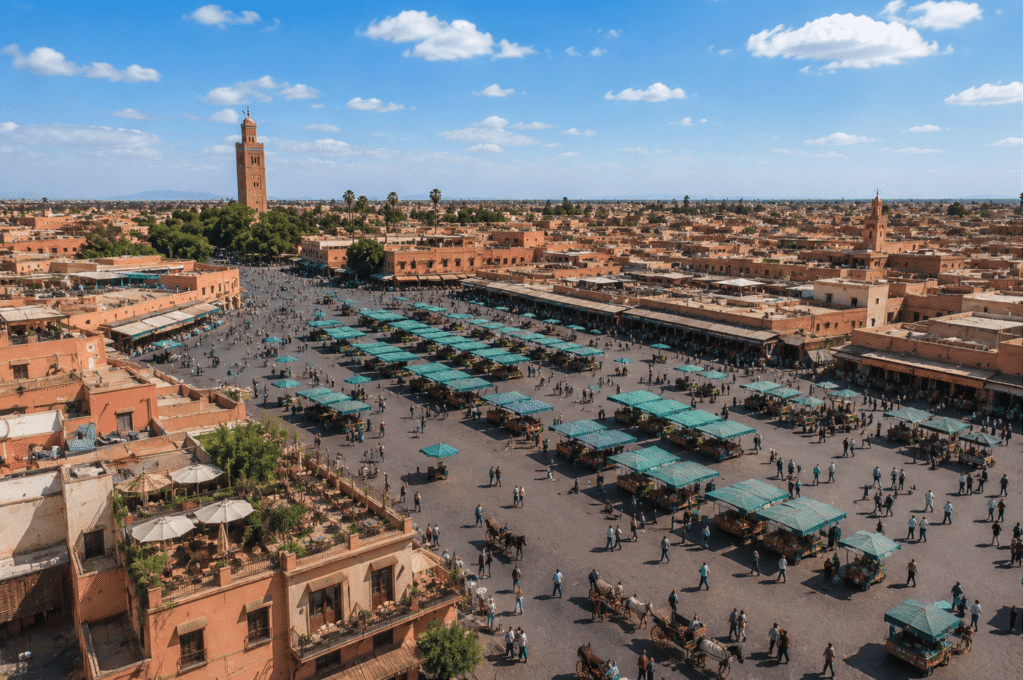
Medina of Marrakesh is one of North Africa’s most vibrant and historic urban centers, renowned for its maze of narrow streets, bustling souks, magnificent palaces, and centuries-old mosques. Located in central Morocco, Marrakesh has served as an important political, commercial, and cultural hub since the 11th century. Today, its historic medina remains a living city where traditional craftsmanship, Islamic architecture, and everyday life continue to flourish, making it one of the world’s most fascinating UNESCO World Heritage Sites.
What is the Medina of Marrakesh?
Medina of Marrakesh is the city’s historic walled district and the oldest part of Marrakesh. Founded in 1070 AD by the Almoravid dynasty, it grew into one of Morocco’s great imperial cities and remains the cultural heart of the country.
Within its ancient walls are historic mosques, magnificent palaces, peaceful gardens, traditional markets (souks), madrasas (Islamic schools), riads (traditional courtyard houses), lively public squares, and a maze of narrow winding streets. Covering approximately 1,483 acres (600 hectares), the medina is still home to thousands of residents and continues to thrive as a vibrant urban community.
Why is the Medina Famous?
The Medina of Marrakesh is famous for being one of Morocco’s four historic imperial cities. It is home to the iconic Jemaa el-Fnaa square, vibrant traditional souks, magnificent examples of Islamic architecture, and centuries-old Moroccan craftsmanship. As one of Africa’s most visited historic destinations, it offers visitors a unique blend of history, culture, and everyday life.
History of the Medina
Foundation:
Marrakesh was founded in 1070 AD by Abu Bakr ibn Umar during the expansion of the Almoravid dynasty. It quickly became the capital of a powerful empire that stretched across North Africa and parts of the Iberian Peninsula.
Almohad Period:
During the 12th century, the Almohad Caliphate transformed the city into one of the greatest cultural and political centers of the Islamic world. Many of its most famous monuments, including the Koutoubia Mosque, were built during this period.
Saadian and Alaouite Dynasties:
The city continued to flourish under later Moroccan dynasties. Magnificent palaces, gardens, fountains, and religious schools were constructed, many of which have survived to the present day.
Modern Marrakesh:
Today, Marrakesh remains one of Morocco’s cultural capitals, where centuries-old traditions blend seamlessly with modern tourism, commerce, and contemporary city life.
UNESCO World Heritage Site
The Medina of Marrakesh was inscribed as a UNESCO World Heritage Site in 1985 for its outstanding Islamic architecture, well-preserved historic urban layout, and vibrant cultural traditions that have endured for centuries.
Major Landmarks
A. Jemaa el-Fnaa
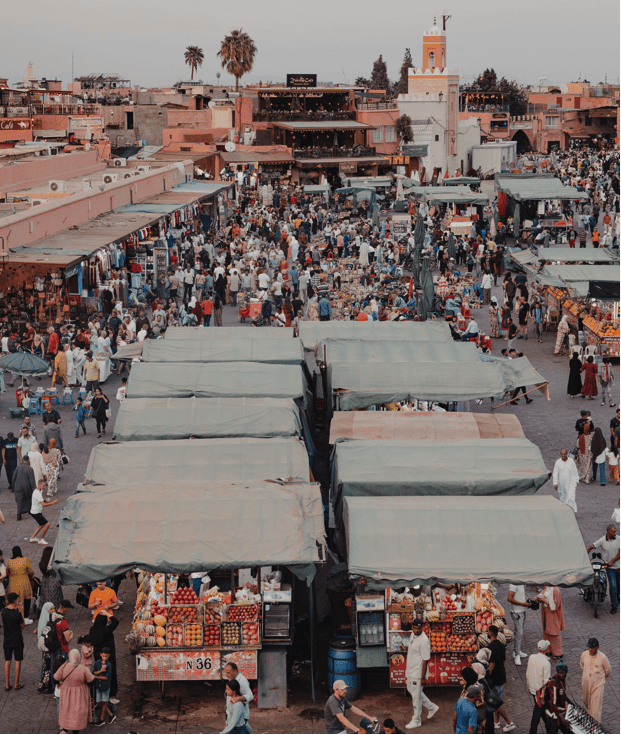
The lively heart of the city, this famous square comes alive throughout the day with storytellers, musicians, street performers, food stalls, and market vendors. UNESCO has also recognized it for its rich intangible cultural heritage.
B. Koutoubia Mosque
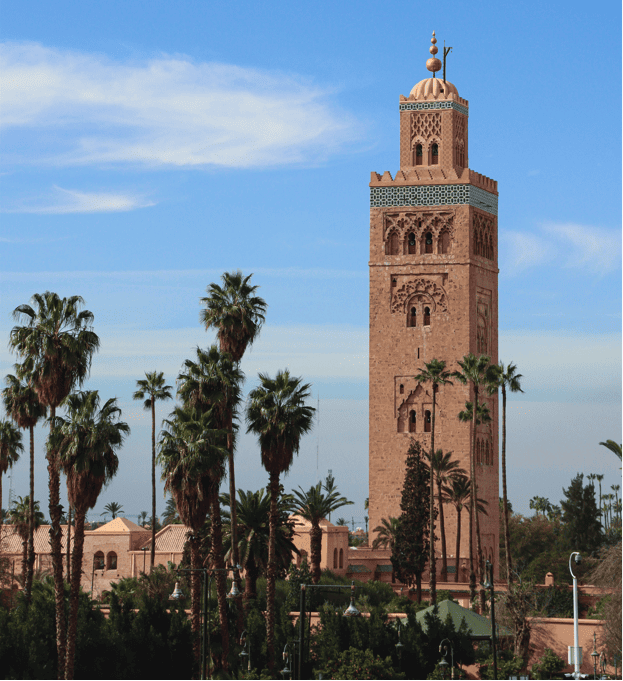
Built in the 12th century, the Koutoubia Mosque is Marrakesh’s most recognizable landmark. Its elegant minaret rises about 253 feet (77 meters) and is considered one of the finest examples of Almohad architecture. It also served as the architectural model for several famous Islamic towers, including the Giralda in Seville.
C. Bahia Palace
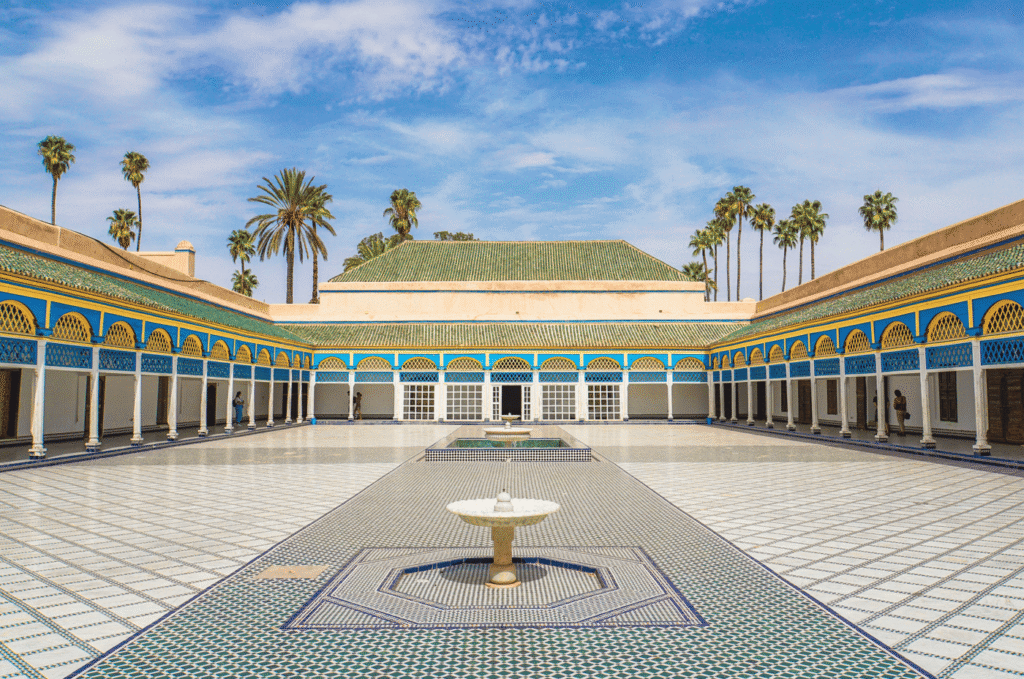
Constructed in the late 19th century, Bahia Palace is admired for its peaceful courtyards, intricate zellij tilework, carved cedar ceilings, and beautifully landscaped gardens.
D. Ben Youssef Madrasa
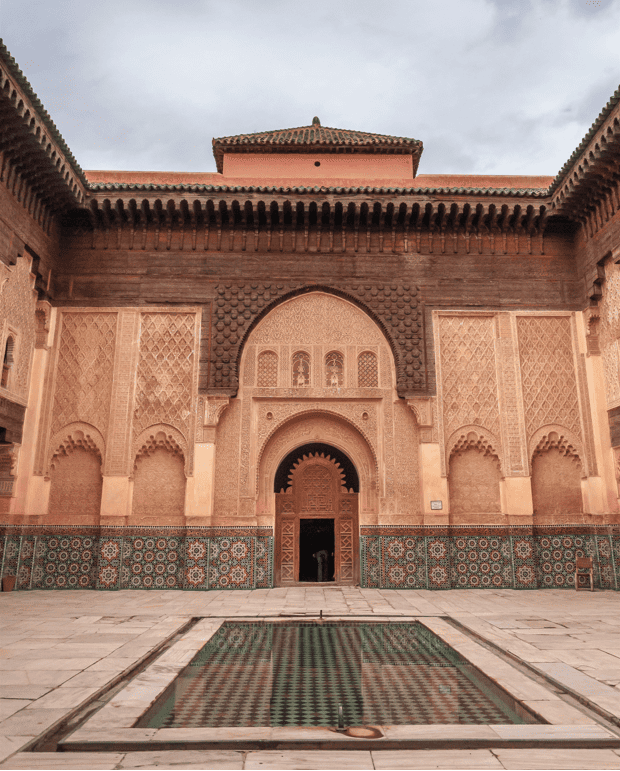
Once one of North Africa’s largest Islamic schools, this remarkable building is celebrated for its exquisite Moroccan craftsmanship, geometric patterns, and elegant decorative details.
E. Saadian Tombs
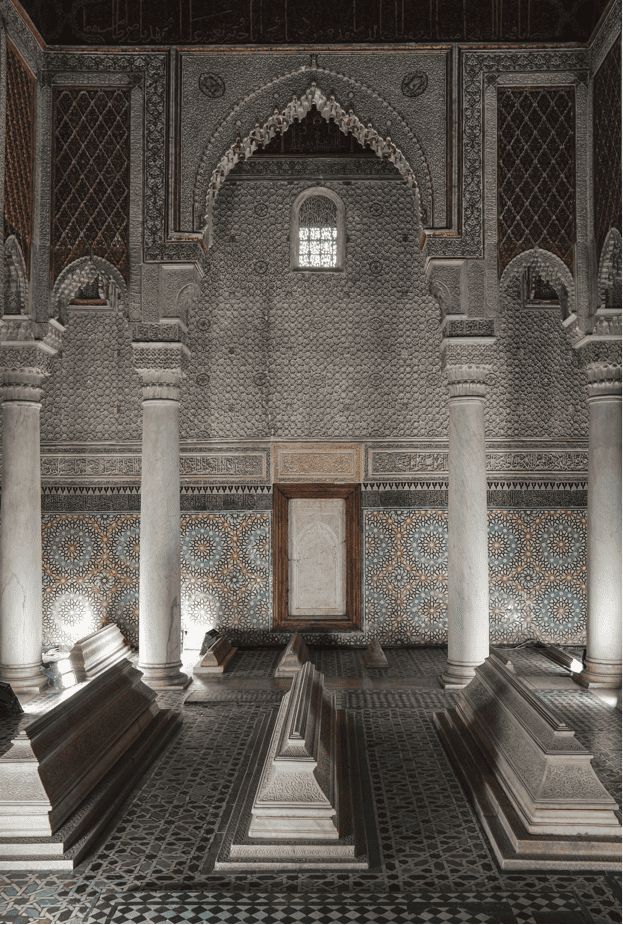
Dating back to the 16th century, these beautifully decorated mausoleums contain the tombs of members of the Saadian dynasty and are among the city’s most treasured historical sites.
Architecture
The Medina of Marrakesh showcases some of the finest examples of Moroccan and Islamic architecture. Its buildings are distinguished by red-earth walls, intricate stucco carvings, colorful zellij tilework, graceful horseshoe arches, carved cedar wood ceilings, peaceful interior courtyards, ornate fountains, and traditional riads.
Together, these architectural elements create a harmonious cityscape that reflects centuries of artistic excellence and cultural heritage.
Culture and Traditions
The medina remains a living cultural center where centuries-old traditions continue to thrive. Visitors can wander through workshops producing handwoven carpets, leather goods, pottery, metalwork, jewelry, textiles, wood carvings, and the traditional Moroccan lanterns for which the city is famous.
Its bustling souks preserve historic trading traditions, offering an authentic glimpse into the craftsmanship and daily life that have defined Marrakesh for generations.
10. Historic Sanctuary of Machu Picchu
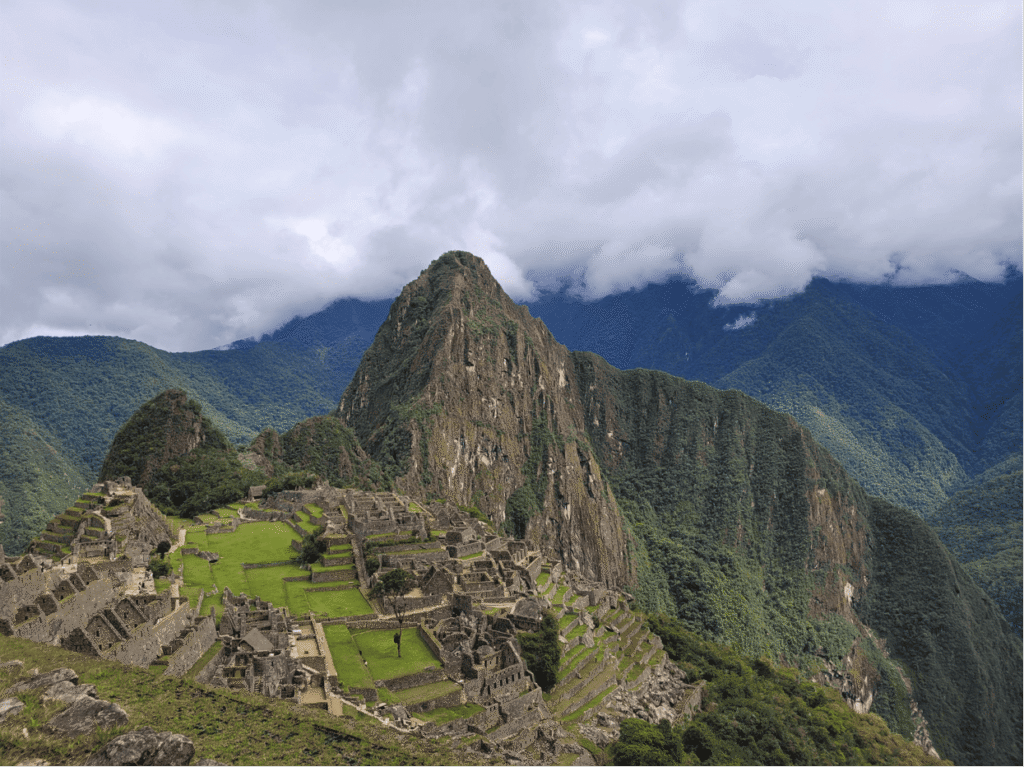
Historic Sanctuary of Machu Picchu is one of the world’s most extraordinary archaeological and natural treasures. Nestled high in the Andes Mountains of Peru, Machu Picchu was built by the Inca Empire during the 15th century. Renowned for its breathtaking mountain setting, remarkable stone architecture, and sophisticated engineering, it is one of the best-preserved Inca cities and one of the New Seven Wonders of the World.
What is the Historic Sanctuary of Machu Picchu?
Machu Picchu is a protected cultural and natural area covering approximately 80,535 acres (32,592 hectares). At its heart lies the ancient Inca citadel, surrounded by cloud forests, rugged mountain peaks, winding rivers, and extraordinary biodiversity.
The sanctuary includes the ancient city, agricultural terraces, ceremonial temples, royal residences, stone stairways, fountains, sacred mountains, and native forests that support a wide variety of wildlife. The seamless integration of architecture with the surrounding landscape is widely regarded as one of the greatest achievements of the Inca civilization.
Why is Machu Picchu Famous?
Machu Picchu is famous for being one of the best-preserved cities of the Inca Empire and for its spectacular location high in the Andes Mountains. It is celebrated for its remarkable stone construction, advanced engineering, agricultural terraces, and impressive astronomical alignment. As both a UNESCO World Heritage Site and one of the New Seven Wonders of the World, it has become one of South America’s most iconic landmarks and attracts millions of visitors each year.
History of Machu Picchu
Construction:
Machu Picchu was built around 1450 AD during the reign of Emperor Pachacuti, one of the greatest rulers of the Inca Empire. Historians believe it served as a royal estate, a ceremonial center, or possibly both, although its exact purpose remains uncertain.
The Inca Civilization:
The Inca Empire was the largest empire in pre-Columbian America, stretching across much of western South America. The city showcased the Incas’ remarkable achievements in architecture, engineering, agriculture, astronomy, and urban planning.
Abandonment:
Around the 16th century, during the period of the Spanish conquest, the site was abandoned. Although the Spanish never documented or destroyed it, the city gradually became covered by dense vegetation and remained largely unknown to the outside world for centuries.
Rediscovery:
In 1911, American historian Hiram Bingham III brought international attention to Machu Picchu during an expedition supported by Yale University and the National Geographic Society. However, local Indigenous communities had always known about the site’s existence, and Bingham’s expedition introduced it primarily to the wider international audience.
UNESCO World Heritage Site
Historic Sanctuary of Machu Picchu was inscribed as a UNESCO World Heritage Site in 1983 for its outstanding cultural and natural significance. In 2007, it was also selected as one of the New Seven Wonders of the World, recognizing its exceptional global importance.
Major Structures
A. Temple of the Sun
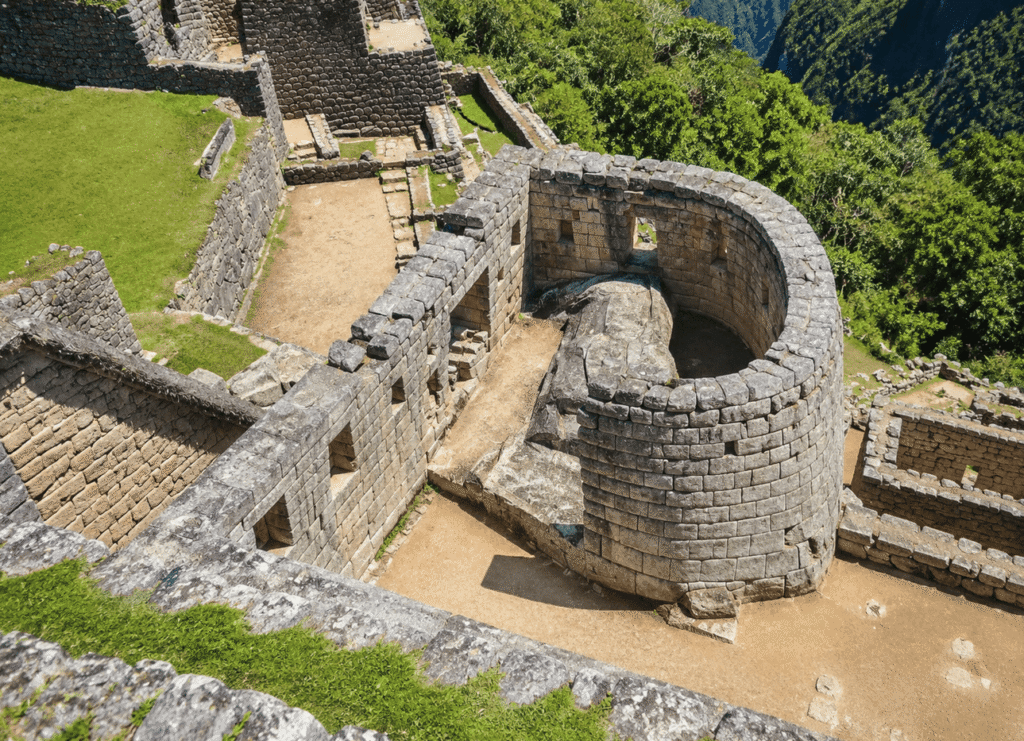
One of the most sacred buildings within the citadel, the Temple of the Sun was carefully designed to align with the sun during important astronomical events.
B. Intihuatana
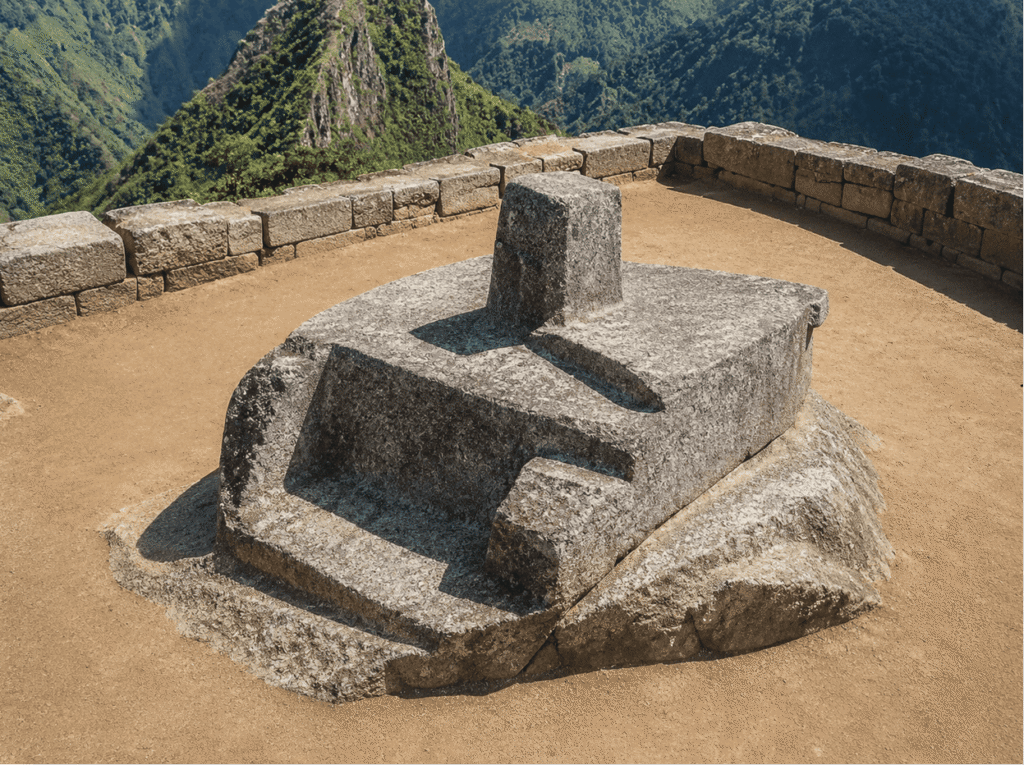
Often called the “Hitching Post of the Sun,” this finely carved stone is believed to have been used for astronomical observations and important ceremonial rituals.
C. Temple of the Three Windows
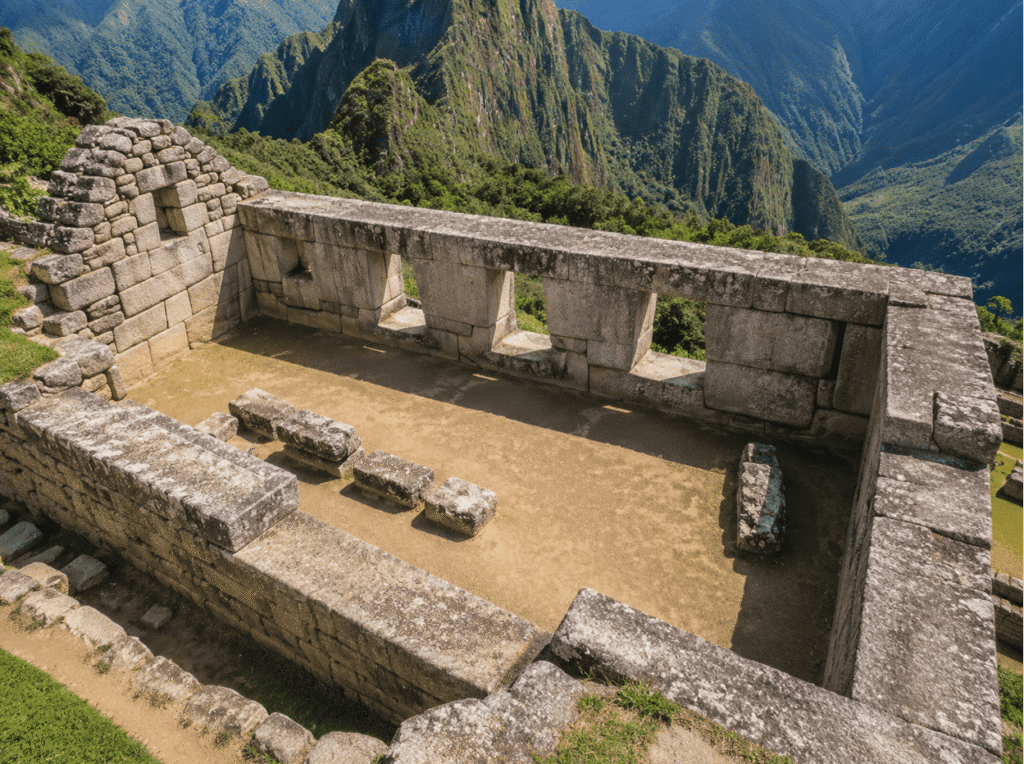
Overlooking the Sacred Plaza, this beautifully crafted ceremonial structure is famous for its three large trapezoidal windows and exceptional stonework.
D. Sacred Plaza
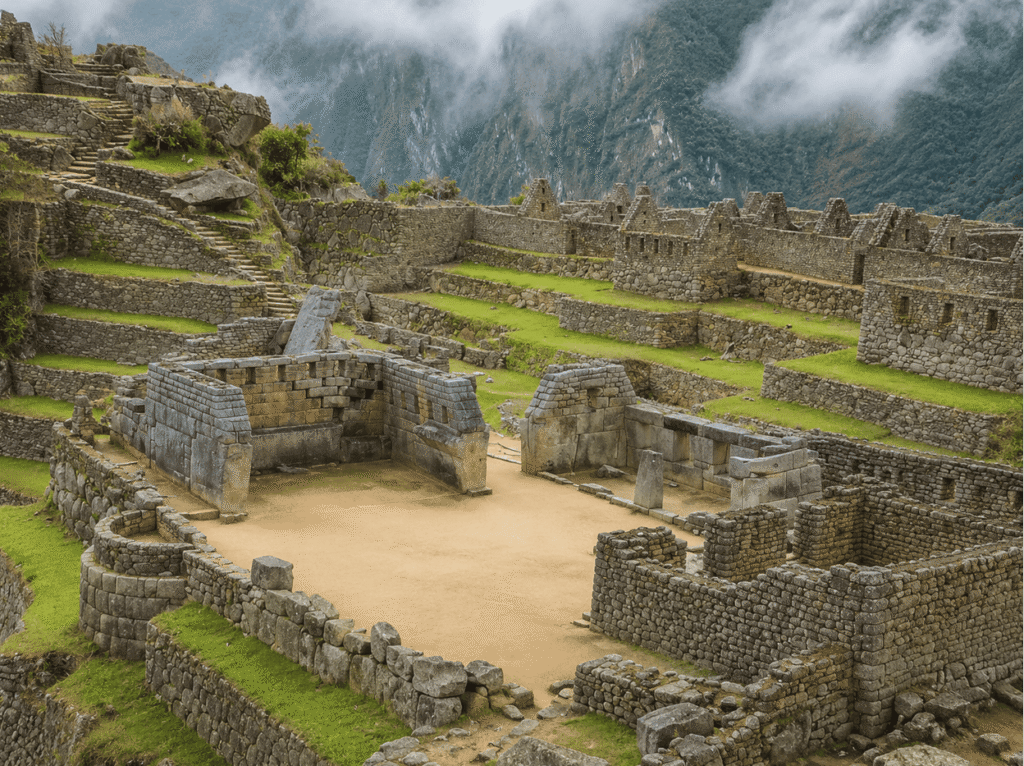
The religious heart of the city, this important open space is surrounded by temples and public buildings where many ceremonies were held.
E. Agricultural Terraces
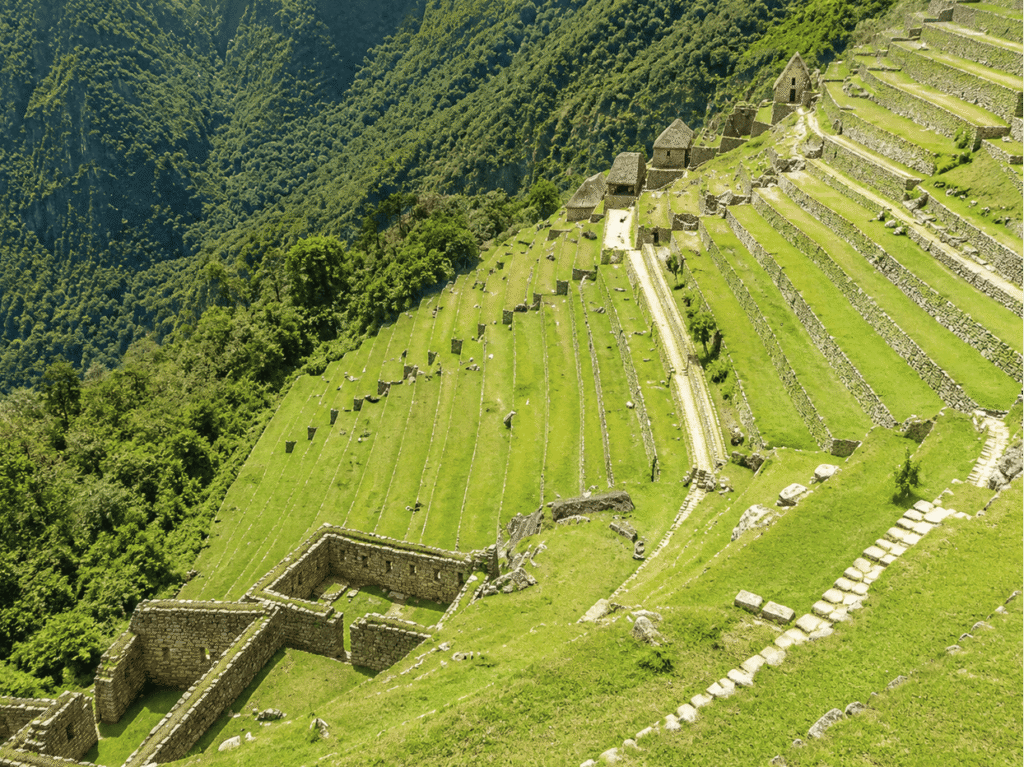
These extensive stone terraces prevented soil erosion, managed rainwater efficiently, and allowed crops to be cultivated on the steep mountainsides, demonstrating the Incas’ advanced agricultural engineering.
Architecture
Machu Picchu is celebrated for its extraordinary stone construction and engineering. Its buildings feature precisely cut granite blocks fitted together without mortar, trapezoidal doors and windows, earthquake-resistant construction, stone stairways, terraced hillsides, and sophisticated drainage systems.
The remarkable precision of Inca craftsmanship has allowed many of these structures to withstand centuries of earthquakes while remaining largely intact.
Religion and Culture
Religion played a central role in Inca society, and Machu Picchu contains numerous ceremonial sites dedicated to Inti, the sun god. The Incas also regarded the surrounding mountains as sacred and practiced ancestor worship alongside agricultural rituals linked to seasonal cycles.
Astronomy was deeply connected to both religion and farming, influencing the planning of ceremonies, festivals, and agricultural calendars throughout the empire.
11. Bagan
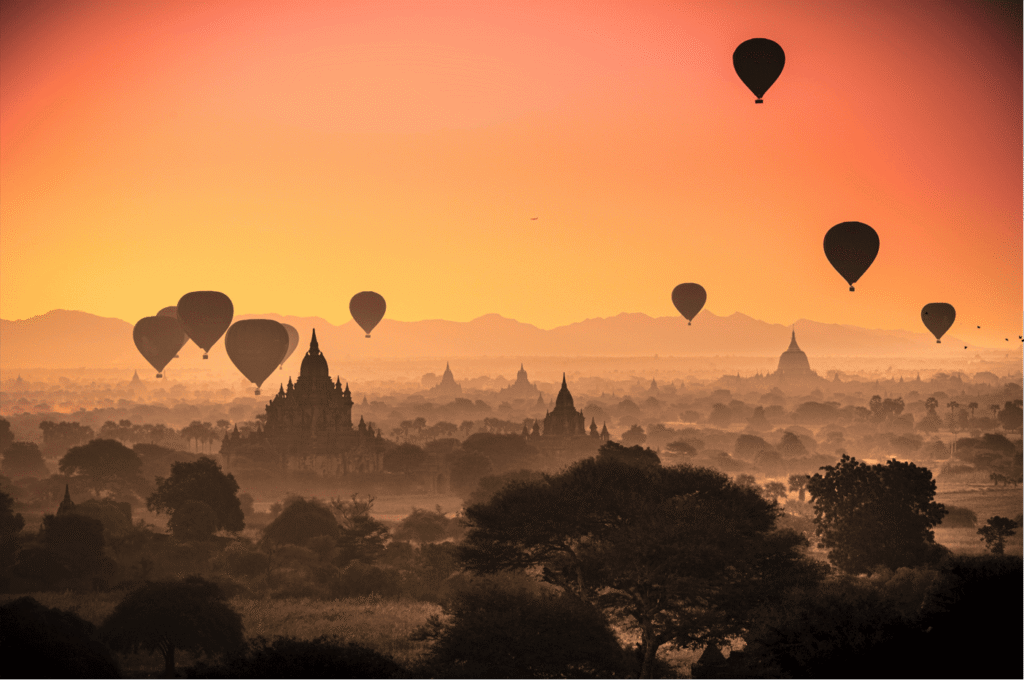
Bagan is one of the world’s greatest archaeological landscapes and the spiritual heart of ancient Myanmar. Located along the banks of the Ayeyarwady River in central Myanmar, it served as the capital of the powerful Pagan Kingdom from the 9th to the 13th centuries. During its golden age, thousands of Buddhist temples, pagodas, monasteries, and stupas were built across the vast plains, creating one of the largest and most remarkable concentrations of religious monuments anywhere in the world.
What is Bagan?
Bagan is a vast archaeological zone covering approximately 56 square miles (146 square kilometers). The site is home to more than 2,000 surviving temples and pagodas, along with ancient monasteries, Buddhist shrines, fresco-covered temples, libraries, monuments, and other archaeological remains.
Historians estimate that more than 10,000 religious structures were originally built between the 11th and 13th centuries, making Bagan one of the greatest centers of Buddhist architecture in the world.
Why is Bagan Famous?
Bagan is famous for being the first capital of the Pagan Kingdom and one of the world’s largest collections of Buddhist temples. More than 2,000 monuments still stand today, spread across an expansive plain that is especially breathtaking at sunrise and sunset. The site represents the golden age of Myanmar’s Buddhist civilization and is widely regarded as one of Southeast Asia’s greatest archaeological treasures.
History of Bagan
Early Settlement:
The Bagan region was first settled as early as the 2nd century AD, but it rose to prominence during the 9th century as political power in the region expanded.
Rise of the Pagan Kingdom:
In 1044 AD, King Anawrahta unified much of present-day Myanmar and established Theravada Buddhism as the kingdom’s principal religion. Under his rule, the construction of temples, monasteries, and religious monuments accelerated, transforming Bagan into a major spiritual center.
Golden Age:
Between the 11th and 13th centuries, Bagan flourished as a center of religion, education, art, architecture, and literature. Kings, nobles, monks, and wealthy citizens sponsored the construction of thousands of temples and pagodas, creating the extraordinary landscape that survives today.
Decline:
In 1287, invasions by the Mongols under Kublai Khan weakened the Pagan Kingdom, leading to its decline as a political capital. Despite this, Bagan remained an important religious center, and many of its temples continued to serve Buddhist pilgrims for centuries.
UNESCO World Heritage Site
Bagan was inscribed as a UNESCO World Heritage Site in 2019 for its exceptional testimony to Buddhist civilization and its extraordinary architectural landscape. Today, it is recognized as one of the world’s most significant collections of Buddhist monuments.
Major Monuments
A. Ananda Temple
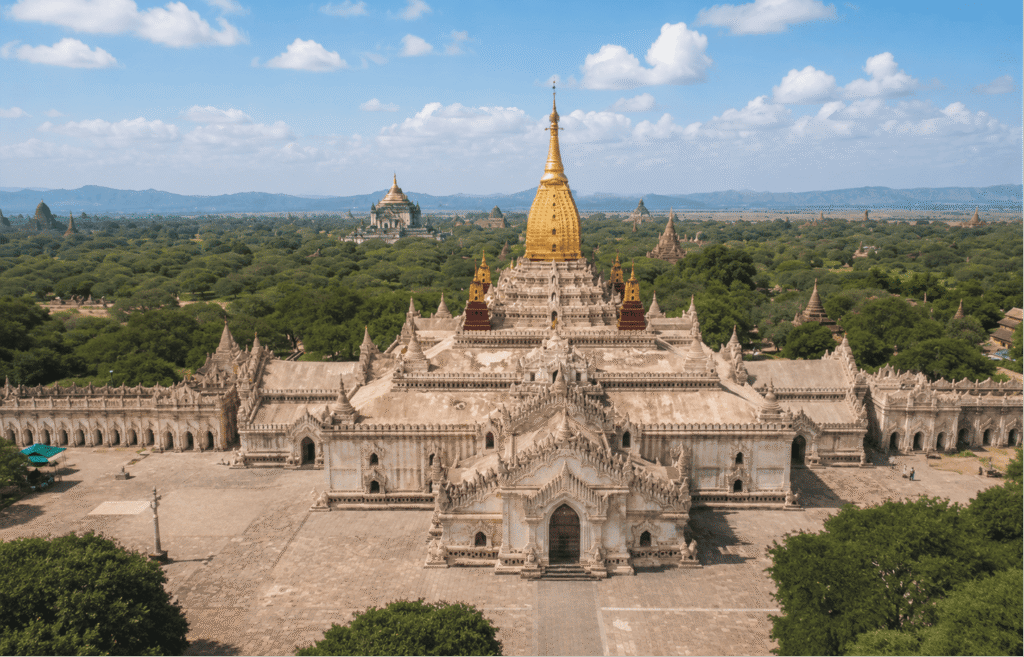
Built around 1105 AD, Ananda Temple is widely regarded as Bagan’s finest temple and one of Myanmar’s greatest architectural masterpieces. It is renowned for its four standing Buddha statues, elegant symmetrical design, and beautifully preserved murals and carvings.
B. Dhammayangyi Temple
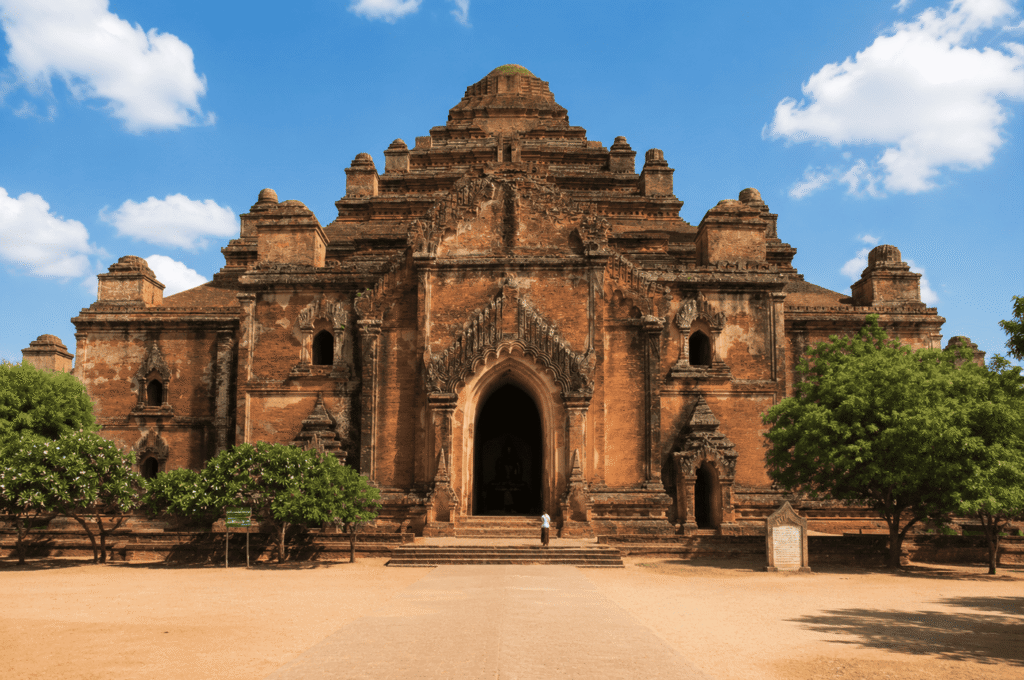
The largest temple in Bagan, Dhammayangyi is famous for its massive brick construction and exceptionally precise masonry, which remains among the finest examples of ancient Burmese craftsmanship.
C. Shwezigon Pagoda
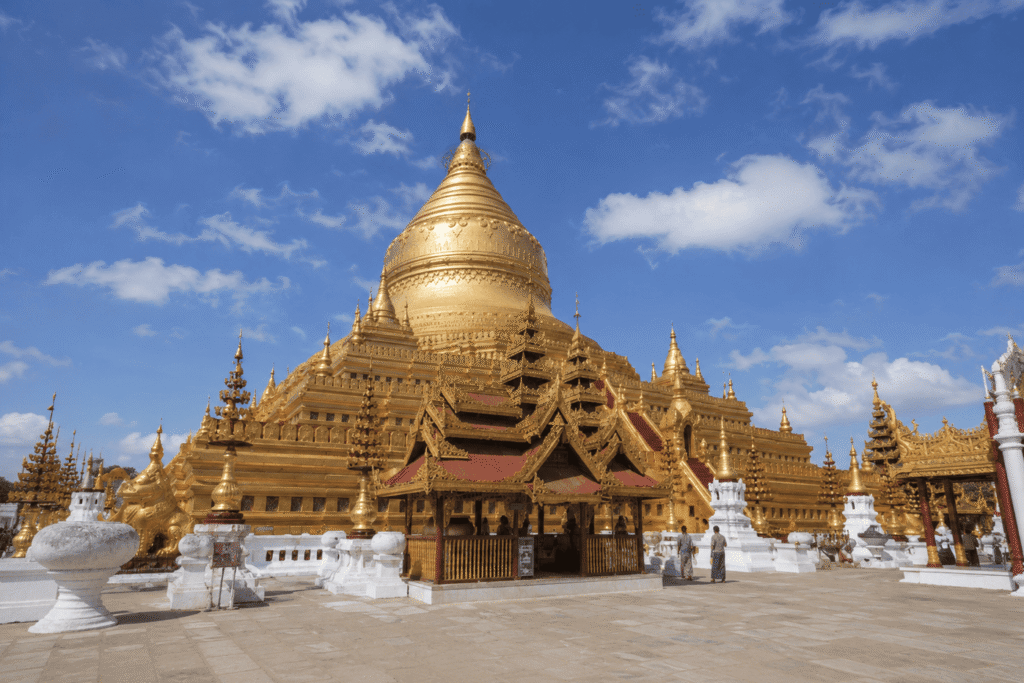
One of Myanmar’s most sacred Buddhist stupas, Shwezigon Pagoda was begun by King Anawrahta and completed by his successor. Its magnificent golden stupa became the architectural model for many later Burmese pagodas.
D. Thatbyinnyu Temple
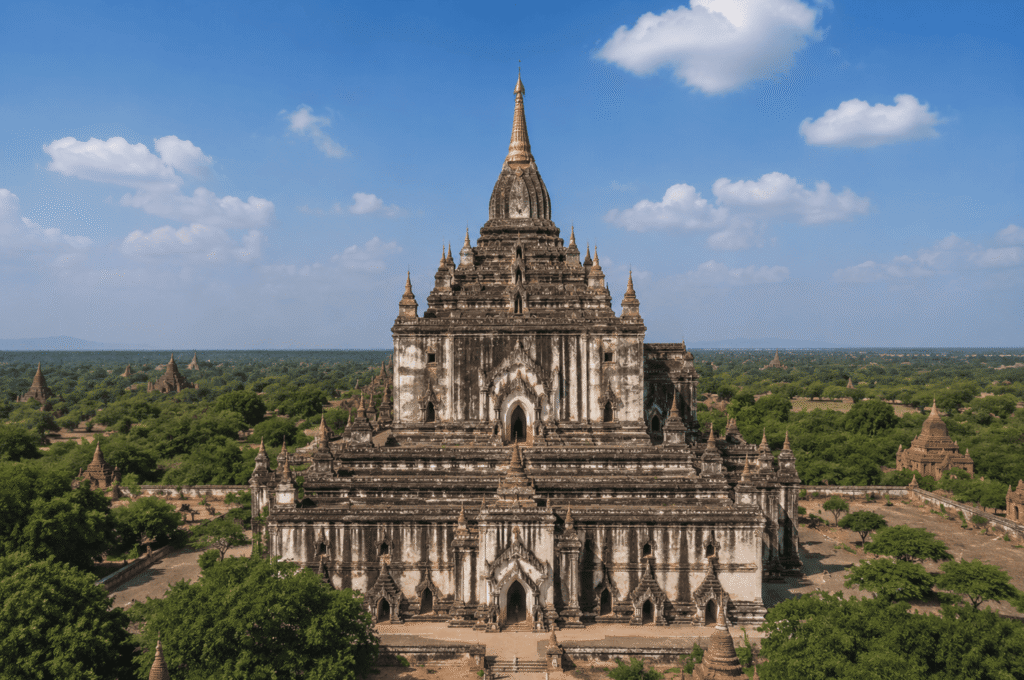
Standing approximately 66 meters (217 feet) tall, Thatbyinnyu Temple is the tallest structure in Bagan and dominates the surrounding plain with its impressive white silhouette.
Architecture
Bagan showcases the evolution of Burmese Buddhist architecture through its remarkable collection of temples and pagodas. The monuments feature sturdy brick construction, graceful golden stupas, pointed towers, vaulted interiors, decorative stucco, intricate stone carvings, colorful murals, and countless Buddha statues.
Many temples still preserve remarkably detailed wall paintings that depict Buddhist teachings, religious ceremonies, and scenes from everyday life in the Pagan Kingdom.
Religion and Culture
Bagan has been a major center of Theravada Buddhism for nearly a thousand years. Many of its temples remain active places of worship where pilgrims continue to pray, meditate, make offerings, and celebrate important Buddhist festivals.
Monks continue to play a vital role in the cultural and spiritual life of the region, ensuring that Bagan remains not only an extraordinary archaeological site but also a living center of Buddhist faith and tradition.
12. Mont-Saint-Michel

Mont-Saint-Michel and its Bay is one of France’s most iconic landmarks and one of the world’s most spectacular island monasteries. Rising dramatically from a vast tidal bay off the coast of Normandy, Mont-Saint-Michel has served as a place of pilgrimage, worship, and defense for more than a thousand years. Its magnificent medieval abbey, winding cobbled streets, and breathtaking setting create one of the world’s most recognizable cultural landscapes.
What is Mont-Saint-Michel?
Mont-Saint-Michel and its Bay is a rocky tidal island crowned by a magnificent medieval abbey. The site includes the famous Benedictine Abbey, a medieval village, a parish church, ancient fortifications, narrow cobbled streets, historic stone houses, defensive walls, and the surrounding tidal bay.
Although the island itself covers only about 17 acres (7 hectares), the surrounding bay is one of the largest tidal areas in Europe and is famous for its dramatic tides that transform the landscape throughout the day.
Why is Mont-Saint-Michel Famous?
Mont-Saint-Michel is famous for being one of the world’s most beautiful island monasteries and home to one of Europe’s finest medieval abbeys. It has been an important Christian pilgrimage destination for more than 1,000 years and is renowned for experiencing some of the highest tidal variations in Europe. Its unique combination of religious significance, military history, remarkable architecture, and breathtaking natural scenery has made it one of France’s most visited attractions.
History of Mont-Saint-Michel
Early Origins:
According to tradition, in 708 AD, Saint Aubert, Bishop of Avranches, received a vision in which the Archangel Michael instructed him to build a sanctuary on the rocky island. A small chapel was soon established, and the site quickly became an important destination for Christian pilgrims.
Medieval Abbey:
In 966 AD, Benedictine monks settled on the island and began constructing the great abbey. Over the following centuries, it expanded into one of medieval Europe’s most important religious centers, attracting pilgrims from across the continent.
Fortress:
Thanks to its strategic location, Mont-Saint-Michel was heavily fortified during the Middle Ages. During the Hundred Years’ War (1337–1453), the island successfully resisted repeated English attacks and was never captured.
Modern Era:
Following the French Revolution, the abbey was converted into a prison for several decades before extensive restoration work began in the 19th century. Today, it functions both as a historic monument and as an active place of worship.
UNESCO World Heritage Site
Mont-Saint-Michel and its Bay was inscribed as a UNESCO World Heritage Site in 1979 for its outstanding medieval architecture and the exceptional harmony between human achievement and the surrounding natural landscape.
Major Landmarks
A. Mont-Saint-Michel Abbey
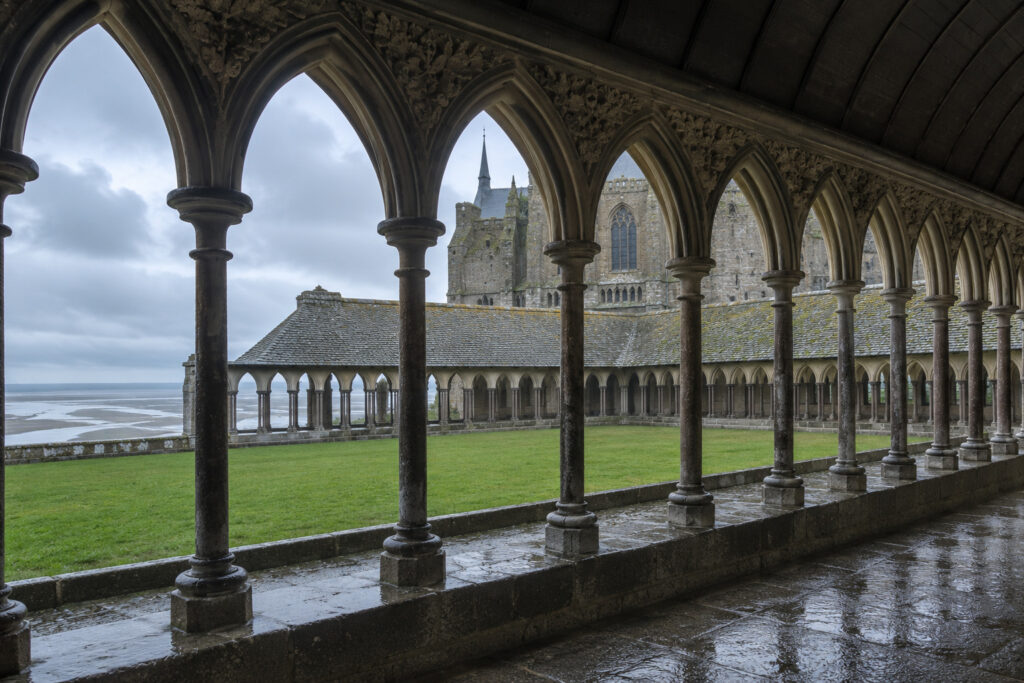
The abbey is the island’s crowning masterpiece. Built over several centuries, it combines Romanesque and Gothic architectural styles and stands atop the rocky summit, overlooking the surrounding bay.
B. Abbey Church
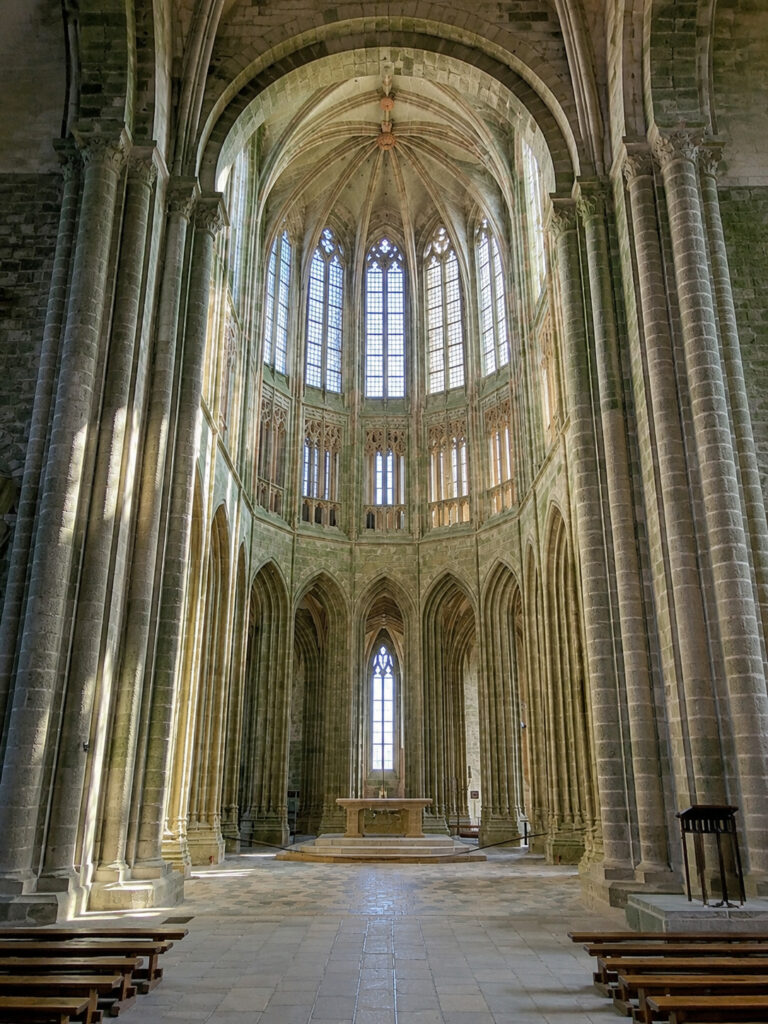
Located at the highest point of the island, the abbey church has welcomed Christian pilgrims for centuries. Its elevated position symbolizes the spiritual journey toward heaven.
C. Ramparts
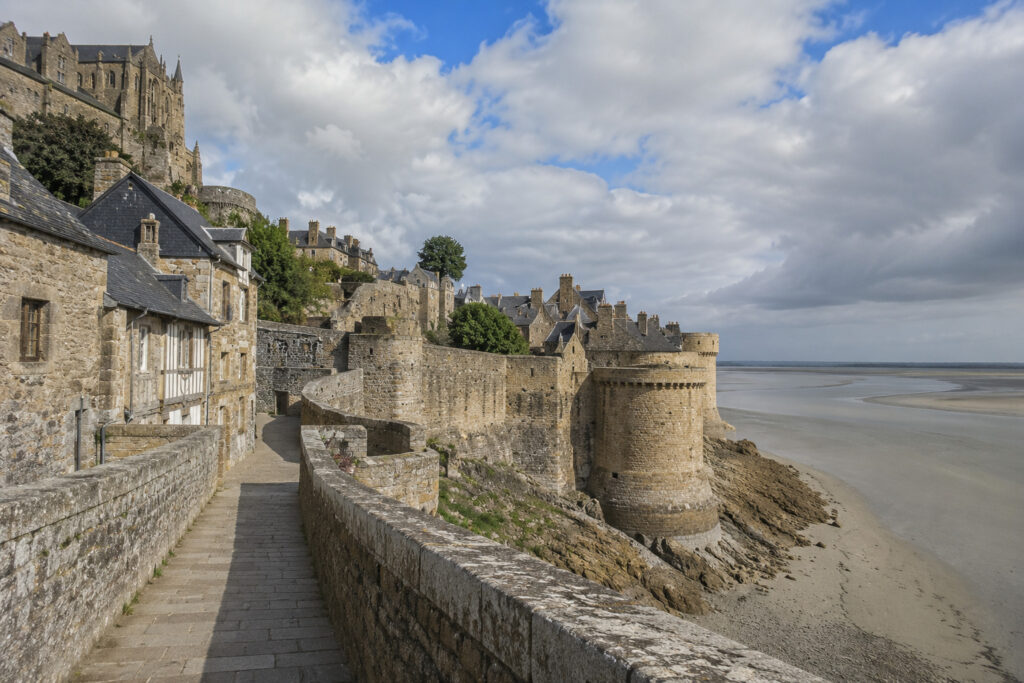
The medieval walls and defensive towers surrounding the village protected Mont-Saint-Michel from invaders and today offer spectacular panoramic views of the bay.
D. Grande Rue
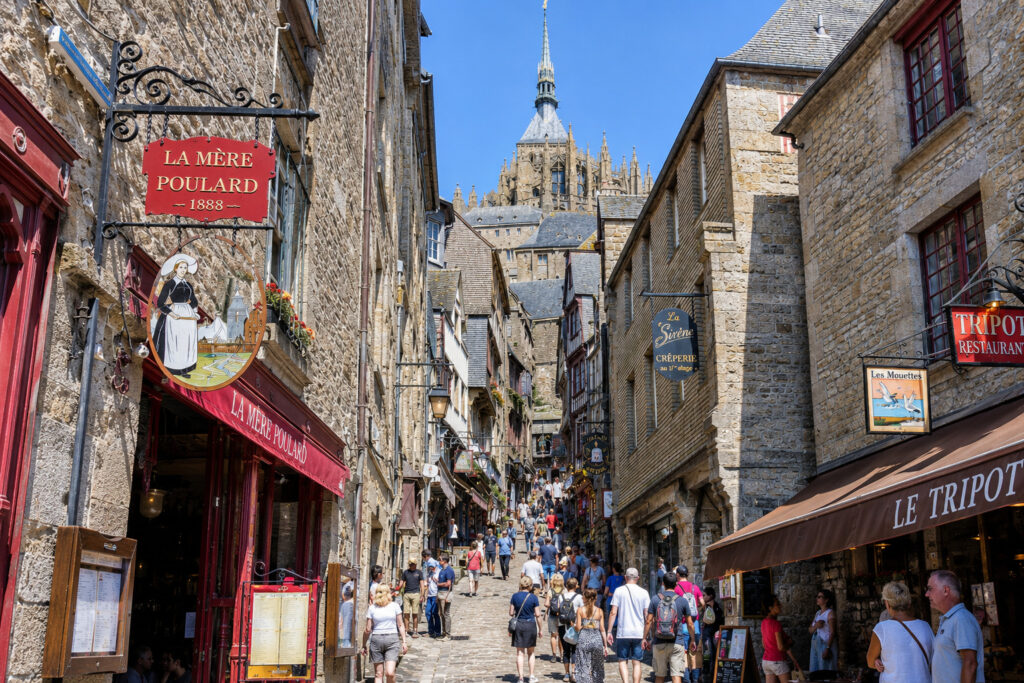
The island’s main street is lined with centuries-old stone houses, charming museums, restaurants, and traditional shops that preserve its unique medieval atmosphere.
Architecture
Mont-Saint-Michel is considered a masterpiece of medieval engineering. Its buildings feature sturdy granite construction, Romanesque foundations, elegant Gothic arches, defensive walls, narrow stone streets, peaceful cloisters, soaring spires, and terraced buildings that climb the rocky island.
The entire complex was carefully adapted to the island’s steep slopes, creating the distinctive pyramid-like silhouette that has become one of France’s most recognizable landmarks.
Religion and Culture
For more than a millennium, Mont-Saint-Michel has been dedicated to the Archangel Michael and has welcomed Christian pilgrims from across Europe. Religious services are still held in the abbey, preserving its centuries-old spiritual tradition. Today, the island is also a vibrant cultural destination, hosting exhibitions, concerts, and historical events that celebrate its remarkable heritage.
The Bay and Tides
The surrounding bay is famous for having some of the highest tidal ranges in Europe, with water levels that can rise or fall by as much as 15 meters (49 feet) between low and high tide.
At high tide, Mont-Saint-Michel becomes a true island, while at low tide, vast stretches of sand and mudflats emerge. Because of powerful currents and areas of quicksand, visitors are advised to explore the bay only with authorized guides.
13. Old City of Dubrovnik
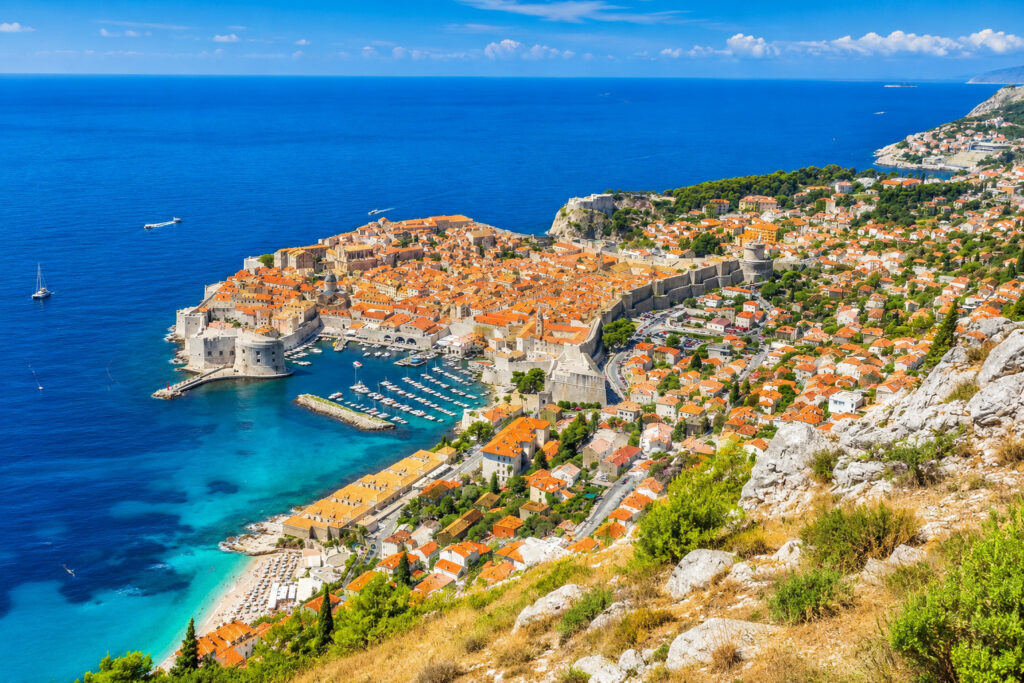
Old City of Dubrovnik is one of the best-preserved medieval walled cities in the world and a jewel of the Adriatic coast. Located in southern Croatia, Dubrovnik was once the capital of the independent Republic of Ragusa, a powerful maritime republic that flourished through trade and diplomacy. Surrounded by massive stone walls and overlooking the crystal-clear Adriatic Sea, the Old City is celebrated for its magnificent churches, palaces, monasteries, and historic streets, making it one of Europe’s most iconic UNESCO World Heritage Sites.
What is the Old City of Dubrovnik?
The Old City of Dubrovnik is the historic heart of Dubrovnik, enclosed by impressive medieval defensive walls. Within its fortified boundaries are historic churches, monasteries, palaces, fortresses, public squares, stone-paved streets, fountains, museums, and centuries-old residential buildings.
Although it covers only about 25 acres (10 hectares), the Old City contains an extraordinary concentration of medieval, Gothic, Renaissance, and Baroque architecture, making it one of Europe’s finest preserved historic centers.
Why is Dubrovnik Famous?
Dubrovnik is famous for being one of the world’s best-preserved medieval walled cities and for serving as the capital of the Republic of Ragusa for more than four centuries. It is renowned for its massive defensive walls, magnificent Gothic, Renaissance, and Baroque architecture, and spectacular views of the Adriatic Sea. In recent years, the city has also gained worldwide recognition as a major filming location for the television series Game of Thrones.
History of Dubrovnik
Early Origins:
Dubrovnik was founded in the 7th century AD by refugees who settled on a rocky island after fleeing invasions on the mainland. Over time, the settlement expanded and merged with nearby communities to form the medieval city.
Republic of Ragusa:
From 1358 to 1808, Dubrovnik flourished as the independent Republic of Ragusa. The republic became one of the Mediterranean’s leading maritime powers through international trade, shipbuilding, diplomacy, banking, and maritime law. Rather than relying on military conquest, it maintained its independence through skilled diplomacy and commercial success.
Earthquake and Reconstruction:
A devastating earthquake struck Dubrovnik in 1667, destroying many buildings and claiming thousands of lives. The city was rebuilt, and many of today’s elegant Baroque buildings date from this remarkable reconstruction period.
Modern Era:
During the Croatian War of Independence (1991–1995), the Old City suffered significant damage from shelling. Extensive restoration efforts, supported by UNESCO and the international community, carefully repaired its historic monuments while preserving their authenticity.
UNESCO World Heritage Site
The Old City of Dubrovnik was inscribed as a UNESCO World Heritage Site in 1979 for its exceptional medieval urban ensemble and outstanding architectural heritage.
Major Landmarks
A. Walls of Dubrovnik
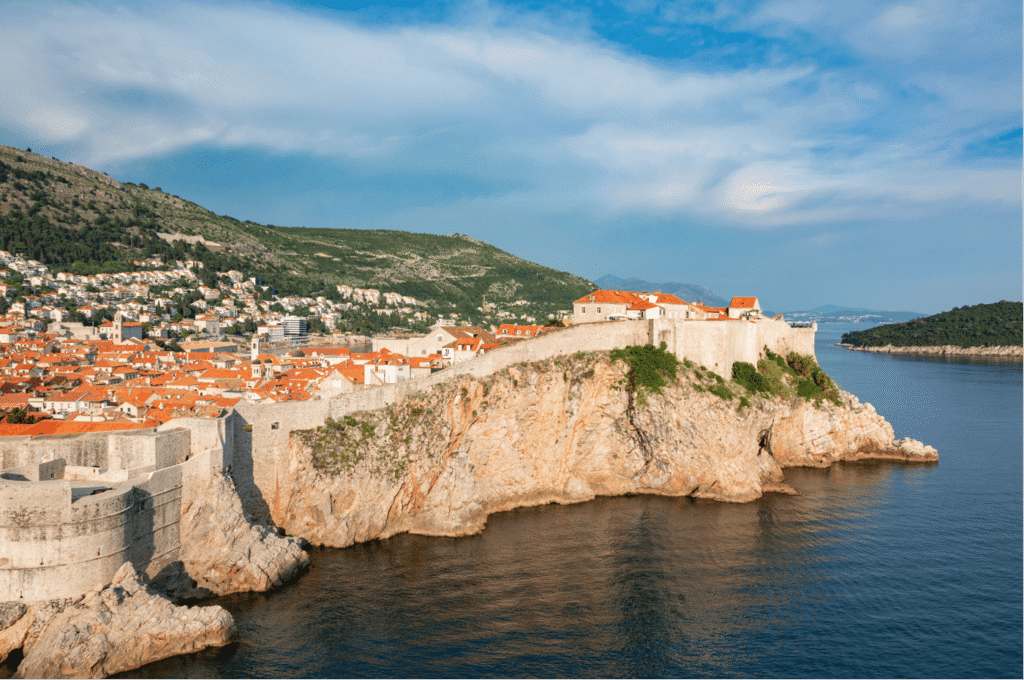
Among the finest preserved defensive systems in Europe, the city walls extend approximately 1.2 miles (1.94 kilometers) and reach heights of up to 82 feet (25 meters). Construction began in the 10th century and continued for several centuries. Today, walking along the walls offers breathtaking panoramic views of the Old City and the Adriatic Sea.
B. Stradun
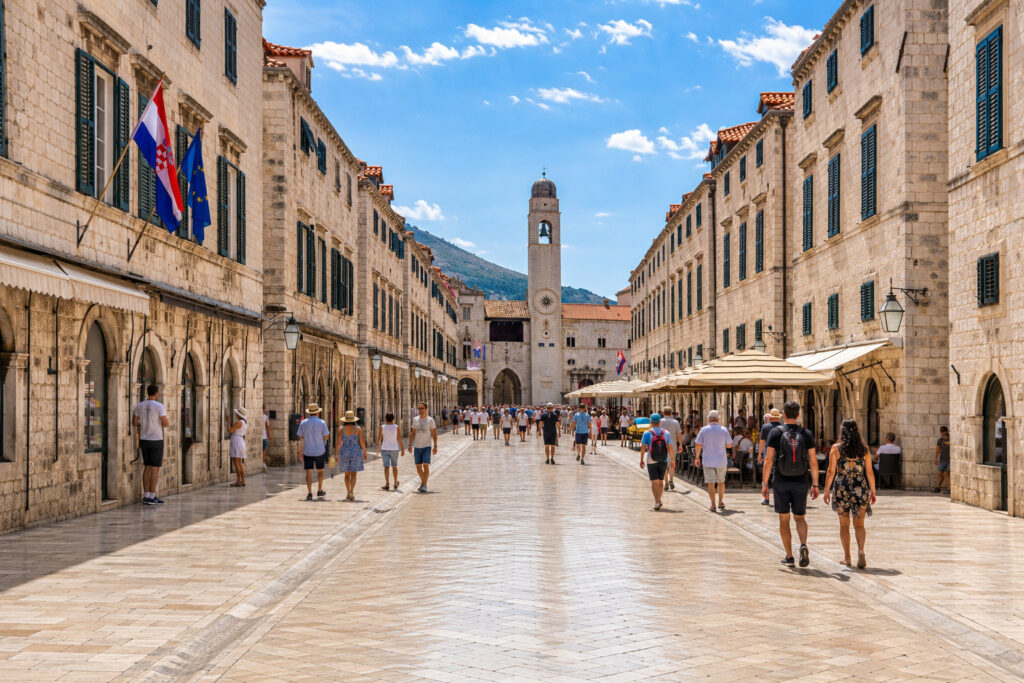
The city’s main limestone-paved street, Stradun is lined with elegant Baroque buildings, charming cafés, shops, and many of Dubrovnik’s most important historic landmarks.
C. Rector’s Palace
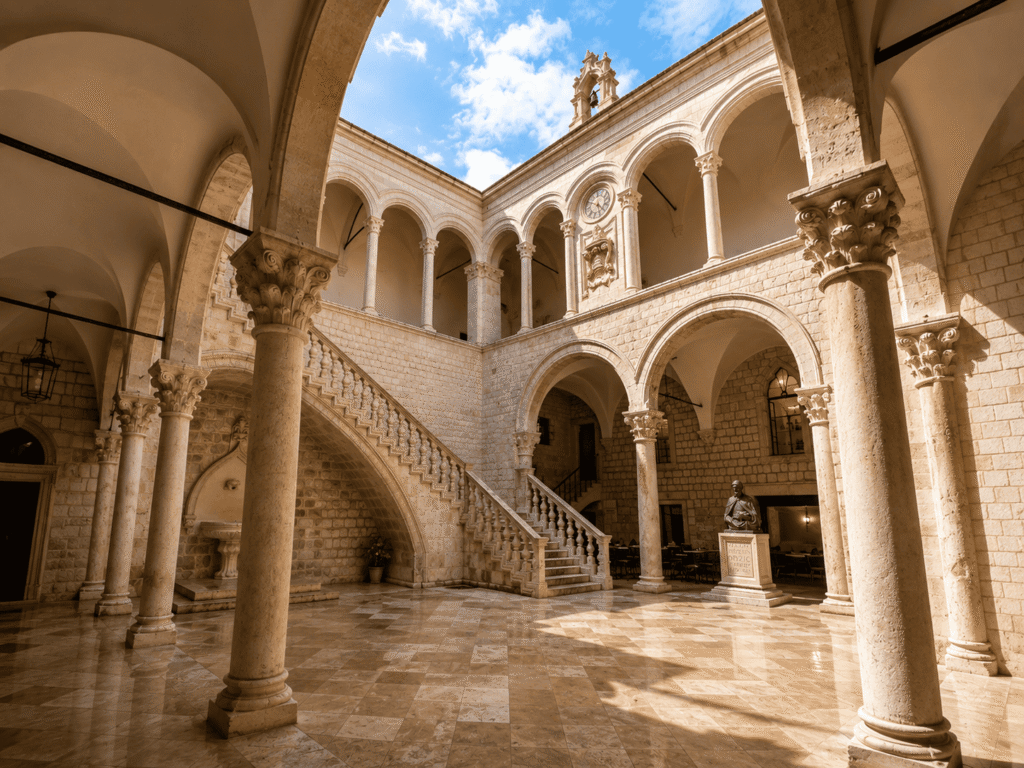
Once the official residence of the elected Rector of the Republic of Ragusa, this remarkable building combines Gothic and Renaissance architectural styles and now serves as a museum showcasing the city’s rich history.
D. Sponza Palace
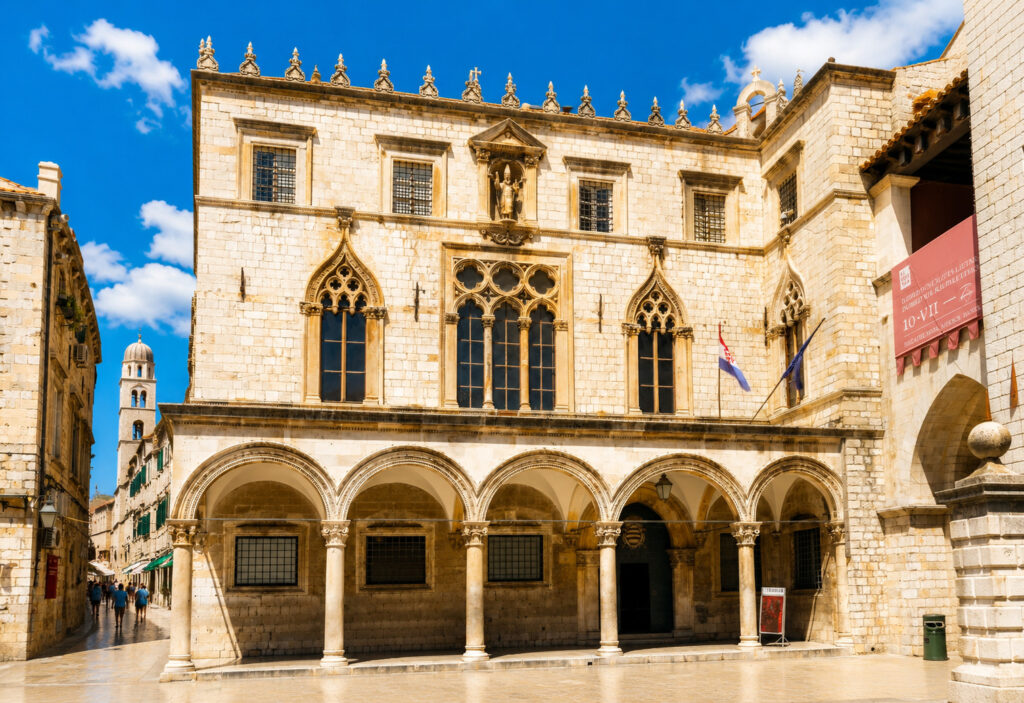
A beautifully preserved Gothic-Renaissance palace that once housed the customs office, mint, and government archives. Today, it remains one of Dubrovnik’s finest historic buildings.
E. Franciscan Monastery
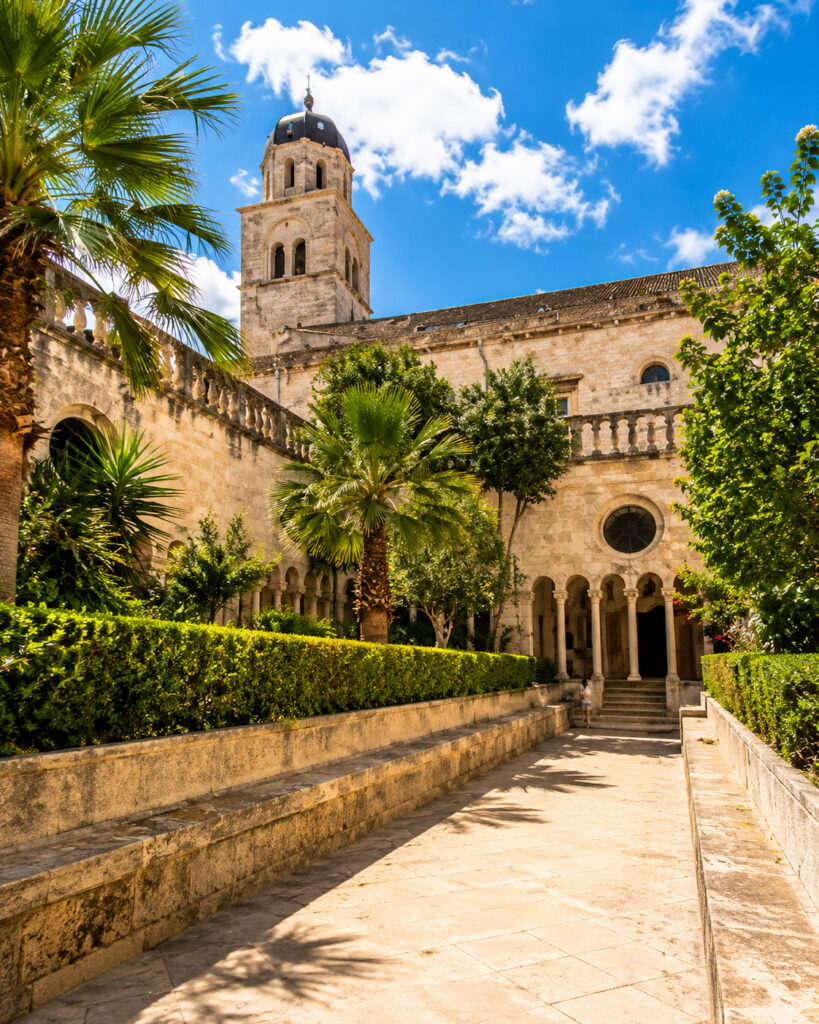
Franciscan Monastery is home to one of Europe’s oldest continuously operating pharmacies, established in 1317, as well as a peaceful Romanesque cloister admired for its elegant stone columns.
Architecture
The Old City showcases an exceptional blend of medieval, Gothic, Renaissance, and Baroque architecture. Its buildings feature finely crafted limestone construction, defensive towers, arched gateways, elegant palaces, richly decorated churches, monasteries, public fountains, and narrow stone alleys. Together, these architectural elements create a remarkably harmonious cityscape that reflects centuries of careful planning, preservation, and restoration.
Culture and Heritage
For centuries, Dubrovnik has been an important center of maritime trade, literature, diplomacy, art, and music. Today, the city continues to celebrate its rich cultural heritage through museums, galleries, concerts, and traditional events.
One of its most celebrated annual events is the Dubrovnik Summer Festival, an internationally renowned celebration of theater, music, and dance held against the city’s spectacular historic backdrop.
14. Moai of Rapa Nui National Park
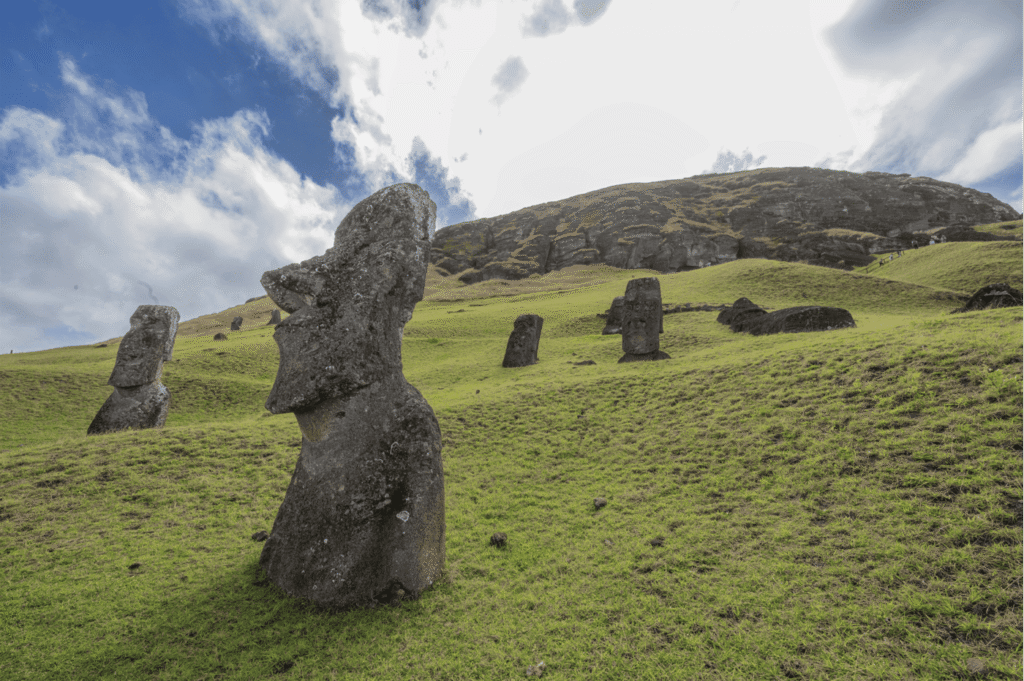
Rapa Nui National Park is one of the world’s most mysterious archaeological sites, best known for its massive Moai statues that have fascinated historians and travelers for centuries. Located on the remote volcanic island of Easter Island in the southeastern Pacific Ocean, the park protects the extraordinary cultural heritage of the Rapa Nui people. Along with hundreds of giant stone statues, visitors can explore ceremonial platforms, volcanic quarries, ancient villages, and sacred sites that showcase the incredible engineering and artistic achievements of this ancient civilization.
What is Rapa Nui National Park?
Rapa Nui National Park covers around 40% of Easter Island, spanning approximately 17,620 acres (7,130 hectares). It is home to nearly 1,000 Moai statues, ceremonial platforms known as Ahu, ancient villages, traditional stone houses, petroglyphs, volcanic craters, sacred caves, and archaeological quarries. Together, these sites preserve the rich history, culture, and spiritual traditions of the Rapa Nui civilization.
Why is Rapa Nui Famous?
Rapa Nui National Park is famous for its nearly 1,000 giant Moai statues, making it one of the world’s most recognizable archaeological sites. It offers a fascinating glimpse into one of history’s most isolated civilizations and highlights remarkable prehistoric engineering and craftsmanship. Its dramatic volcanic landscapes, rugged coastline, and enduring archaeological mysteries continue to attract researchers and visitors from around the world.
History of Rapa Nui
Early Settlement:
Polynesian settlers arrived on Easter Island between 800 and 1200 AD. Over time, they developed a unique culture that adapted to the island’s remote environment.
Construction of the Moai:
Between 1250 and 1500 AD, the Rapa Nui people carved hundreds of enormous stone statues from volcanic rock. Most of these statues were created at the volcanic quarry of Rano Raraku before being transported across the island to ceremonial platforms. The Moai are believed to represent respected ancestors, chiefs, or other important figures whose spiritual power was thought to protect their communities.
Decline:
By the 17th century, environmental challenges and social changes brought an end to large-scale Moai construction. During periods of conflict, many statues were deliberately toppled. In the 20th century, extensive archaeological restoration projects successfully raised many of the fallen Moai once again.
UNESCO World Heritage Site
Rapa Nui National Park was designated a UNESCO World Heritage Site in 1995 in recognition of its outstanding cultural significance and its remarkable collection of monumental art created by the Rapa Nui civilization.
The Moai Statues
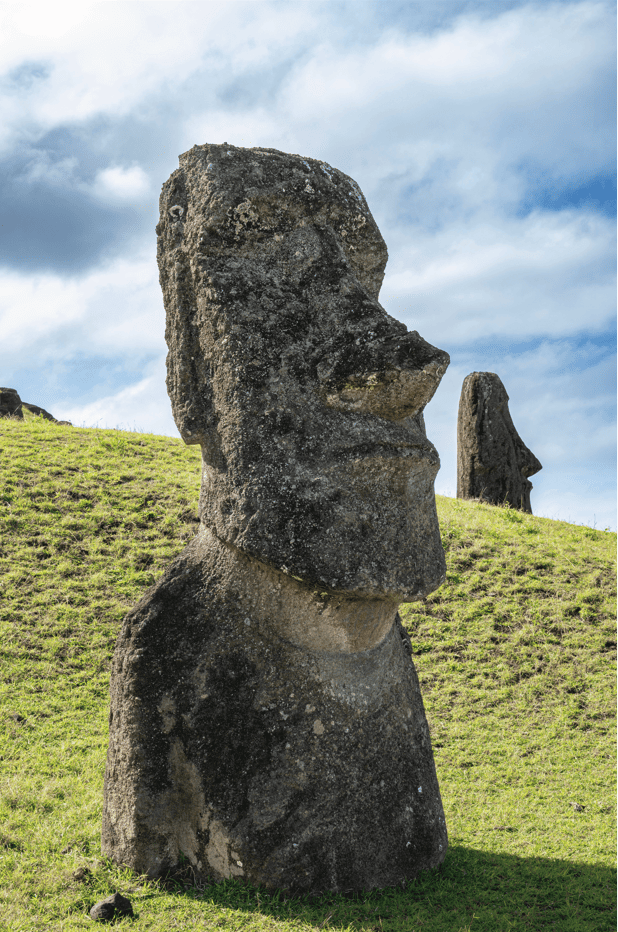
Moai are enormous monolithic human figures carved mainly from compressed volcanic ash known as tuff. Archaeologists have identified nearly 1,000 statues, most of which were carved between 1250 and 1500 AD.
On average, a Moai stands about 13 feet (4 meters) tall and weighs 10 to 14 tonnes. The largest completed Moai measures approximately 33 feet (10 meters) in height and weighs over 80 tonnes. An unfinished statue at Rano Raraku would have reached an incredible 69 feet (21 meters) if it had been completed. Many Moai originally wore large red stone topknots called pukao, carved from red volcanic scoria.
Major Archaeological Sites
A. Ahu Tongariki
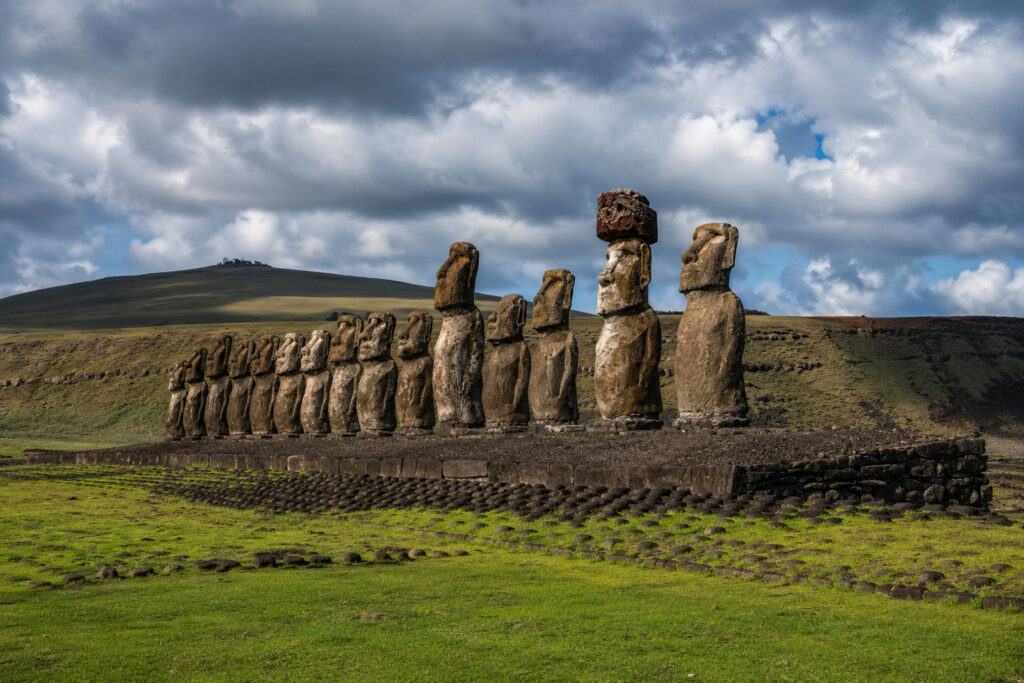
The island’s largest restored ceremonial platform, featuring 15 standing Moai overlooking the Pacific Ocean.
B. Rano Raraku
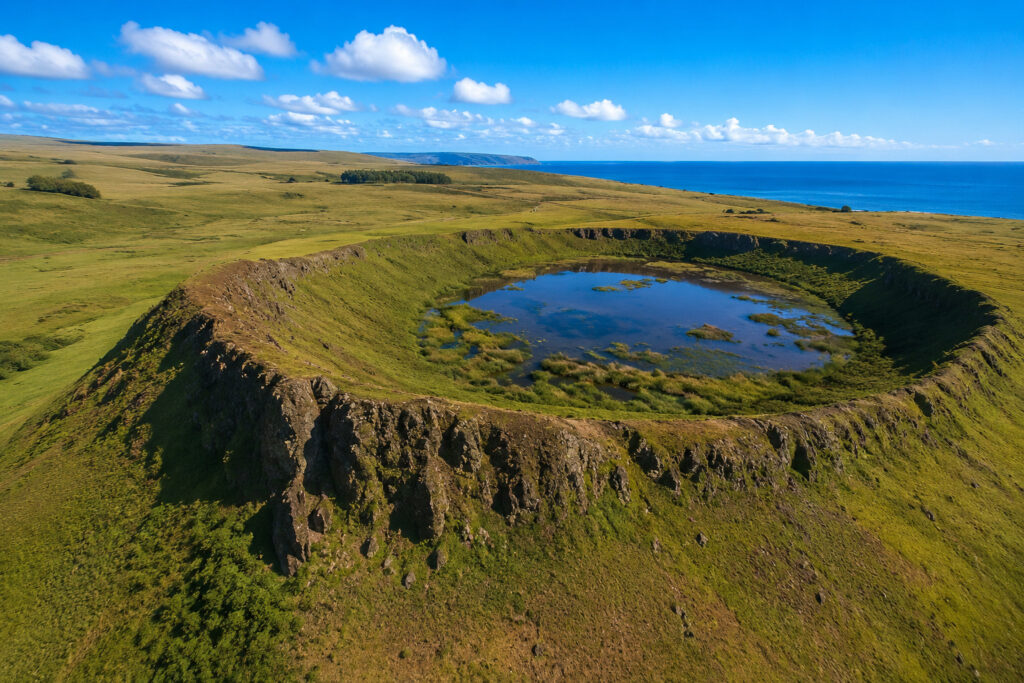
The volcanic quarry where most of the Moai were carved. Hundreds of unfinished statues remain scattered across its slopes, offering a rare look into the carving process.
C. Ahu Nau Nau
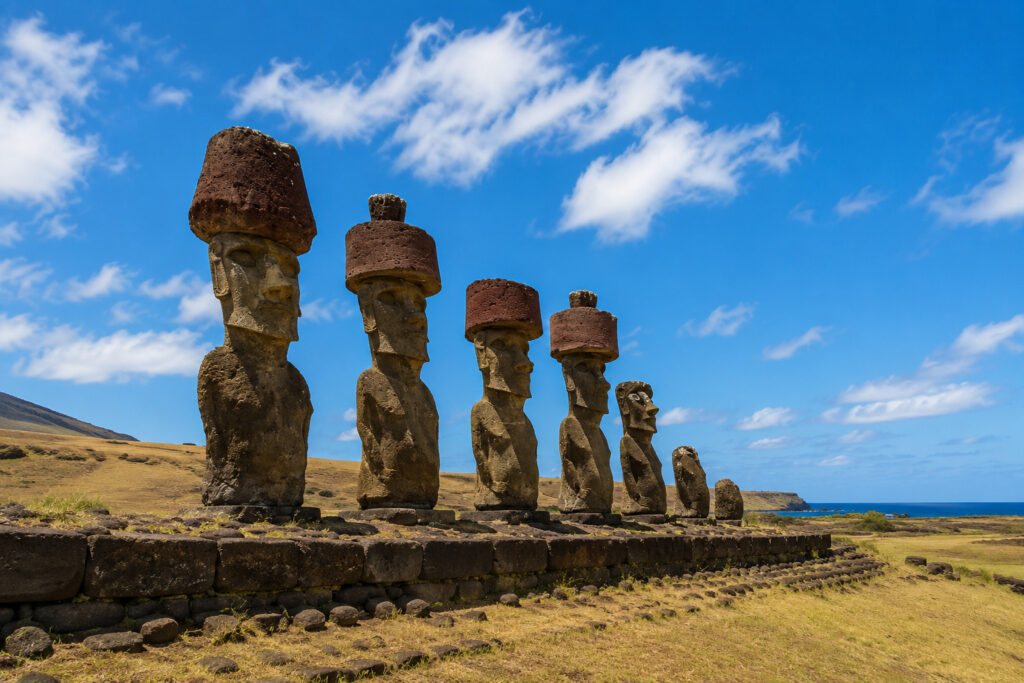
Located at Anakena Beach, this ceremonial platform is home to some of the island’s best-preserved Moai, many of which still display intricate carvings.
D. Orongo
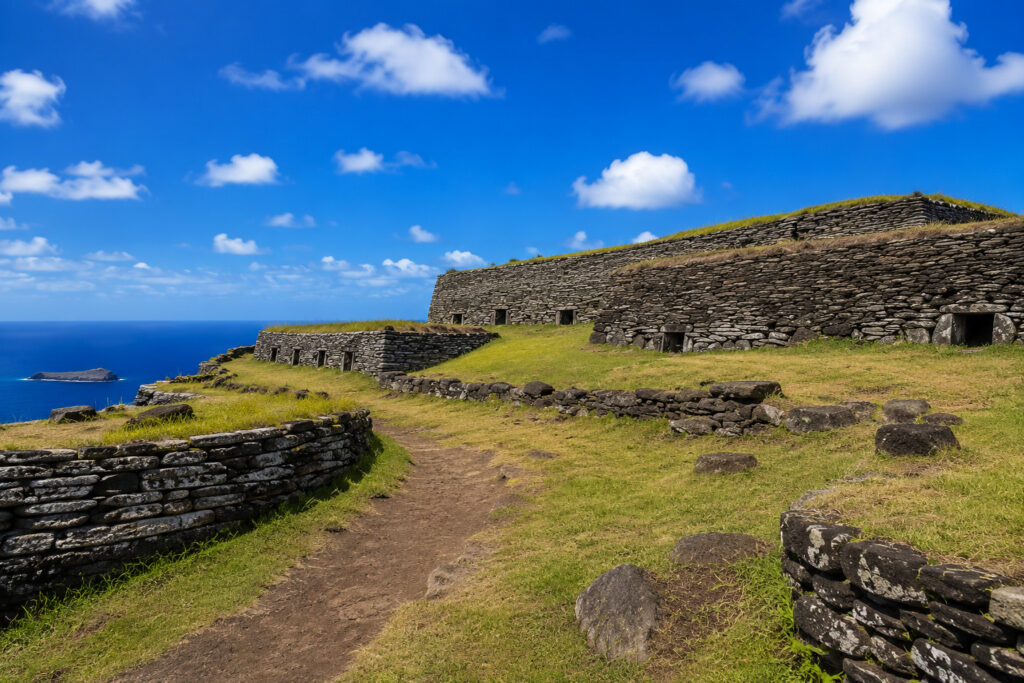
A ceremonial village built on the rim of the Rano Kau volcanic crater. It was the center of the Birdman (Tangata Manu) cult, which became an important part of Rapa Nui’s later religious traditions.
Architecture and Engineering
Rapa Nui people demonstrated extraordinary engineering skills through their monumental stone carvings and carefully constructed ceremonial platforms. They successfully transported massive statues across the island, built impressive dry-stone structures, and aligned many sacred sites with astronomical events. Although the exact methods remain debated, many researchers believe the Moai were “walked” upright using ropes and coordinated human effort.
Religion and Culture
Rapa Nui believed the Moai contained the mana, or spiritual power, of their ancestors. The statues were placed on ceremonial platforms facing inland so they could symbolically watch over and protect their communities. Over time, religious beliefs evolved, and the Birdman (Tangata Manu) cult, centered at Orongo, became one of the island’s most important spiritual traditions.
15. Borobudur Temple Compounds
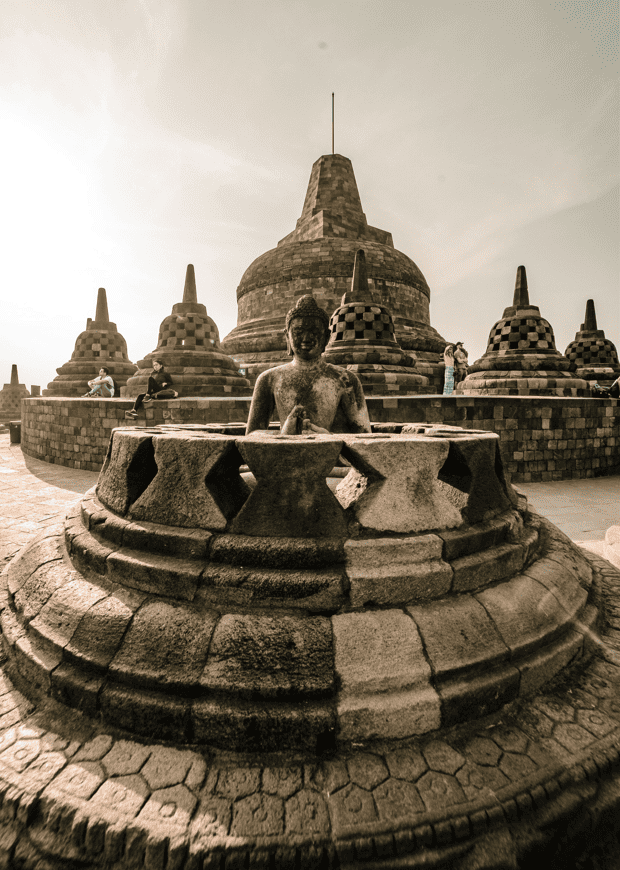
Borobudur Temple Compounds is the world’s largest Buddhist temple complex and one of the greatest masterpieces of Buddhist architecture. Located in Central Java, Indonesia, Borobudur was built during the 8th and 9th centuries under the Sailendra dynasty. Famous for its massive stone terraces, thousands of intricate relief carvings, and hundreds of Buddha statues, the temple beautifully represents the Buddhist path to enlightenment and remains one of Southeast Asia’s most treasured cultural landmarks.
What are the Borobudur Temple Compounds?
The Borobudur Temple Compounds is a UNESCO World Heritage Site that includes three interconnected Buddhist temples: Borobudur, Mendut, and Pawon. Among them, Borobudur is the largest and most significant, serving as the spiritual and architectural centerpiece of the complex.
Built from approximately 2 million volcanic stone blocks, Borobudur is designed as a giant mandala, symbolizing the Buddhist cosmos and the spiritual journey from the earthly world to enlightenment.
Why is Borobudur Famous?
Borobudur is famous for being the largest Buddhist temple in the world. It features more than 2,600 stone relief panels, 504 Buddha statues, and 72 perforated stupas surrounding a massive central stupa. Beyond its impressive architecture, the temple symbolizes the Buddhist journey toward enlightenment and is one of Indonesia’s most visited cultural and religious landmarks.
History of Borobudur
Construction:
Borobudur was built between 780 and 850 AD during the reign of the Sailendra dynasty. It served as an important center for Buddhist worship, meditation, and pilgrimage.
Abandonment:
Around the 14th century, the temple was gradually abandoned as political power shifted and Islam became the dominant religion in Java. Over the following centuries, volcanic eruptions, ash, tropical vegetation, and dense jungle growth buried much of the monument.
Rediscovery:
In 1814, during the British administration of Java, Thomas Stamford Raffles ordered an investigation after hearing reports of a hidden monument. Excavations eventually uncovered the magnificent temple beneath layers of earth and vegetation.
Restoration:
Several restoration projects took place during the 20th century, with the largest conservation effort led by UNESCO between 1975 and 1982. This extensive restoration helped preserve Borobudur and protect it for future generations.
UNESCO World Heritage Site
The Borobudur Temple Compounds were inscribed as a UNESCO World Heritage Site in 1991 for their outstanding artistic achievement, religious importance, and exceptional testimony to Buddhist civilization.
Borobudur Temple
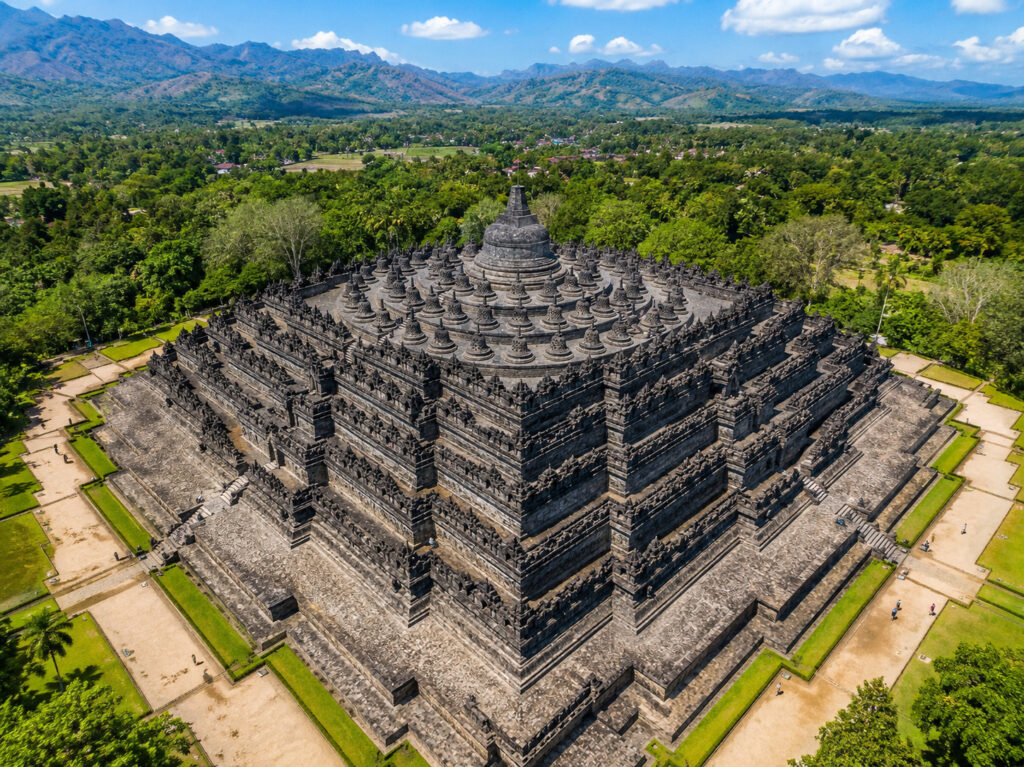
The main temple is built as a massive stepped pyramid consisting of nine stacked platforms—six square terraces followed by three circular terraces—with a large central stupa at the summit.
After restoration, the monument stands approximately 115 feet (35 meters) tall. It was constructed using around 2 million volcanic stone blocks and contains 504 Buddha statues, 72 perforated stupas, and 2,672 relief panels. Together, these carvings stretch for more than 3 miles (5 kilometers), making them one of the world’s longest narrative stone reliefs.
Pilgrims traditionally walk clockwise around each level while gradually ascending the temple, symbolizing the spiritual journey toward enlightenment.
Architecture
Borobudur is considered one of the greatest engineering achievements of the ancient world. Its design features monumental terraces, stone stupas, a mandala-inspired layout, intricate relief carvings, Buddha statues, sophisticated drainage systems, and precisely cut volcanic stone masonry. Remarkably, the monument was built without mortar, relying on expertly crafted interlocking stones for stability.
Buddhist Symbolism
The temple represents the Buddhist universe through three symbolic levels:
- Kamadhatu – the world of desire.
- Rupadhatu – the world of forms.
- Arupadhatu – the formless realm of spiritual enlightenment.
As visitors ascend through these levels, they symbolically progress from earthly desires toward wisdom, inner peace, and ultimate enlightenment.
Art and Reliefs
Borobudur’s relief panels tell the story of Gautama Buddha’s life, Buddhist teachings, Jataka tales, pilgrimages, ancient Javanese society, maritime trade, and everyday life during the 8th and 9th centuries. These beautifully carved panels are considered some of the finest examples of Buddhist art anywhere in the world, offering invaluable insight into both religious traditions and the history of ancient Java.
16. Stonehenge
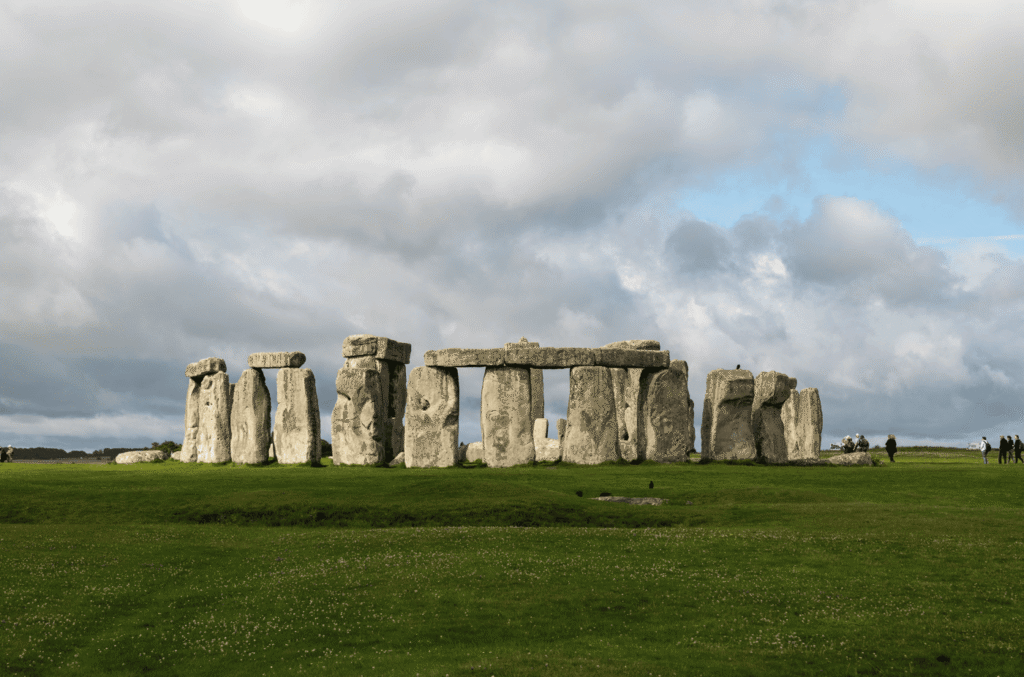
Stonehenge, Avebury and Associated Sites is one of the world’s most famous prehistoric landscapes and one of history’s greatest mysteries. Located on Salisbury Plain in southern England, this UNESCO World Heritage Site is home to the iconic Stonehenge stone circle, along with ancient burial mounds, ceremonial avenues, earthworks, and other remarkable prehistoric monuments. Built thousands of years ago, Stonehenge is celebrated for its impressive engineering, astronomical alignments, and lasting cultural significance.
What is Stonehenge?
Stonehenge is a prehistoric stone monument built in several stages between 3000 BC and 1600 BC. It forms part of the larger Stonehenge, Avebury and Associated Sites UNESCO World Heritage Site, which also includes the nearby Avebury stone circles, ancient burial mounds (barrows), ceremonial avenues, earthworks, and Neolithic settlements.
At its center is the famous stone circle, where massive upright stones are arranged in circular and horseshoe-shaped formations with remarkable precision.
Why is Stonehenge Famous?
Stonehenge is famous for being one of the world’s best-known prehistoric monuments. Some of its largest standing stones weigh up to 30 tonnes, yet they were transported and positioned thousands of years ago without modern machinery.
The monument is also renowned for its precise alignment with the summer solstice sunrise and the winter solstice sunset, suggesting that astronomy played an important role in its design. Combined with its remarkable engineering and enduring mystery, Stonehenge continues to attract archaeologists, historians, and millions of visitors every year.
History of Stonehenge
Early Construction:
Construction began around 3000 BC with the creation of a circular earthwork enclosure and ditch. This earliest phase is believed to have been used for ceremonial activities and burials.
The Stone Circle:
Between 2500 BC and 2400 BC, builders erected the iconic sarsen stones, which were transported from the Marlborough Downs, about 25 kilometers (16 miles) away. Smaller bluestones were brought from the Preseli Hills in present-day Wales, a remarkable journey of more than 200 kilometers (125 miles).
Later Modifications:
The monument continued to evolve for nearly 1,500 years. During this period, stones were rearranged, additional earthworks were built, and the site gradually took on the form we recognize today before major construction eventually ended around 1600 BC.
UNESCO World Heritage Site
Stonehenge, Avebury and Associated Sites was designated a UNESCO World Heritage Site in 1986 for its exceptional prehistoric monuments and its outstanding contribution to our understanding of Neolithic and Bronze Age societies.
The Stone Circle
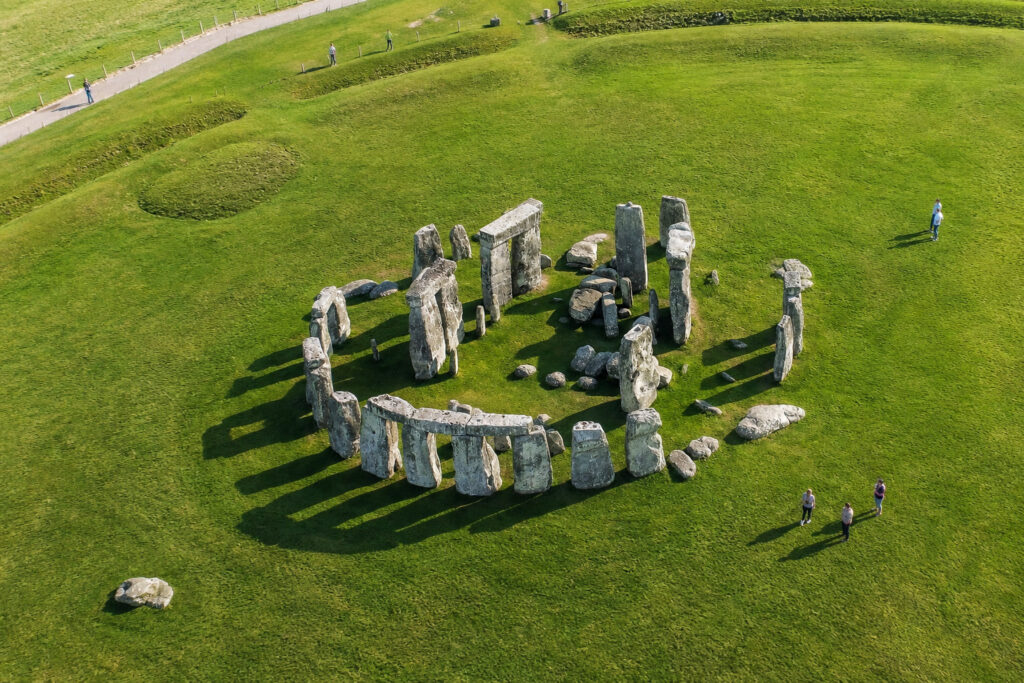
Stonehenge is made up of several types of carefully arranged stones. Its largest sarsen stones stand up to 30 feet (9 meters) tall and weigh around 30 tonnes each. The monument originally included about 30 upright sarsen stones and 80 smaller bluestones, many of which were transported from Wales.
Several of the upright stones are connected by horizontal lintels using mortise-and-tenon joints—a sophisticated woodworking technique adapted for stone construction. The monument’s precision and stability remain extraordinary considering the technology available more than 4,000 years ago.
Purpose of Stonehenge
Although its exact purpose remains unknown, archaeologists believe Stonehenge likely served several roles throughout its history. It may have been used for religious ceremonies, burial rituals, astronomical observations, seasonal celebrations, and community gatherings.
Its precise alignment with the summer solstice sunrise and winter solstice sunset strongly suggests that tracking important celestial events was central to the monument’s design.
Architecture and Engineering
Stonehenge showcases the remarkable engineering skills of prehistoric Britain. Its builders successfully transported enormous stones across long distances, shaped them with impressive accuracy, and assembled them using interlocking joints that have survived for thousands of years.
The carefully planned circular layout, horseshoe-shaped arrangement, astronomical alignments, and surrounding earthworks demonstrate a sophisticated understanding of both engineering and landscape design.
Archaeological Landscape
Stonehenge is only one part of a much larger ceremonial landscape. The surrounding UNESCO site includes ancient burial mounds, processional avenues, timber circles, prehistoric settlements, ritual monuments, and the impressive stone circles at Avebury.
Together, these monuments provide valuable insight into the beliefs, rituals, and daily lives of Britain’s prehistoric communities, making the area one of the world’s most important archaeological landscapes.
17. Historic Centre of Prague
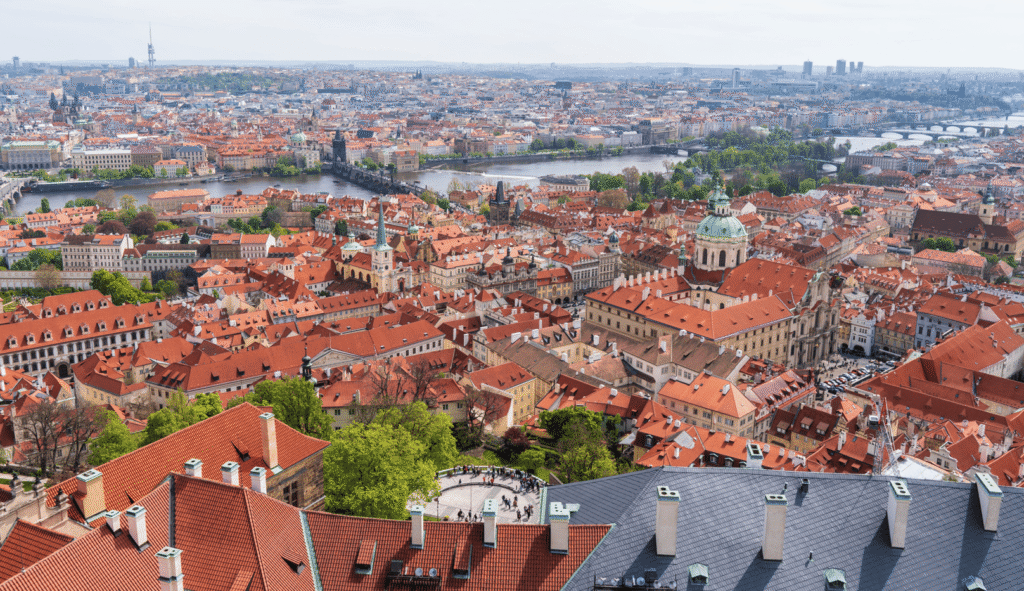
Historic Centre of Prague is one of Europe’s most beautiful and best-preserved historic cities. Often called the “City of a Hundred Spires,” Prague has been a political, cultural, and economic center of Central Europe for more than a thousand years. Located on the banks of the Vltava River in the Czech Republic, the city is renowned for its magnificent castles, churches, bridges, palaces, and medieval streets that showcase nearly every major architectural style from the Middle Ages to the modern era.
What is the Historic Centre of Prague?
The Historic Centre of Prague includes the city’s oldest and most historically significant districts, including Old Town (Staré Město), New Town (Nové Město), Lesser Town (Malá Strana), Prague Castle, and the historic Jewish Quarter (Josefov).
Covering approximately 2,140 acres (866 hectares), the historic center preserves an exceptional urban landscape that has evolved continuously for more than 1,000 years, making it one of Europe’s finest examples of a well-preserved medieval city.
Why is Prague Famous?
Prague is famous for its remarkably preserved medieval architecture, rich history, and vibrant cultural heritage. It is home to the world’s largest ancient castle complex, the iconic Charles Bridge, and the famous Prague Astronomical Clock. The city also features an impressive blend of Romanesque, Gothic, Renaissance, Baroque, and Art Nouveau architecture, reflecting centuries of artistic and cultural development. As the historic capital of the Kingdom of Bohemia, Prague remains one of Europe’s most visited UNESCO World Heritage Sites.
History of Prague
Early Origins:
Prague began to develop during the 9th century around Prague Castle, which became the seat of the ruling Přemyslid dynasty. Its strategic location along major trade routes helped transform the settlement into an important commercial and political center.
Medieval Golden Age:
During the reign of Charles IV in the 14th century, Prague became one of Europe’s leading cities. He founded Charles University in 1348, the oldest university in Central Europe, established the New Town (Nové Město), oversaw the construction of the Charles Bridge, and supported the building of numerous churches, public buildings, and fortifications.
Habsburg Era:
From the 16th century onward, Prague flourished under the House of Habsburg. During this period, magnificent Baroque churches, palaces, and gardens transformed much of the city’s appearance while preserving its medieval layout.
Modern History:
Despite periods of war and political upheaval, Prague escaped much of the widespread destruction that affected many European cities during World War II. As a result, its historic center remains remarkably well preserved and continues to reflect more than a millennium of architectural and cultural history.
UNESCO World Heritage Site
Historic Centre of Prague was designated a UNESCO World Heritage Site in 1992 for its outstanding urban landscape and exceptional collection of architectural monuments spanning more than a thousand years.
Major Landmarks
A. Prague Castle
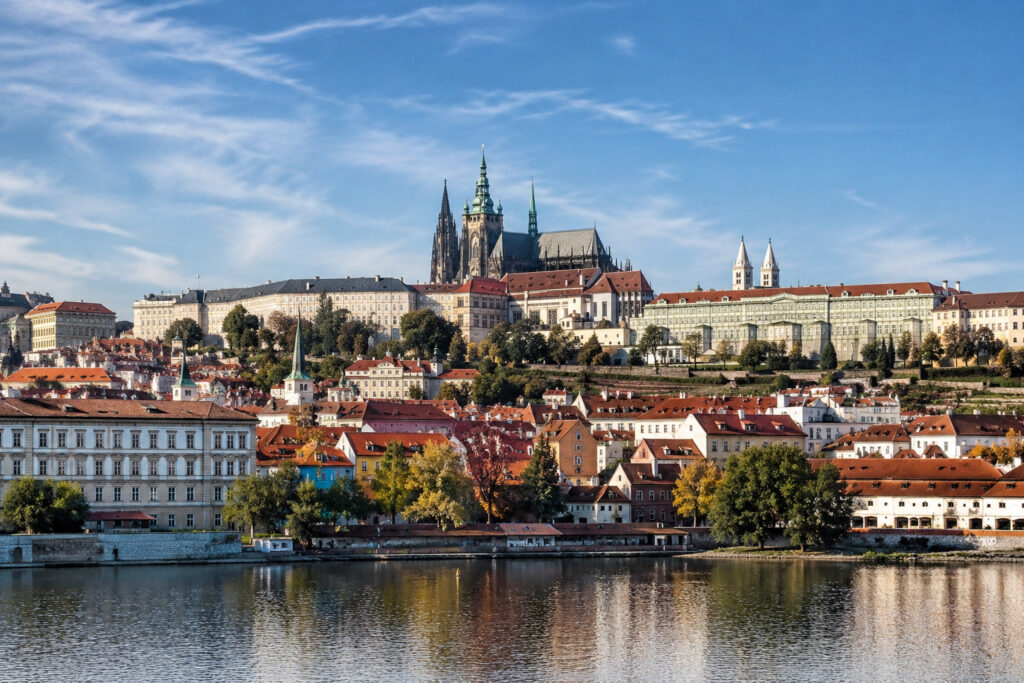
Founded in the 9th century, Prague Castle is recognized as the largest ancient castle complex in the world, covering approximately 750,000 square feet (70,000 square meters). The vast complex includes royal palaces, museums, gardens, churches, and important government buildings.
B. Charles Bridge
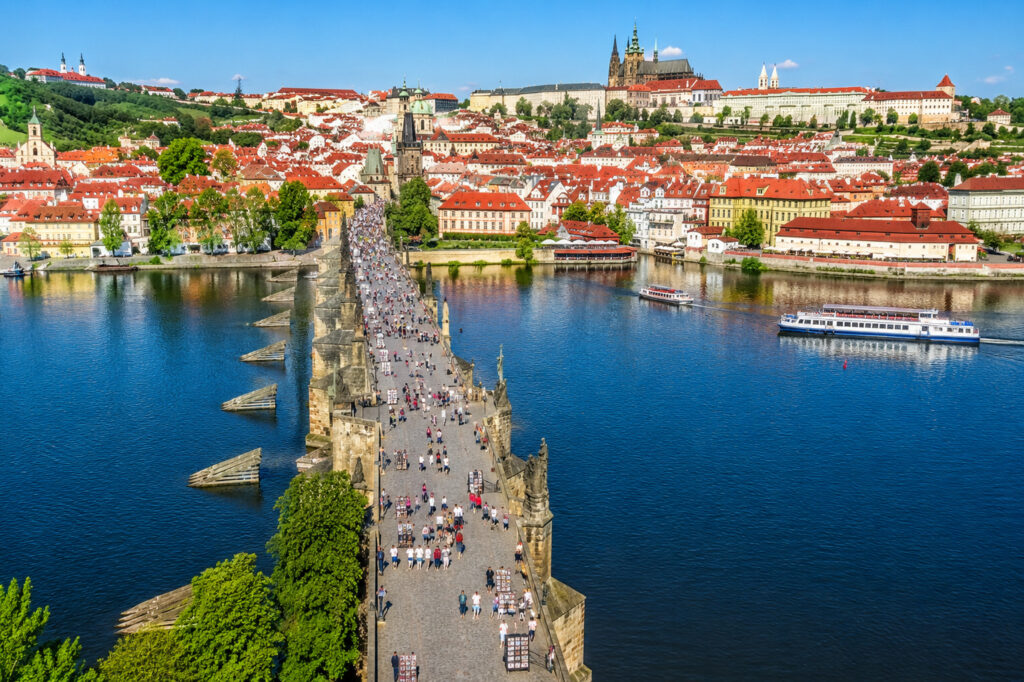
Completed in the early 15th century, Charles Bridge spans the Vltava River and connects the Old Town with the Lesser Town. Lined with 30 Baroque statues, it is one of Prague’s most iconic landmarks and a favorite spot for visitors.
C. Old Town Square
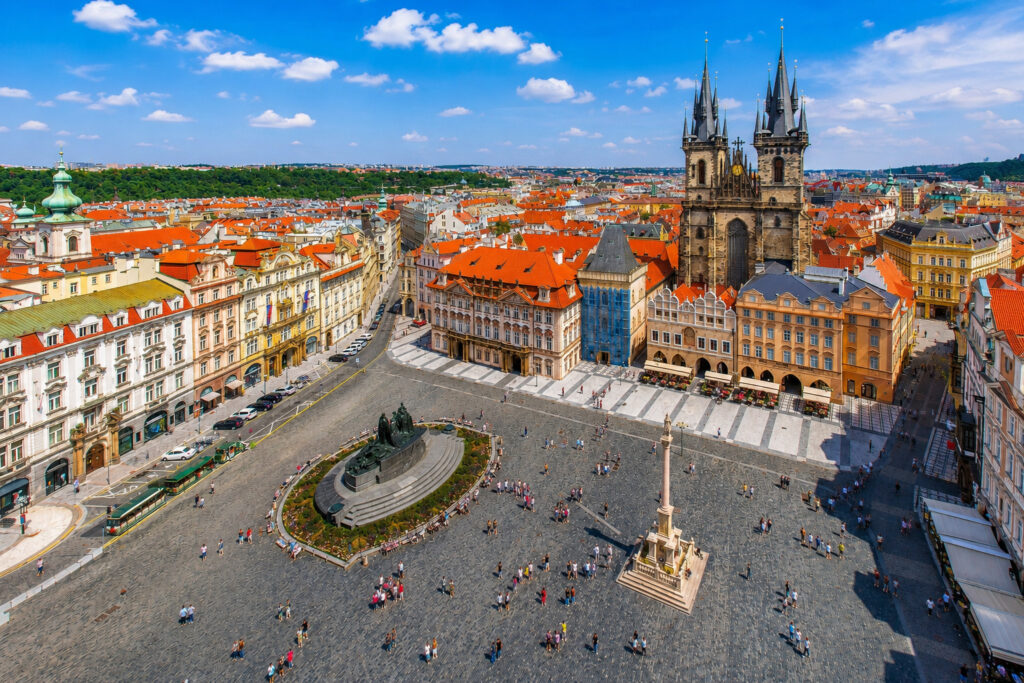
The historic heart of Prague, Old Town Square has served as the city’s central marketplace and gathering place for centuries. It is surrounded by colorful medieval buildings, historic churches, cafés, and impressive public monuments.
D. Prague Astronomical Clock
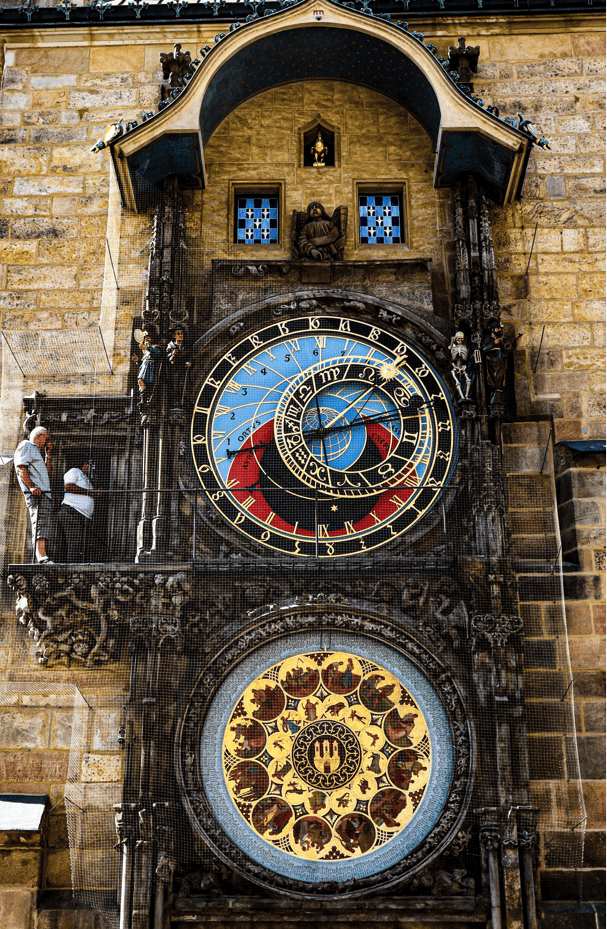
Installed in 1410, the Prague Astronomical Clock is one of the oldest astronomical clocks still operating in the world. Every hour, crowds gather to watch its famous procession of moving apostles and mechanical figures.
E. St. Vitus Cathedral
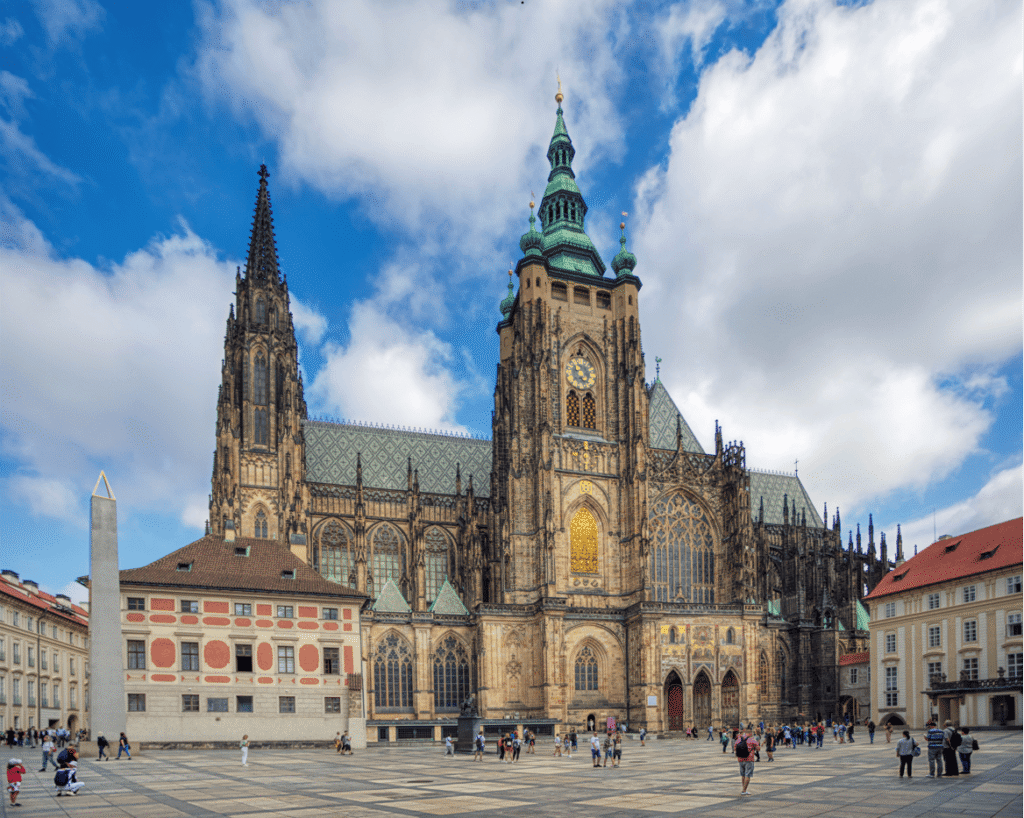
Located within Prague Castle, St. Vitus Cathedral is the largest and most important church in the Czech Republic. This magnificent Gothic masterpiece houses the tombs of Bohemian kings as well as the Czech Crown Jewels.
Architecture
The Historic Centre of Prague showcases an extraordinary collection of European architectural styles. Visitors can admire Romanesque churches, Gothic cathedrals, Renaissance palaces, Baroque churches, Rococo residences, Art Nouveau buildings, medieval towers, and charming cobblestone streets. This remarkable architectural diversity gives Prague its distinctive skyline and timeless character.
Culture and Heritage
For centuries, Prague has been a major center of literature, music, science, education, art, and politics. The city has inspired and been home to renowned figures such as Franz Kafka and Antonín Dvořák, while Wolfgang Amadeus Mozart enjoyed great success in Prague, where his opera Don Giovanni premiered in 1787. Today, Prague continues to be one of Europe’s leading cultural destinations, attracting millions of visitors with its rich history, vibrant arts scene, and beautifully preserved heritage.
18. Alhambra
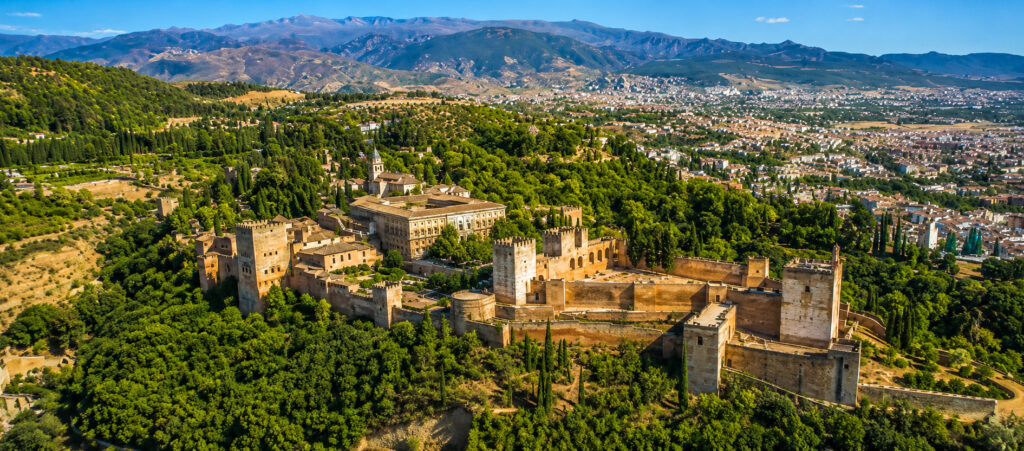
Alhambra, Generalife and Albayzín, Granada is one of the world’s greatest masterpieces of Islamic architecture and one of Spain’s most treasured cultural landmarks. Perched on a hill overlooking the city of Granada in southern Spain, the Alhambra served as the magnificent palace-fortress of the Nasrid dynasty, the last Muslim rulers of the Iberian Peninsula. Renowned for its elegant palaces, intricate geometric designs, peaceful courtyards, and lush gardens, the Alhambra is widely regarded as one of the finest surviving examples of medieval Islamic art and architecture.
What is the Alhambra?
Alhambra, Generalife and Albayzín, Granada is a UNESCO World Heritage Site that consists of three main parts: the Alhambra Palace-Fortress, the Generalife, and the historic Albayzín neighborhood.
The Alhambra itself is a vast complex of royal palaces, defensive towers, fortified walls, courtyards, gardens, bathhouses, administrative buildings, and the remains of historic mosques. Its name comes from the Arabic phrase “Al-Qal’a al-Hamra,” meaning “The Red Fortress,” a reference to the reddish color of its walls.
Why is the Alhambra Famous?
The Alhambra is famous as one of the world’s finest examples of Islamic architecture. It was the royal residence of the Nasrid dynasty and is celebrated for its intricate geometric patterns, elegant Arabic calligraphy, decorative tilework, tranquil courtyards, and beautiful fountains. The nearby Generalife Gardens further enhance the site’s beauty, making the Alhambra one of Spain’s most visited UNESCO World Heritage Sites and a lasting symbol of the artistic achievements of Muslim Spain.
History of the Alhambra
Early Origins:
A small fortress stood on the hill as early as the 9th century, but the Alhambra evolved into a magnificent royal complex during the 13th century.
Nasrid Dynasty:
Construction began around 1238 under Muhammad I ibn al-Ahmar, founder of the Nasrid Kingdom of Granada. Over the next two centuries, successive Nasrid rulers expanded the complex by building magnificent palaces, gardens, courtyards, and public buildings.
Christian Rule:
In 1492, Granada was conquered by Queen Isabella I of Castile and King Ferdinand II of Aragon, marking the end of Muslim rule in Spain. The Alhambra became a royal residence for the Catholic Monarchs, and later Emperor Charles V commissioned the construction of a Renaissance palace within the complex.
Preservation:
Although parts of the Alhambra suffered damage over the centuries due to neglect, earthquakes, and conflict, extensive restoration and conservation efforts have helped preserve its remarkable architecture and artistic treasures for future generations.
UNESCO World Heritage Site
Alhambra, Generalife and Albayzín, Granada was inscribed as a UNESCO World Heritage Site in 1984. The historic Albayzín district was added to the designation in 1994, recognizing the area’s exceptional cultural, historical, and architectural significance.
Major Landmarks
A. Nasrid Palaces
The heart of the Alhambra, the Nasrid Palaces are admired for their elegant courtyards, beautifully carved stucco walls, colorful tilework, intricately decorated wooden ceilings, and graceful Arabic inscriptions.
B. Court of the Lions
One of the Alhambra’s most iconic spaces, the Court of the Lions features a magnificent marble fountain supported by 12 sculpted stone lions. The courtyard is surrounded by elegant arcades and richly decorated halls, making it one of the finest examples of Islamic palace design.
C. Generalife
Generalife served as the summer palace and retreat of the Nasrid rulers. It is famous for its peaceful gardens, fountains, reflecting pools, flower-filled courtyards, and shaded walkways that create a tranquil atmosphere.
D. Palace of Charles V
Built during the 16th century, the Palace of Charles V is a striking Renaissance building known for its impressive circular courtyard. Its classical design provides a fascinating contrast to the surrounding Islamic architecture.
E. Alcazaba
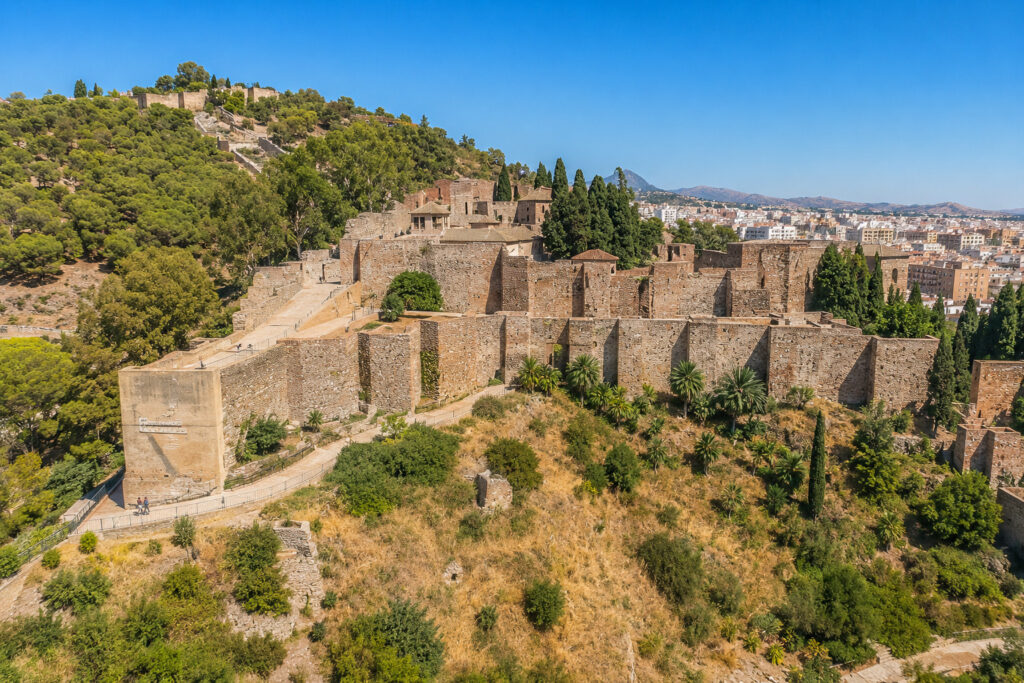
Alcazaba is the oldest section of the Alhambra and originally served as its military fortress. Its defensive towers offer spectacular panoramic views over the city of Granada and the surrounding countryside.
Architecture
The Alhambra is widely regarded as one of the greatest achievements of Islamic architecture. Its buildings feature elegant horseshoe arches, intricate muqarnas (stalactite vaulting), colorful geometric tile mosaics, beautifully carved stucco, Arabic calligraphy, finely crafted cedar wood ceilings, reflecting pools, and decorative fountains. Throughout the complex, water, light, gardens, and architecture are carefully integrated to create a remarkable sense of harmony and balance.
Culture and Heritage
The Alhambra reflects centuries of cultural exchange between Islamic and Christian civilizations. Over the centuries, it served as a royal palace, military fortress, administrative center, and cultural hub. Its artistic and architectural innovations have influenced generations of architects and designers, making it one of the most significant cultural monuments in both Spain and the wider world.
19. Kyoto Historic Monuments
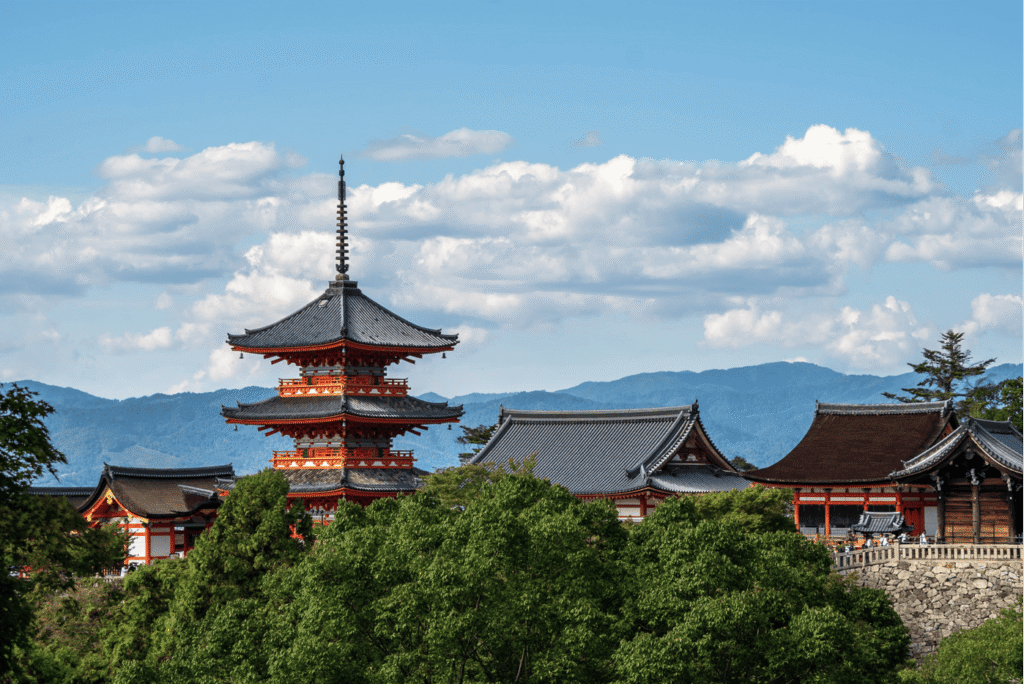
Historic Monuments of Ancient Kyoto (Kyoto, Uji and Ōtsu Cities) preserve the cultural heart of Japan and showcase more than a thousand years of the country’s history, religion, architecture, and art. Located across the cities of Kyoto, Uji, and Ōtsu, this UNESCO World Heritage Site includes magnificent Buddhist temples, Shinto shrines, castles, and traditional gardens that flourished while Kyoto served as Japan’s imperial capital for over a millennium. Together, these monuments represent the evolution of Japanese architecture, landscape design, and spiritual culture.
What are the Historic Monuments of Ancient Kyoto?
Historic Monuments of Ancient Kyoto (Kyoto, Uji and Ōtsu Cities) is a UNESCO World Heritage Site comprising 17 historic monuments, including 13 Buddhist temples, 3 Shinto shrines, and 1 castle. Spread across Kyoto, Uji, and Ōtsu, these monuments preserve some of the finest examples of Japan’s classical architecture, landscape gardening, and religious heritage.
Why is Ancient Kyoto Famous?
Ancient Kyoto is famous for serving as Japan’s imperial capital for more than 1,000 years. The city is home to many of the country’s most important temples and shrines, including the iconic Kinkaku-ji (Golden Pavilion). Its beautifully preserved wooden architecture, traditional gardens, and centuries-old religious sites make Kyoto the spiritual center of Japanese Buddhism and Shinto. Today, it remains one of Japan’s most visited UNESCO World Heritage destinations.
History of Ancient Kyoto
Founding of Kyoto:
In 794 AD, Emperor Kanmu moved Japan’s capital to Heian-kyō, the city now known as Kyoto. From that point onward, Kyoto became the nation’s political, cultural, and religious center for more than a thousand years.
Cultural Golden Age:
During the Heian Period (794–1185), Kyoto flourished as a center of literature, art, religion, architecture, garden design, and traditional crafts. Many of Japan’s greatest cultural achievements, including classical literature, tea culture, and refined artistic traditions, developed during this era.
Survival Through History:
Unlike many Japanese cities, Kyoto escaped widespread destruction during World War II, allowing many of its historic temples, shrines, and gardens to survive largely intact. Today, it remains one of Asia’s best-preserved historic cities.
UNESCO World Heritage Site
Historic Monuments of Ancient Kyoto (Kyoto, Uji and Ōtsu Cities) were inscribed as a UNESCO World Heritage Site in 1994 in recognition of their outstanding cultural significance and exceptional collection of historic monuments.
Major Monuments
A. Kinkaku-ji (Golden Pavilion)
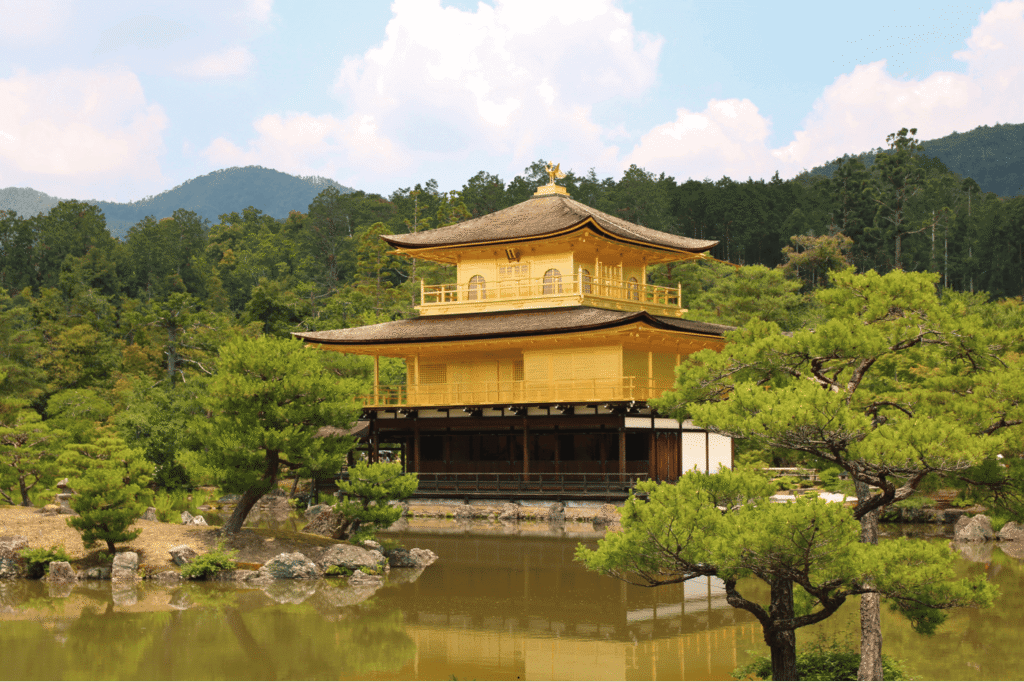
One of Japan’s most iconic landmarks, Kinkaku-ji is covered in brilliant gold leaf and beautifully reflected in the surrounding pond. Originally built in 1397 as the retirement villa of Ashikaga Yoshimitsu, it was later converted into a Zen Buddhist temple.
B. Kiyomizu-dera
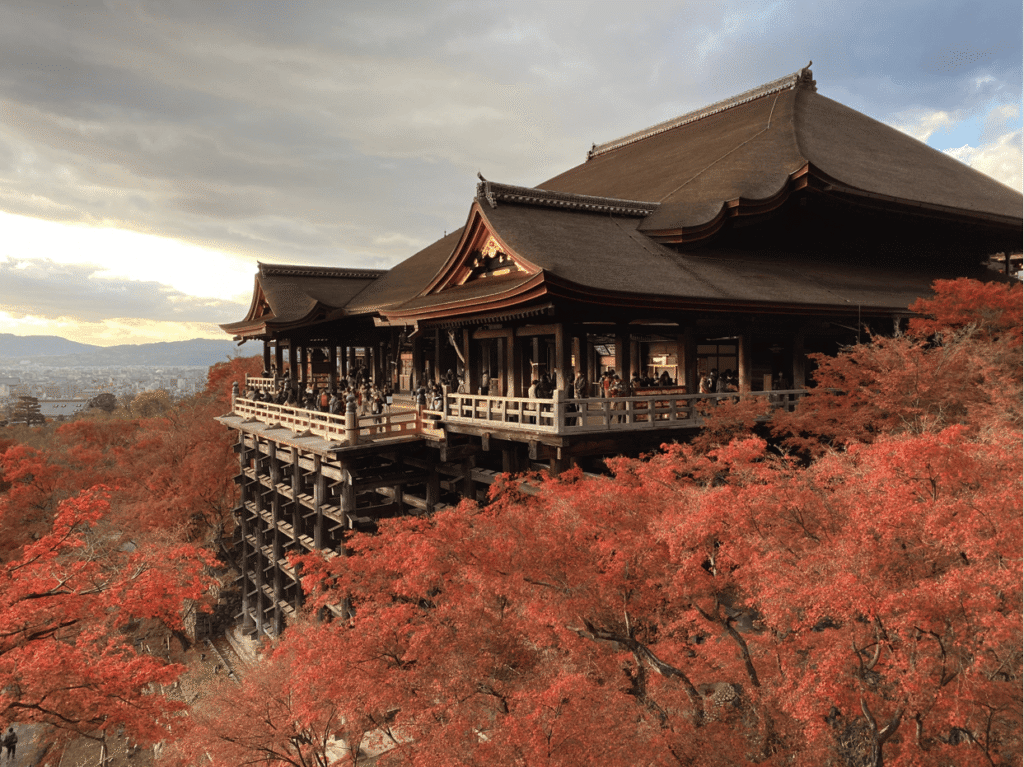
Founded in 778 AD, Kiyomizu-dera is famous for its enormous wooden stage that extends over a hillside, offering breathtaking views of Kyoto. Remarkably, the main structure was built without using nails in its traditional wooden framework.
C. Byōdō-in
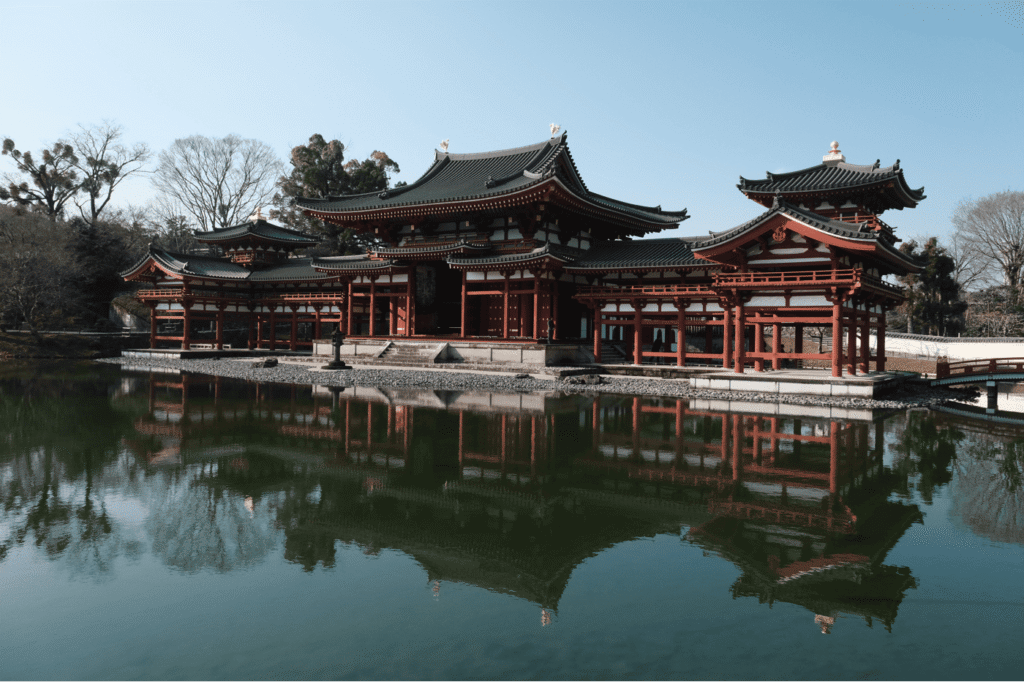
Located in Uji, Byōdō-in is home to the famous Phoenix Hall, one of Japan’s finest examples of Pure Land Buddhist architecture. Its image is featured on Japan’s 10-yen coin.
D. Ryōan-ji
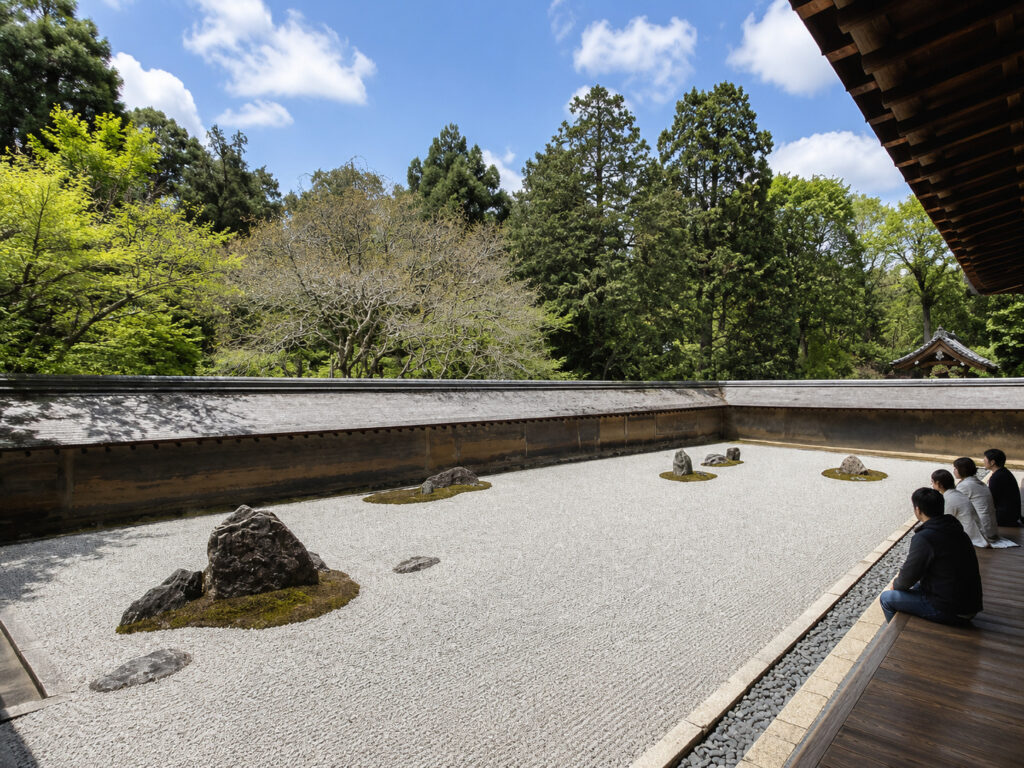
Ryōan-ji is internationally renowned for its minimalist Zen rock garden, where carefully arranged stones rest on a bed of white gravel designed to inspire meditation and quiet reflection.
E. Nijō Castle
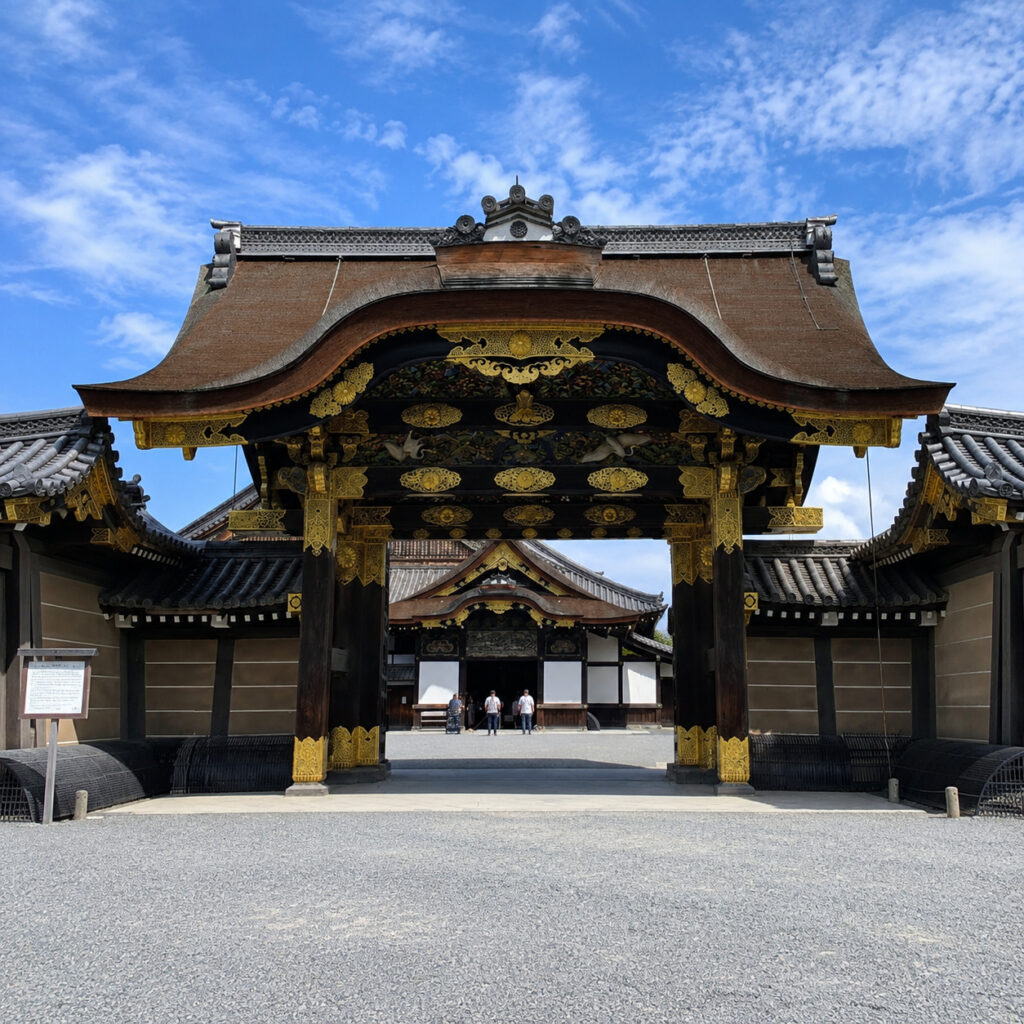
Built in the early 17th century as the Kyoto residence of the Tokugawa shoguns, Nijō Castle is known for its richly decorated interiors and its famous “nightingale floors,” which chirp when walked upon to warn of approaching visitors.
Other UNESCO Monuments
The remaining UNESCO monuments include Ginkaku-ji (Silver Pavilion), Shimogamo Shrine, Kamigamo Shrine, Daigo-ji, Ninna-ji, Tenryū-ji, Kōzan-ji, Saihō-ji (Moss Temple), Tō-ji, Nishi Hongan-ji, and Enryaku-ji. Together, they represent centuries of religious devotion, artistic achievement, and architectural excellence.
Architecture and Gardens
The monuments of Ancient Kyoto showcase the finest traditions of Japanese architecture and landscape design. Visitors can admire elegant wooden temples, curved tiled roofs, sliding paper screens, graceful pagodas, Zen rock gardens, landscaped gardens, ornamental ponds, and traditional tea houses. Throughout the complex, architecture blends harmoniously with the surrounding natural environment, reflecting the core principles of Japanese aesthetics.
Religion and Culture
For centuries, Ancient Kyoto has been the spiritual heart of Japan. Its monuments reflect the country’s rich religious traditions, including Zen, Pure Land, Tendai, and Shingon Buddhism, alongside Shinto, Japan’s indigenous faith. Many of these sacred sites continue to host religious ceremonies, seasonal festivals, and pilgrimages, preserving traditions that have been passed down for generations.
20. Historic Centre of Florence
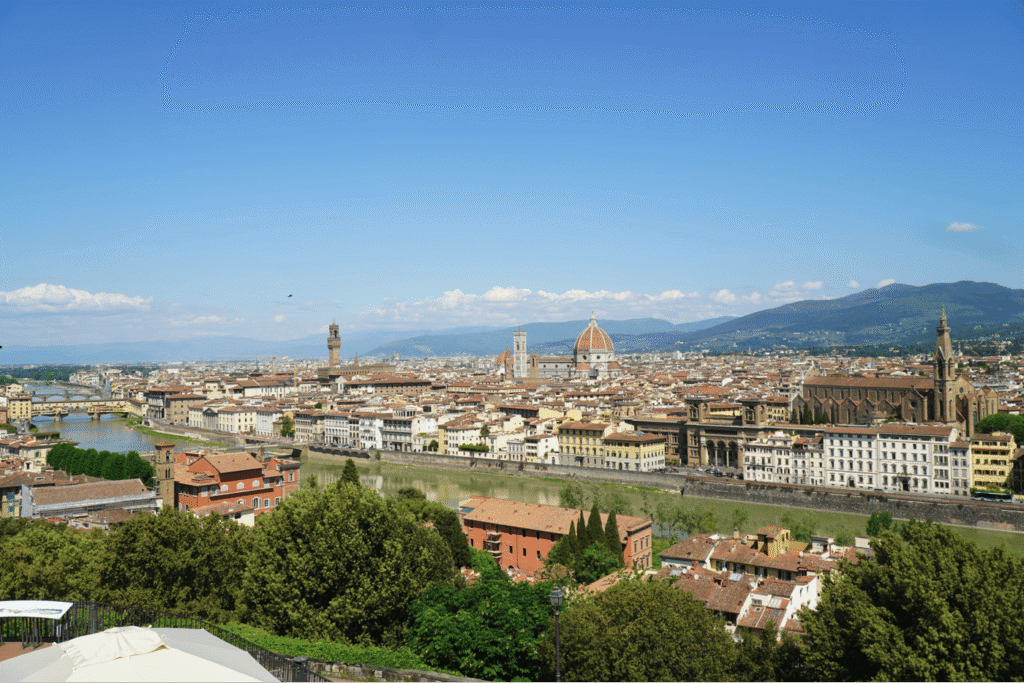
Historic Centre of Florence is one of the world’s greatest artistic and cultural treasures and is widely regarded as the birthplace of the Italian Renaissance. Located along the Arno River in central Italy, Florence flourished between the 14th and 16th centuries as a leading center of art, architecture, science, literature, and finance. Home to magnificent cathedrals, palaces, museums, and public squares, the city nurtured some of history’s greatest artists and thinkers, including Leonardo da Vinci, Michelangelo, Sandro Botticelli, and Galileo Galilei.
What is the Historic Centre of Florence?
Historic Centre of Florence encompasses the city’s medieval and Renaissance heart, preserving one of the world’s richest collections of architectural and artistic masterpieces. The historic center includes magnificent cathedrals, churches, palaces, museums, public squares, bridges, medieval streets, and beautifully preserved Renaissance buildings.
Covering approximately 1,248 acres (505 hectares), Florence is considered one of the finest examples of Renaissance urban planning and architecture, reflecting centuries of artistic innovation and cultural achievement.
Why is Florence Famous?
Florence is famous as the birthplace of the Renaissance, a movement that transformed European art, architecture, literature, and science. The city is home to iconic landmarks such as the Florence Cathedral (Duomo) and world-renowned museums filled with masterpieces by Michelangelo, Leonardo da Vinci, Botticelli, and many other legendary artists.
Florence also flourished under the patronage of the influential Medici family, whose support helped shape the city’s remarkable artistic and intellectual legacy. Today, it remains one of Italy’s most visited UNESCO World Heritage Sites.
History of Florence
Roman Origins:
Florence was founded by the Romans in 59 BC as the colony of Florentia. Its strategic location along important trade routes allowed it to grow into a prosperous commercial center.
Rise During the Middle Ages:
By the 12th and 13th centuries, Florence had become one of Europe’s wealthiest cities thanks to its thriving banking industry, textile production, and international trade. This prosperity financed ambitious building projects and supported the city’s growing artistic community.
Renaissance Golden Age:
During the 15th and 16th centuries, Florence became the center of the Renaissance under the patronage of the powerful House of Medici. Artists, architects, scientists, philosophers, and scholars transformed the city into one of the most influential cultural capitals in history.
Modern Preservation:
Despite centuries of political change, Florence has preserved much of its medieval street layout and Renaissance architecture. As a result, it remains one of Europe’s best-preserved historic cities and a living showcase of Renaissance urban design.
UNESCO World Heritage Site
The Historic Centre of Florence was designated a UNESCO World Heritage Site in 1982 in recognition of its outstanding contribution to art, architecture, and urban development during the Renaissance.
Major Landmarks
A. Florence Cathedral (Duomo)
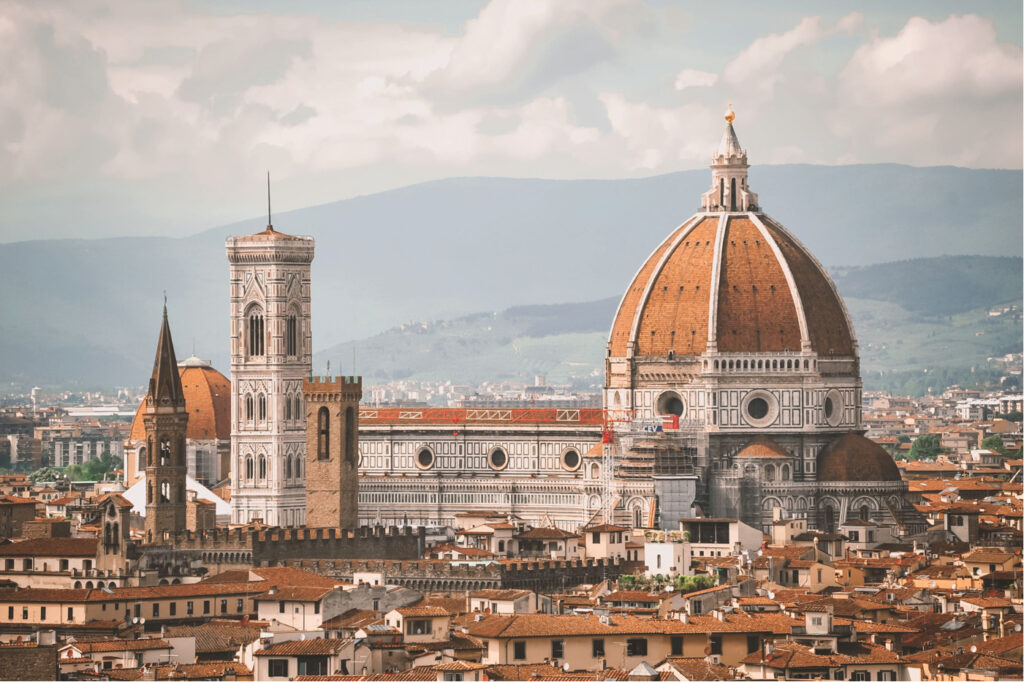
Officially known as the Cathedral of Santa Maria del Fiore, the Florence Cathedral is famous for its enormous brick dome designed by Filippo Brunelleschi. Completed during the 15th century, the dome was a groundbreaking engineering achievement that became a defining symbol of Renaissance architecture.
B. Ponte Vecchio
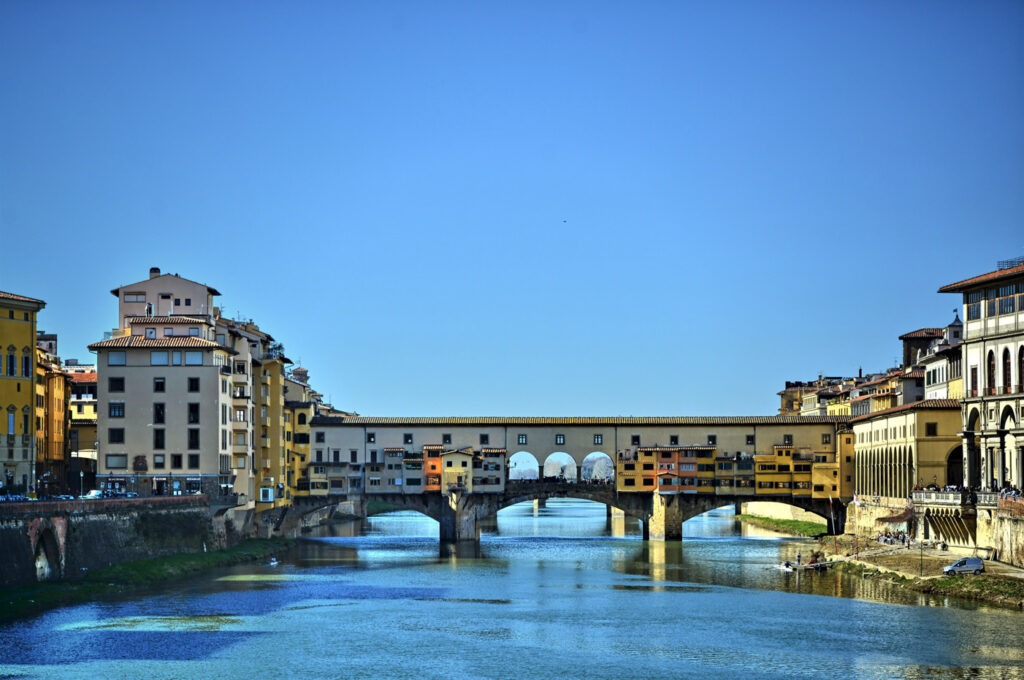
Ponte Vecchio is one of the world’s most famous medieval bridges. Built in 1345, it spans the Arno River and is lined with historic jewelry shops. It is also the only bridge in Florence to have survived World War II intact.
C. Piazza della Signoria
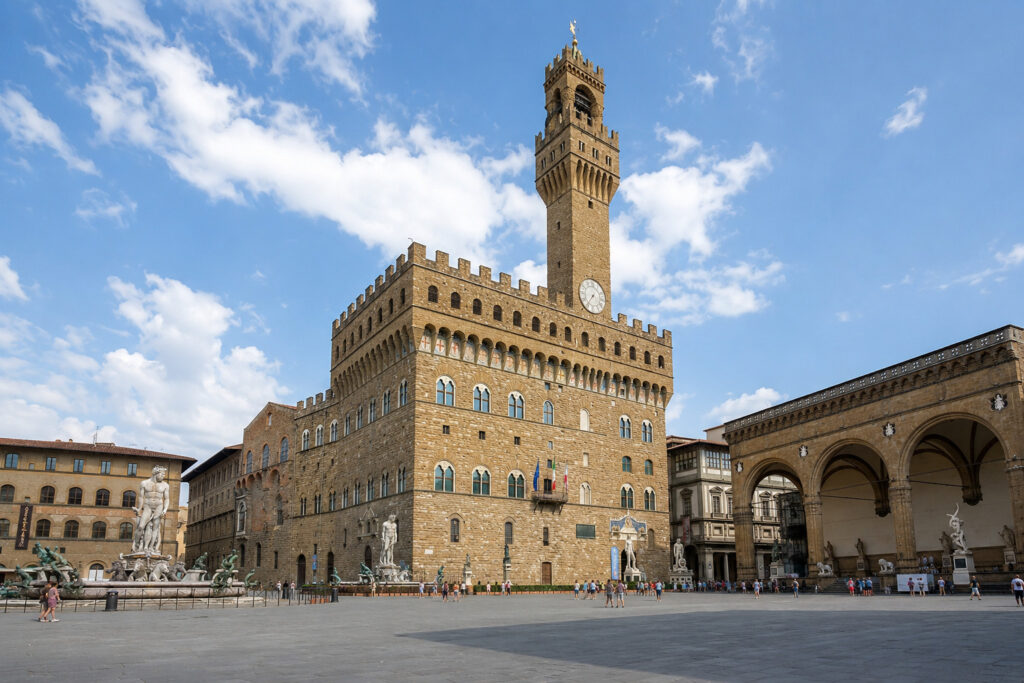
For centuries, Piazza della Signoria has served as Florence’s political and civic center. The square is surrounded by historic buildings and impressive sculptures that reflect the city’s rich artistic heritage.
D. Palazzo Vecchio
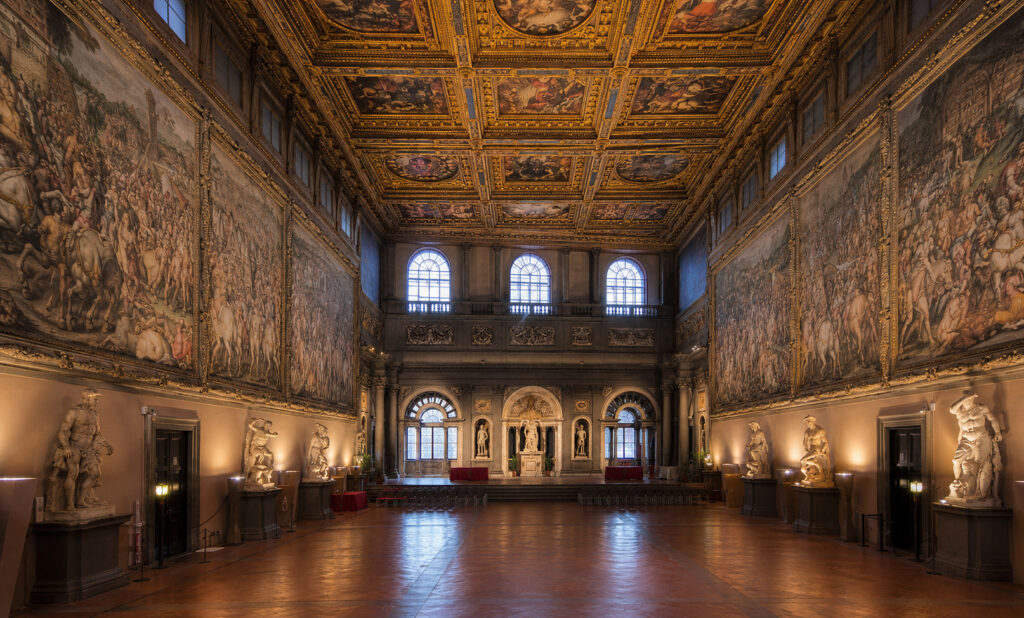
Built in the late 13th century, Palazzo Vecchio served as the seat of Florence’s government and remains one of the city’s most recognizable landmarks, with its imposing tower overlooking Piazza della Signoria.
E. Uffizi Gallery
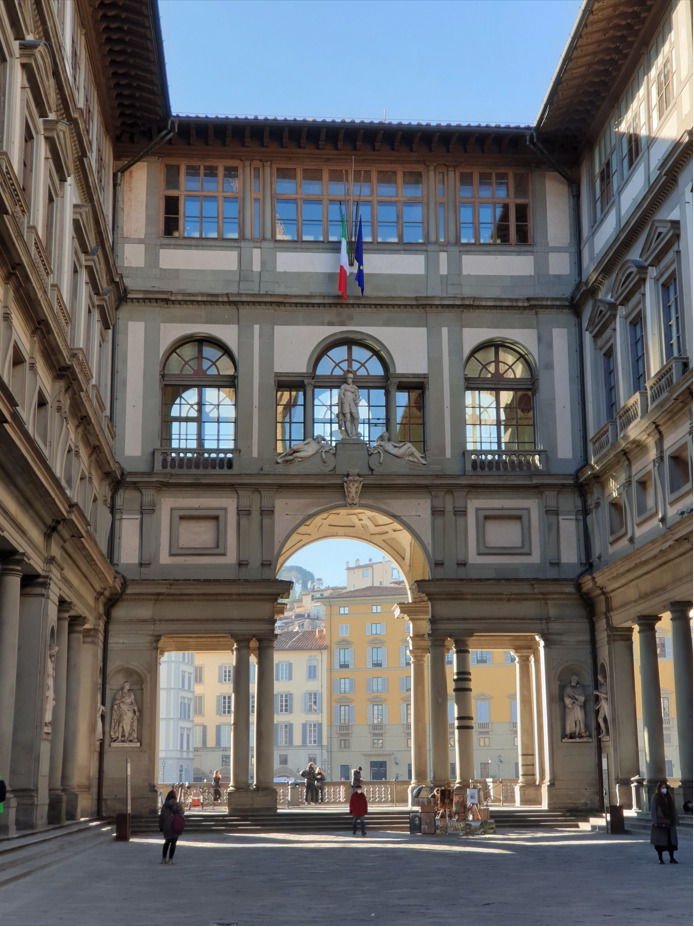
Uffizi Gallery is one of the world’s most celebrated art museums, housing masterpieces by Botticelli, Leonardo da Vinci, Michelangelo, Raphael, Titian, and Caravaggio.
F. Basilica of Santa Croce
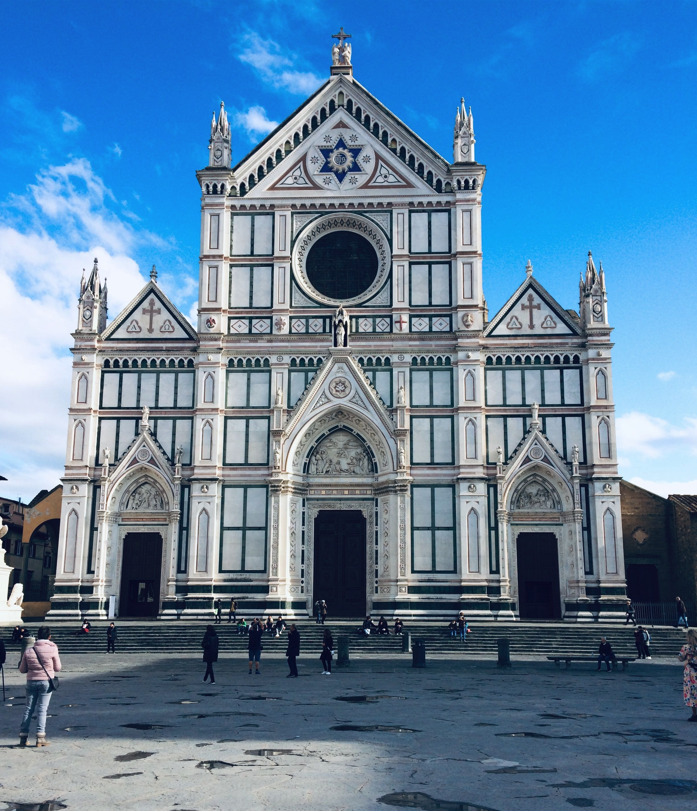
Often called the Temple of the Italian Glories, the Basilica of Santa Croce contains the tombs of many of Italy’s greatest historical figures, including Michelangelo, Galileo Galilei, and Niccolò Machiavelli.
Architecture
Historic Centre of Florence showcases an extraordinary blend of Romanesque, Gothic, Renaissance, and Early Baroque architecture. Visitors can admire elegant marble façades, magnificent domes, soaring bell towers, grand palaces, stone bridges, spacious public squares, decorative frescoes, and harmonious classical proportions. Florence’s architectural innovations profoundly influenced cities throughout Europe and helped shape the Renaissance style.
Art and Culture
Florence is widely recognized as the birthplace of the Renaissance, a cultural movement that transformed painting, sculpture, architecture, literature, science, and philosophy across Europe. The city inspired generations of artists and intellectuals, and many of the world’s greatest masterpieces were created here. Today, Florence continues to attract millions of visitors who come to experience its extraordinary museums, historic landmarks, and enduring artistic legacy.
21. Taj Mahal
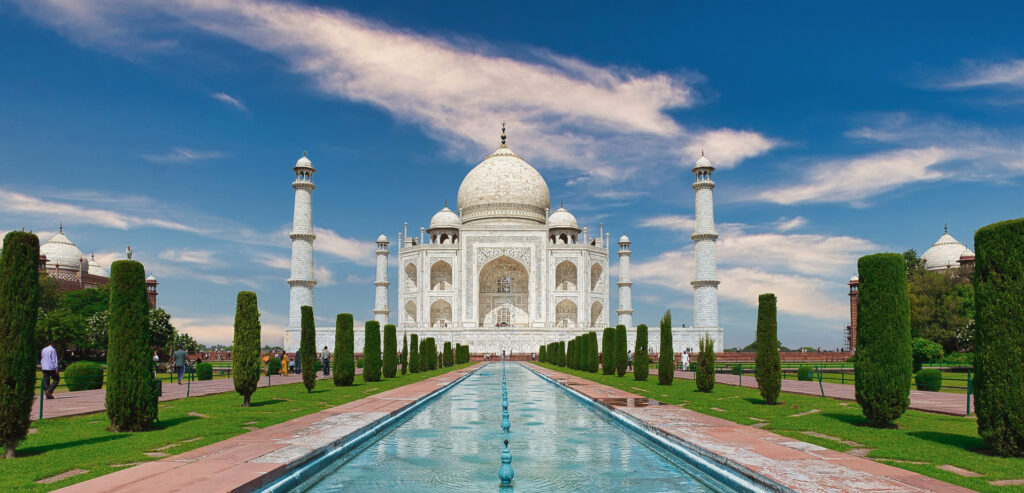
Taj Mahal is one of the world’s most celebrated architectural masterpieces and the finest example of Mughal architecture. Located on the banks of the Yamuna River in Agra, India, it was commissioned by the Mughal emperor Shah Jahan as a mausoleum for his beloved wife, Mumtaz Mahal. Renowned for its gleaming white marble, perfect symmetry, intricate carvings, and magnificent gardens, the Taj Mahal is widely regarded as one of the greatest monuments ever built and a timeless symbol of love.
What is the Taj Mahal?
Taj Mahal is a monumental mausoleum complex built during the Mughal Empire. The complex includes the iconic white marble mausoleum, a grand entrance gateway, a traditional Charbagh (Mughal garden), reflecting pools, a mosque, a guest house, decorative walls, and riverfront terraces overlooking the Yamuna River.
At the center of the complex stands the mausoleum, which contains the beautifully decorated cenotaphs of Mumtaz Mahal and Shah Jahan. Their actual graves are located in a lower crypt beneath the main chamber.
Why is the Taj Mahal Famous?
Taj Mahal is famous as one of the world’s finest examples of Mughal architecture and is admired for its remarkable symmetry, elegant design, and exceptional craftsmanship. Built by Emperor Shah Jahan in memory of Mumtaz Mahal, it is constructed primarily from brilliant white Makrana marble and decorated with intricate carvings, precious stone inlay, and Quranic calligraphy.
Recognized as one of the New Seven Wonders of the World, the Taj Mahal is also among the most visited UNESCO World Heritage Sites and one of India’s most iconic landmarks.
History of the Taj Mahal
The Love Story:
In 1631, Mumtaz Mahal died while giving birth to the couple’s 14th child. Heartbroken by her death, Emperor Shah Jahan commissioned a magnificent mausoleum to honor her memory, creating what would become one of the world’s greatest monuments.
Construction:
Construction began in 1632 and was substantially completed by 1648, while the surrounding buildings and decorative work continued for several more years. The project employed thousands of artisans, architects, craftsmen, and laborers from across the Mughal Empire and beyond.
Mughal Legacy:
Taj Mahal became the crowning achievement of Mughal architecture, blending Persian, Indian, and Islamic artistic traditions into a harmonious masterpiece. After Shah Jahan’s death in 1666, he was buried beside Mumtaz Mahal within the mausoleum.
UNESCO World Heritage Site
Taj Mahal was designated a UNESCO World Heritage Site in 1983 in recognition of its outstanding universal value as a masterpiece of human creative genius.
Architecture
Taj Mahal is celebrated for its perfect balance, elegant proportions, and harmonious design. The complex features a massive white marble dome, four graceful minarets, symmetrical gardens, decorative arches, intricately carved marble screens (jali), floral carvings, precious stone inlay (pietra dura), and beautifully crafted Quranic calligraphy in black marble.
Every element is carefully arranged along a central axis, creating the remarkable symmetry that has made the Taj Mahal famous around the world.
The Mausoleum
White marble mausoleum is the centerpiece of the entire complex. Standing approximately 240 feet (73 meters) tall, including its finial, it is constructed primarily from white Makrana marble quarried in Rajasthan.
The structure is crowned by a magnificent onion-shaped dome and surrounded by four slender minarets, each designed with a slight outward lean to help protect the main mausoleum in the unlikely event of an earthquake. Inside, visitors can admire the beautifully decorated cenotaphs of Mumtaz Mahal and Shah Jahan, enclosed by an exquisitely carved marble screen.
Gardens and Surroundings
Charbagh garden symbolizes the Islamic vision of paradise. Tree-lined pathways, reflecting pools, flowing water channels, flower beds, and elegant fountains create a peaceful setting that complements the monument’s beauty.
The long reflecting pool leading toward the mausoleum provides one of the world’s most recognizable and photographed views.
Art and Decoration
Taj Mahal is renowned for its extraordinary craftsmanship and artistic detail. Its walls are decorated with intricate pietra dura inlay using semi-precious stones such as jade, jasper, turquoise, and lapis lazuli. Delicate marble carvings, geometric patterns, floral motifs, elegant Arabic calligraphy, and finely crafted lattice screens further enhance its beauty.
These decorative elements combine influences from Persian, Central Asian, and Indian artistic traditions, making the Taj Mahal one of the finest achievements in the history of architecture and decorative art.
22. Petra
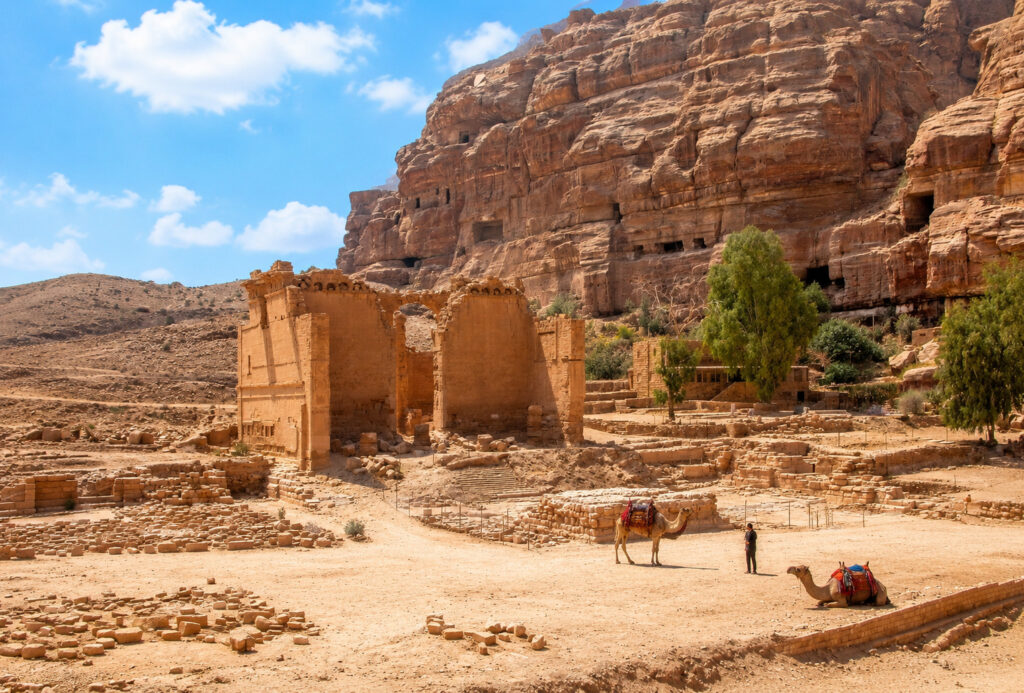
Petra is one of the world’s most extraordinary archaeological cities and the greatest surviving legacy of the ancient Nabataean civilization. Hidden among the rose-red sandstone cliffs of southern Jordan, Petra flourished as a wealthy trading center more than 2,000 years ago. Renowned for its monumental rock-cut architecture, sophisticated water management system, and breathtaking desert landscape, Petra is often called the “Rose City” because of the distinctive pink-red color of its sandstone cliffs. Today, it is regarded as one of the world’s greatest archaeological treasures and a proud symbol of Jordan’s rich cultural heritage.
What is Petra?
Petra is an ancient city carved directly into towering sandstone cliffs. The archaeological site includes monumental rock-cut tombs, temples, royal burial chambers, a theater, colonnaded streets, monasteries, ancient stairways, residential areas, and an impressive network of water channels and reservoirs.
Covering approximately 102 square miles (264 square kilometers), Petra is one of the largest and most important archaeological sites in the Middle East.
Why is Petra Famous?
Petra is famous for being an entire ancient city carved into rock. It served as the capital of the Nabataean Kingdom and is home to the iconic Treasury (Al-Khazneh), one of the world’s most recognizable archaeological monuments.
The city also showcases remarkable engineering, particularly its advanced water management system, which allowed a thriving civilization to flourish in the desert. Recognized as one of the New Seven Wonders of the World, Petra remains one of the Middle East’s most visited and celebrated historical sites.
History of Petra
Early Settlement:
Petra region had been inhabited for thousands of years before it became the capital of the Nabataean Kingdom around the 4th century BC. The Nabataeans were skilled Arab traders who controlled important caravan routes connecting Arabia, Egypt, Syria, and the Mediterranean.
Golden Age:
Between the 1st century BC and the 1st century AD, Petra grew into one of the wealthiest cities in the ancient world. Its prosperity came from the trade of valuable goods such as frankincense, myrrh, spices, silk, precious stones, and textiles. The city’s wealth financed the construction of magnificent temples, tombs, and public buildings.
Roman Period:
In 106 AD, the Roman Empire annexed the Nabataean Kingdom. Petra continued to prosper under Roman rule, with new roads, public buildings, and a larger theater further enhancing the city.
Decline:
Over time, changing trade routes and a series of earthquakes gradually reduced Petra’s importance. By the Middle Ages, much of the city had been abandoned and was largely forgotten by the outside world.
Rediscovery:
In 1812, Swiss explorer Johann Ludwig Burckhardt brought Petra back to international attention after reaching the hidden city while traveling through the region in disguise.
UNESCO World Heritage Site
Petra was designated a UNESCO World Heritage Site in 1985 for its outstanding archaeological, historical, and architectural significance.
Major Landmarks
A. Al-Khazneh (The Treasury)
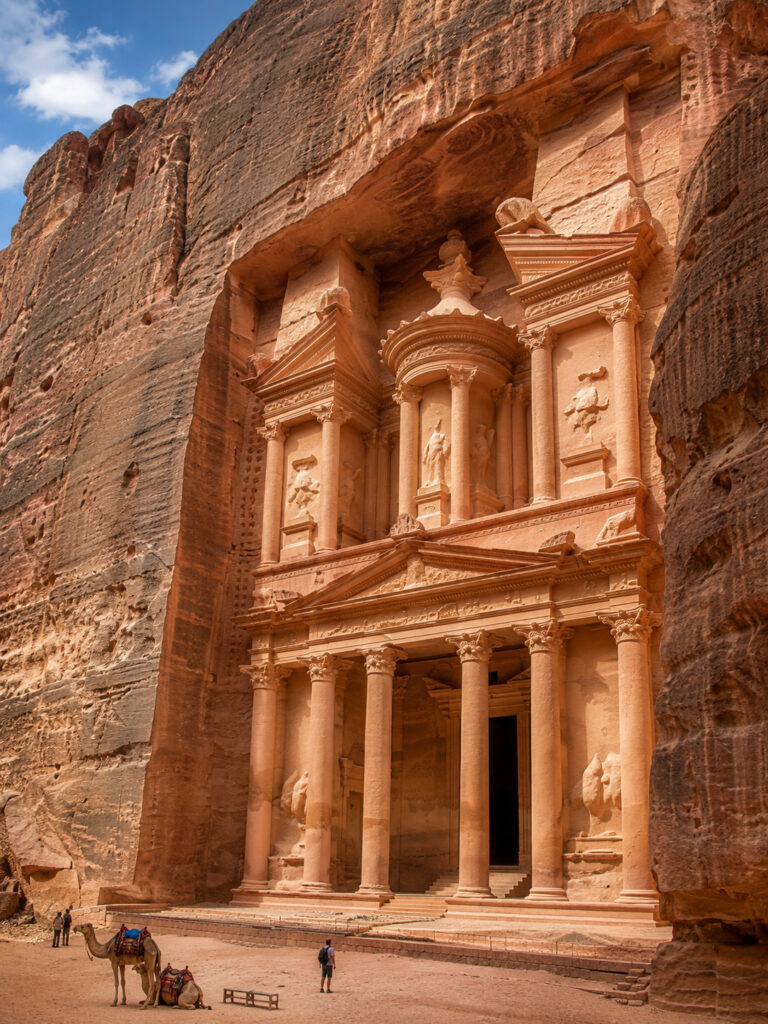
Treasury is Petra’s most famous monument. Carved directly into a sandstone cliff during the 1st century AD, it stands approximately 128 feet (39 meters) tall. Despite its name, archaeologists believe it most likely served as a royal tomb rather than a treasury.
B. The Siq
Siq is a narrow canyon stretching about 0.75 miles (1.2 kilometers) that forms the dramatic entrance to Petra. Towering sandstone cliffs, rising more than 260 feet (80 meters) high, create an unforgettable approach to the ancient city.
C. Ad Deir (The Monastery)
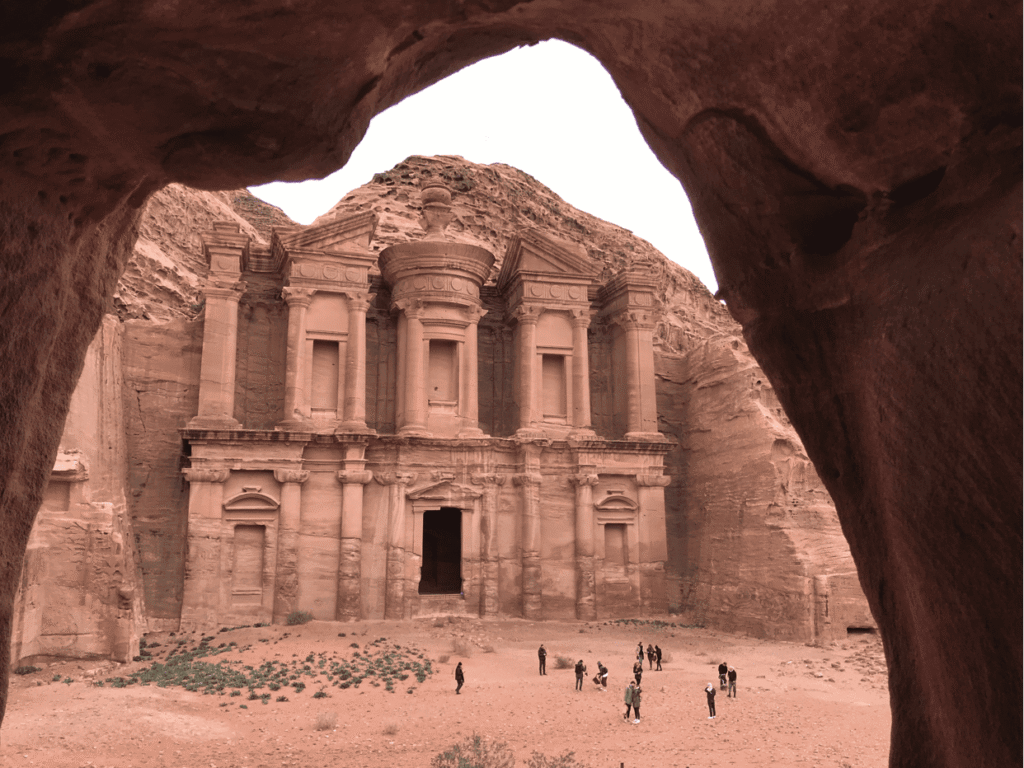
Monastery is one of Petra’s largest and most impressive monuments. Visitors reach it by climbing approximately 800 stone steps, where they are rewarded with spectacular panoramic views of the surrounding landscape.
D. Petra Roman Theatre
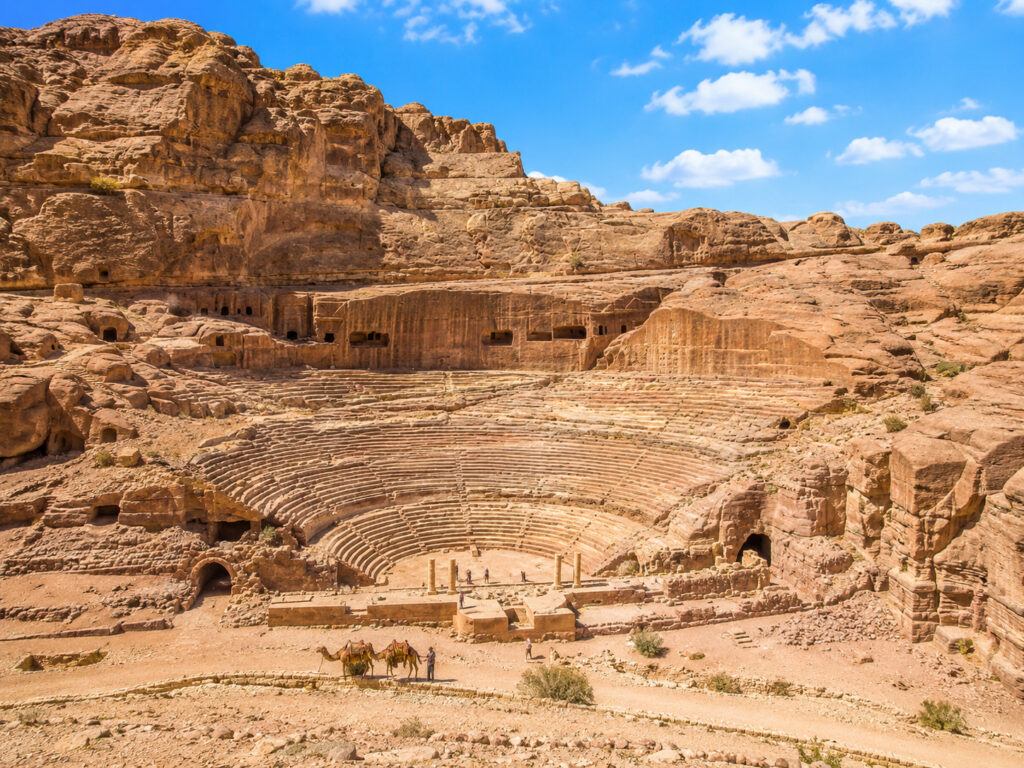
Carved directly into the rock, the Roman Theatre could accommodate around 8,000 spectators, making it one of the city’s largest public gathering places.
E. Royal Tombs
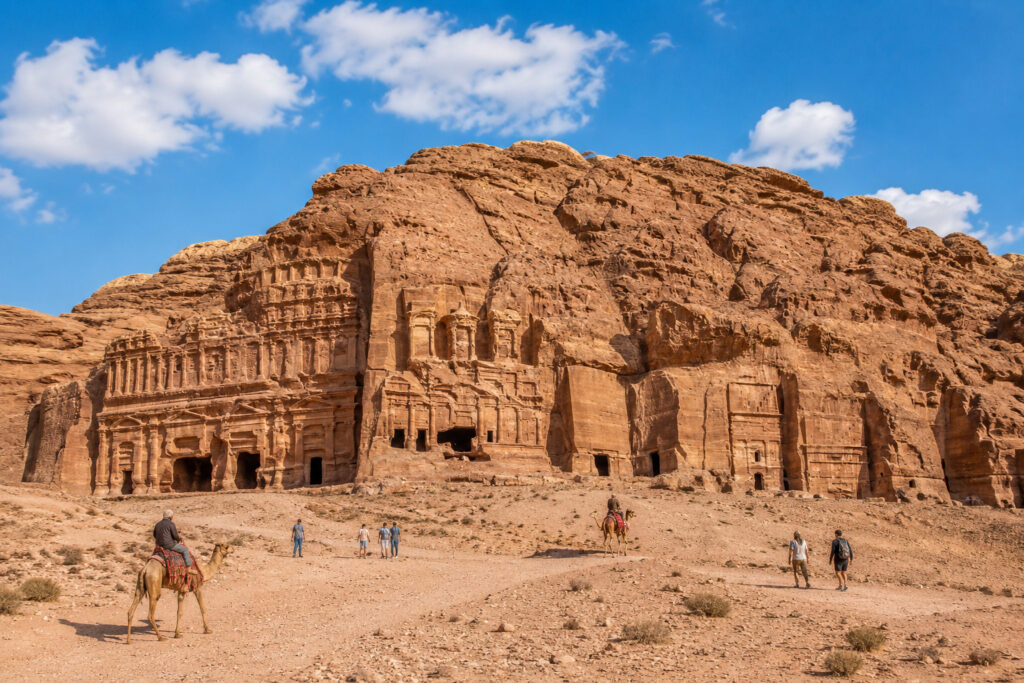
Royal Tombs are a collection of monumental burial chambers that showcase the Nabataeans’ exceptional craftsmanship, decorative artistry, and architectural skill.
Architecture
Petra is renowned for its extraordinary rock-cut architecture, where entire buildings were carved directly into sandstone cliffs. Its monuments combine Nabataean craftsmanship with Greek and Roman architectural influences, creating a distinctive style found nowhere else in the world.
Visitors can admire monumental façades, temples, colonnaded streets, grand stairways, intricately carved tombs, and decorative details that have survived for more than two millennia.
Water Engineering
One of Petra’s greatest achievements was its sophisticated water management system. The Nabataeans built an extensive network of dams, reservoirs, rock-cut channels, aqueducts, and cisterns to collect, store, and distribute water throughout the city.
These engineering innovations enabled Petra to thrive in an arid desert environment and remain one of the ancient world’s most remarkable examples of sustainable urban planning.
23. Great Wall of China

Great Wall of China is one of the world’s greatest engineering achievements and the longest man-made structure ever built. Stretching across the mountains, deserts, grasslands, and valleys of northern China, the Great Wall was constructed over more than 2,000 years by successive Chinese dynasties to defend the empire against invasions and protect important trade routes. Today, it stands as a powerful symbol of China’s history, resilience, and architectural ingenuity, attracting millions of visitors from around the world.
What is the Great Wall of China?
Great Wall is a vast network of defensive walls, watchtowers, fortresses, mountain passes, and beacon towers that were built and rebuilt over many centuries. Rather than being a single continuous wall, it is an interconnected system of fortifications constructed during different historical periods.
The complex includes stone and brick walls, earthen ramparts, military garrisons, defensive trenches, fortified passes, and thousands of watchtowers, all designed to strengthen China’s northern frontier.
Why is the Great Wall Famous?
Great Wall is famous as the longest man-made structure ever built and one of the greatest feats of ancient engineering. Constructed over more than 2,000 years, it protected successive Chinese kingdoms from invasions while helping control trade and movement along the northern frontier.
Stretching across mountains, deserts, forests, and grasslands, the wall demonstrates remarkable engineering adapted to a wide variety of landscapes. It is also recognized as one of the New Seven Wonders of the World and remains China’s most iconic landmark.
History of the Great Wall
Early Walls:
The earliest defensive walls were built during the 7th century BC by several Chinese states. Constructed mainly from rammed earth, these early fortifications were intended to defend regional territories.
Qin Dynasty:
After unifying China in 221 BC, Emperor Qin Shi Huang ordered many of the existing northern walls to be connected and expanded to defend against nomadic tribes. This marked the beginning of the Great Wall as a large-scale defensive system.
Han Dynasty:
During the Han Dynasty (206 BC–220 AD), the wall was extended westward to help protect the valuable Silk Road trade routes and strengthen China’s frontier defenses.
Ming Dynasty:
Most of the Great Wall visible today was built during the Ming Dynasty (1368–1644). Using bricks, stone, and advanced engineering techniques, the Ming rulers reinforced and expanded the wall to guard against invasions from the north.
UNESCO World Heritage Site
The Great Wall was designated a UNESCO World Heritage Site in 1987 in recognition of its outstanding historical, architectural, and cultural significance.
Size and Engineering
Great Wall is one of the most ambitious engineering projects in human history. Including all of its branches, the documented length is approximately 13,171 miles (21,196 kilometers).
Construction continued for more than 2,000 years, using locally available materials such as stone, brick, rammed earth, and wood. Thousands of watchtowers, beacon towers, and military fortresses were integrated into the defensive network, allowing soldiers to communicate rapidly using smoke signals during the day and fire beacons at night.
Major Sections
A. Badaling
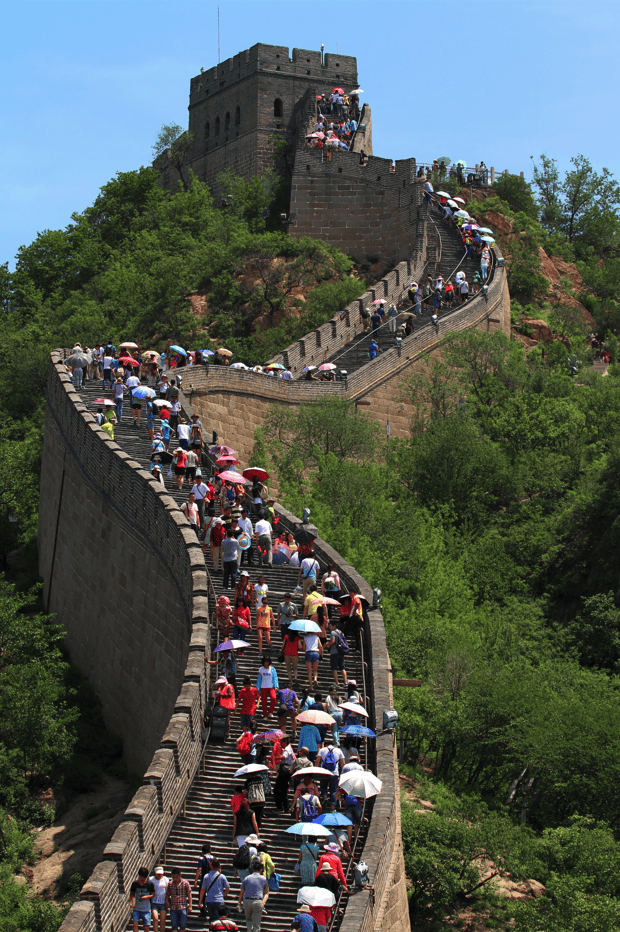
Badaling section is the most visited and best-preserved part of the Great Wall. Located close to Beijing, it is easily accessible and offers a glimpse of the wall at its most impressive.
B. Mutianyu

Surrounded by forests and rolling hills, Mutianyu is known for its beautifully restored watchtowers, scenic views, and fewer crowds than Badaling.
C. Jinshanling
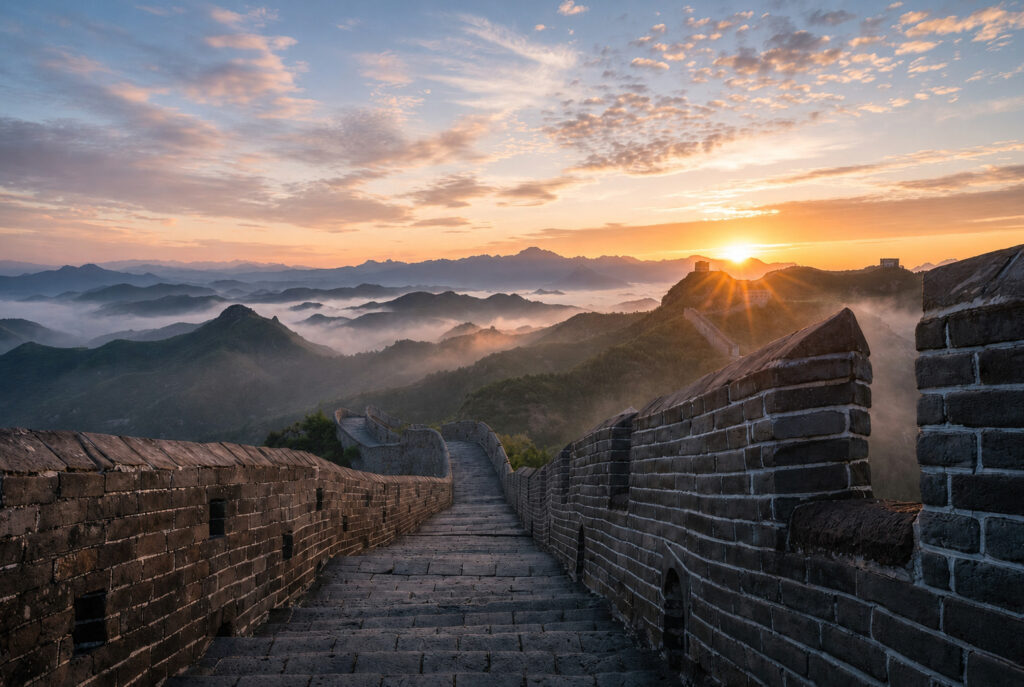
A favorite among hikers and photographers, Jinshanling features a unique combination of carefully restored sections and original Ming-era structures, providing a more authentic experience.
D. Jiankou
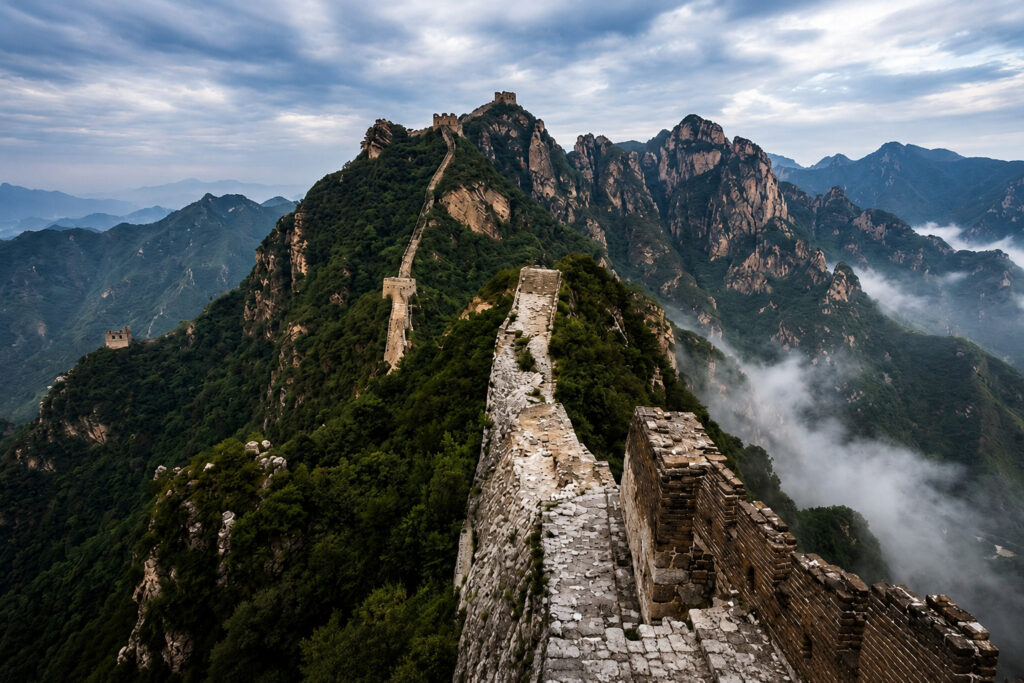
Jiankou section is one of the steepest and most dramatic parts of the Great Wall. Largely unrestored, it is popular with experienced hikers seeking challenging terrain and spectacular views.
Architecture
Great Wall is a remarkable example of ancient military engineering. Its design includes massive defensive walls, watchtowers, beacon towers, fortified gates, stone stairways, battlements, arrow slits, and military barracks. Construction methods varied according to the local terrain, with builders using materials that were readily available in each region, allowing the wall to blend naturally into the surrounding landscape.
Military Purpose
The Great Wall served far more than a defensive role. It helped protect the empire from invasions, controlled border crossings, regulated trade, supported military communication, collected customs duties, and safeguarded agricultural settlements.
Together, these functions made the Great Wall not just a barrier, but a sophisticated military and administrative system that played a vital role in China’s history.
24. Historic Centre of Rome
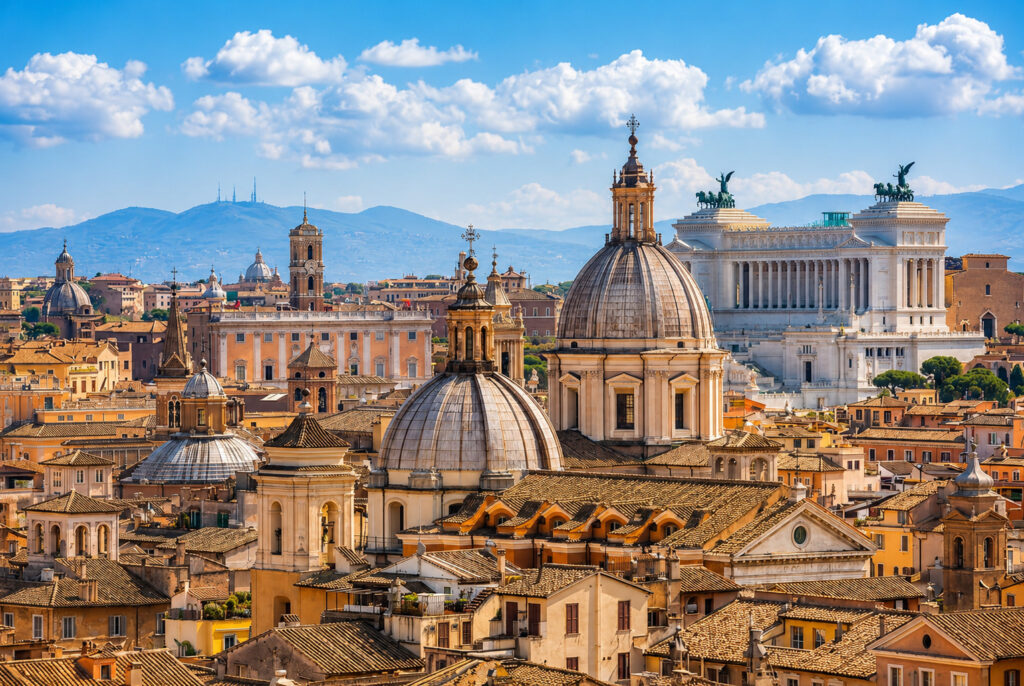
Historic Centre of Rome, the Properties of the Holy See in that City Enjoying Extraterritorial Rights and San Paolo Fuori le Mura is one of the world’s most significant cultural and historical sites. Often called the “Eternal City,” Rome has been continuously inhabited for nearly 3,000 years and has served as the capital of the Roman Empire, the spiritual center of the Roman Catholic Church, and one of the cradles of Western civilization. Its remarkable collection of ancient monuments, Renaissance palaces, Baroque fountains, churches, and archaeological ruins makes Rome one of the richest historic cities in the world.
What is the Historic Centre of Rome?
This UNESCO World Heritage Site encompasses the historic heart of Rome along with several important properties belonging to the Holy See that enjoy extraterritorial status, including the Basilica of Saint Paul Outside the Walls (San Paolo Fuori le Mura).
The site includes ancient Roman monuments, medieval churches, Renaissance palaces, Baroque squares and fountains, archaeological remains, papal basilicas, and historic streets and public spaces. Together, these landmarks preserve more than 2,700 years of continuous urban development and cultural history.
Why is Rome Famous?
Rome is famous as the capital of the ancient Roman Empire and one of the most influential cities in human history. It is home to some of the world’s best-preserved ancient monuments while also serving as the spiritual center of the Roman Catholic Church.
From magnificent Renaissance masterpieces to spectacular Baroque architecture, Rome has shaped the development of law, politics, engineering, architecture, religion, and culture across the globe. Today, it remains one of the world’s most visited UNESCO World Heritage destinations.
History of Rome
Legendary Foundation:
According to Roman tradition, Rome was founded in 753 BC by the twin brothers Romulus and Remus. Although the story is legendary, it remains an important part of the city’s identity and cultural heritage.
Roman Republic and Empire:
Rome grew from a small settlement into the capital of one of history’s greatest empires. At its height, the Roman Empire stretched across much of Europe, North Africa, and the Middle East. During this period, monumental temples, roads, aqueducts, public baths, and civic buildings transformed Rome into one of the ancient world’s greatest cities.
Christian Rome:
After Christianity became the empire’s dominant religion, Rome evolved into the center of the Roman Catholic Church. The city became home to countless churches, basilicas, monasteries, and religious institutions that continue to shape its identity today.
Renaissance and Baroque:
Between the 15th and 18th centuries, successive popes transformed Rome into one of Europe’s artistic capitals by commissioning magnificent churches, palaces, fountains, and public squares. Many of the city’s most iconic landmarks date from this remarkable period.
UNESCO World Heritage Site
Historic Centre of Rome was inscribed as a UNESCO World Heritage Site in 1980. In 1990, the designation was extended to include additional properties of the Holy See and the Basilica of Saint Paul Outside the Walls (San Paolo Fuori le Mura), recognizing their exceptional historical, religious, and cultural importance.
Major Landmarks
A. Colosseum
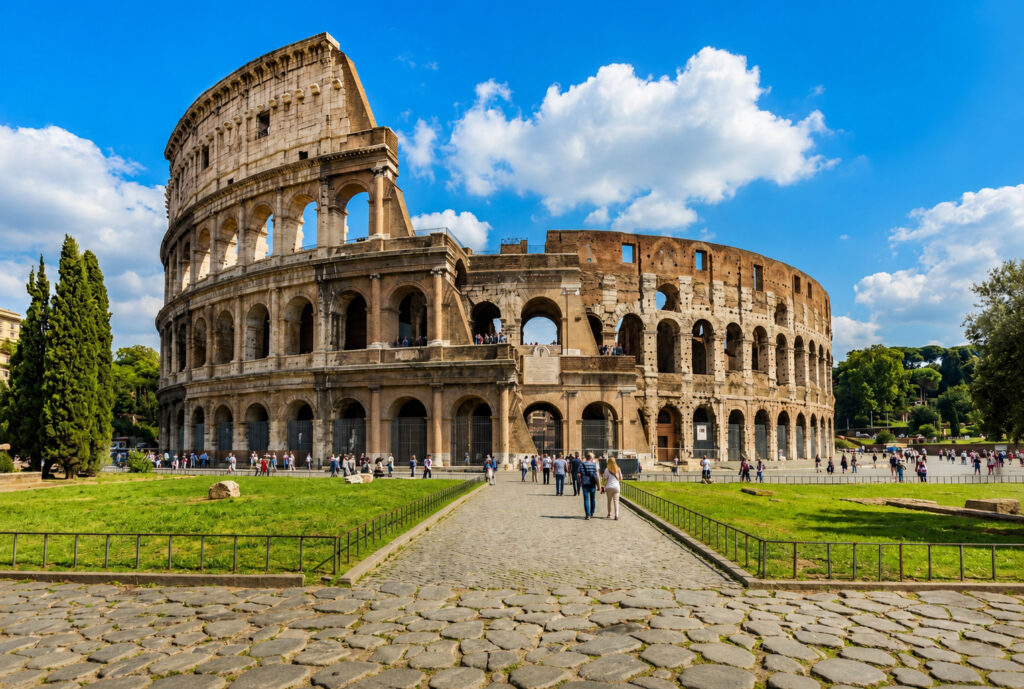
Completed around 80 AD, the Colosseum is the largest ancient amphitheater ever built. It could accommodate between 50,000 and 80,000 spectators for gladiatorial contests, theatrical performances, and public spectacles.
B. Roman Forum
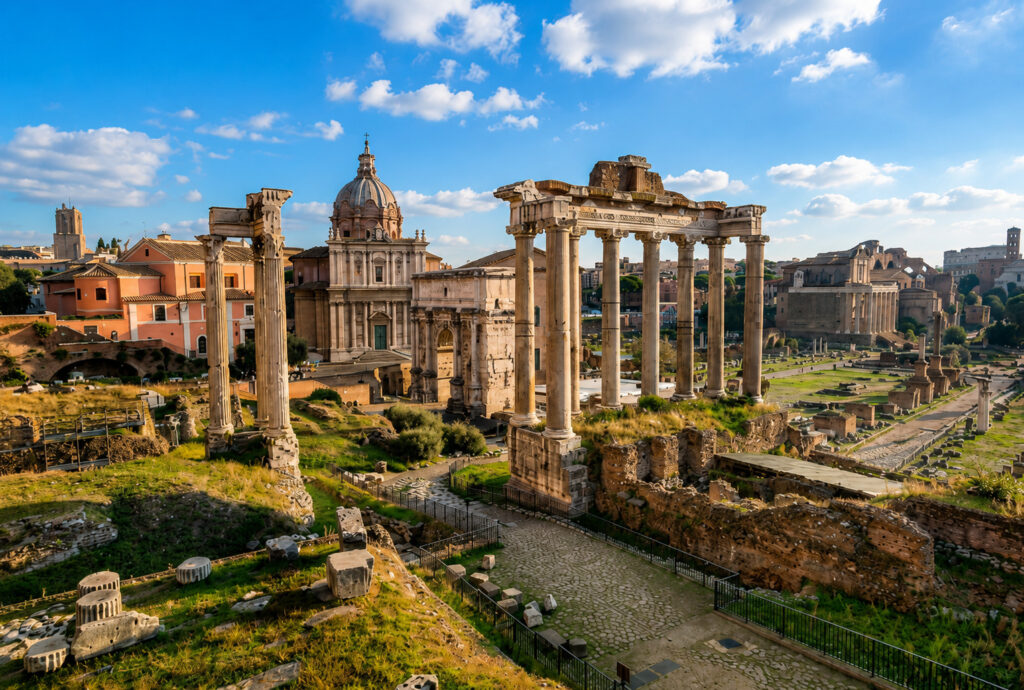
Roman Forum served as the political, religious, and commercial center of ancient Rome. Surrounded by temples, triumphal arches, and government buildings, it was the heart of public life for centuries.
C. Pantheon
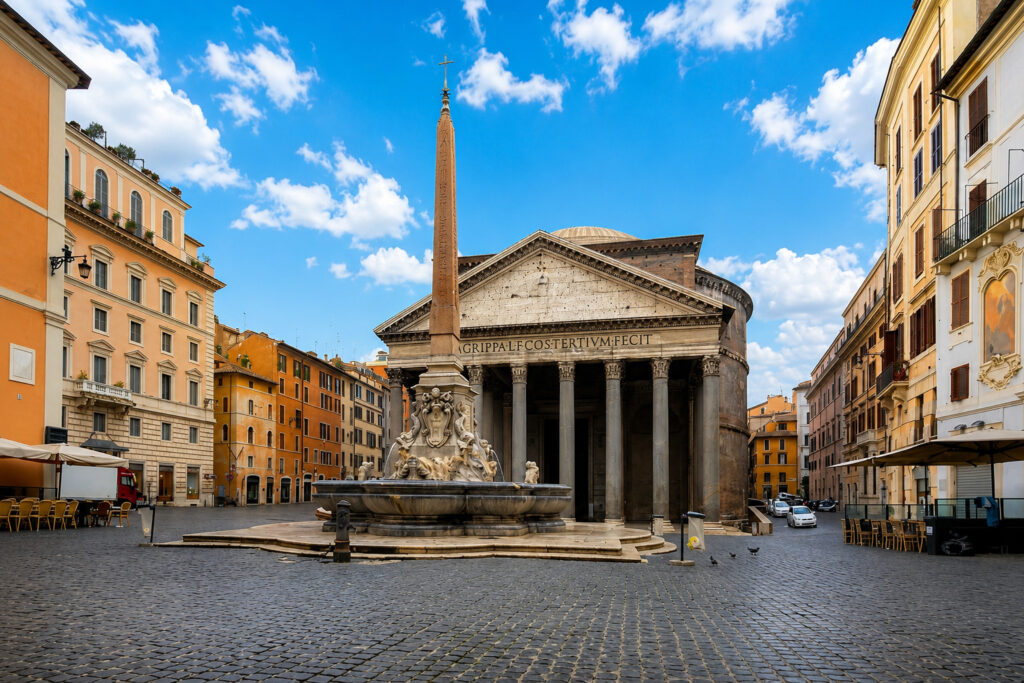
Originally built as a Roman temple and later converted into a Christian church, the Pantheon is renowned for its enormous unreinforced concrete dome and central oculus. It remains one of the best-preserved monuments from ancient Rome.
D. Trevi Fountain
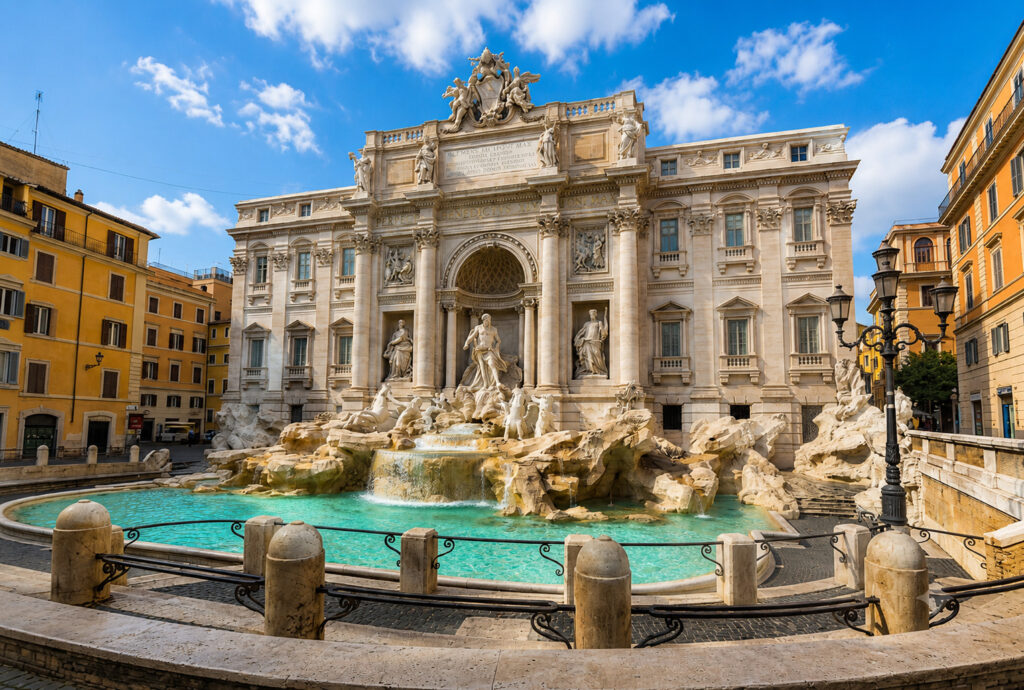
Completed during the 18th century, the Trevi Fountain is one of Rome’s most famous Baroque landmarks. According to local tradition, tossing a coin into the fountain ensures a future return to the city.
E. Palatine Hill
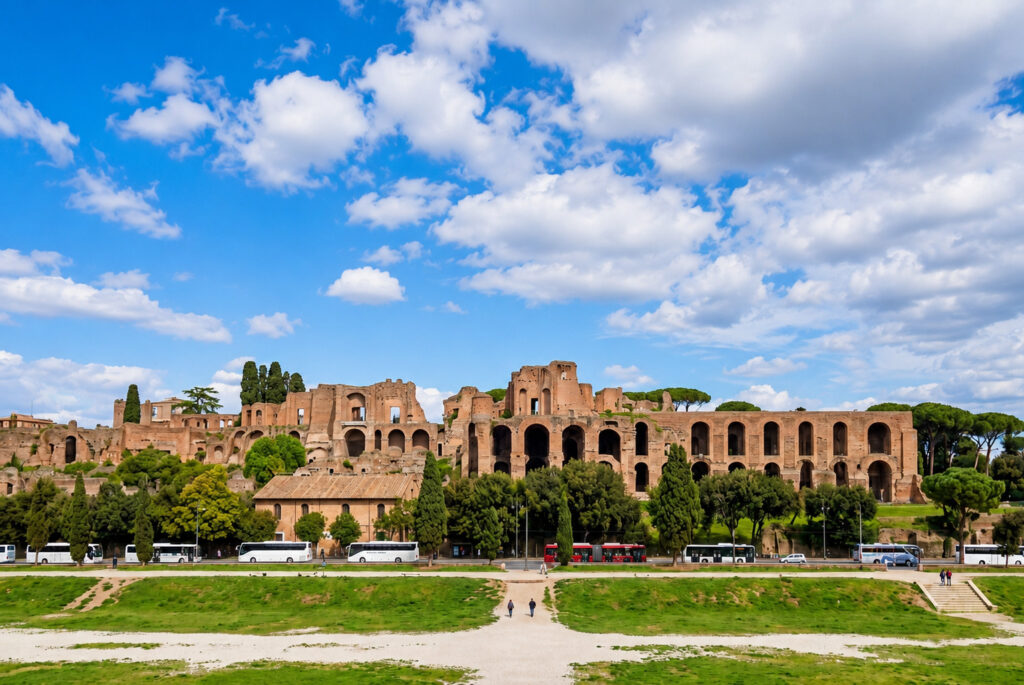
One of Rome’s legendary Seven Hills, Palatine Hill is traditionally regarded as the birthplace of the city. It later became the preferred residence of Roman emperors and offers remarkable archaeological remains and panoramic views.
F. St. Peter’s Basilica
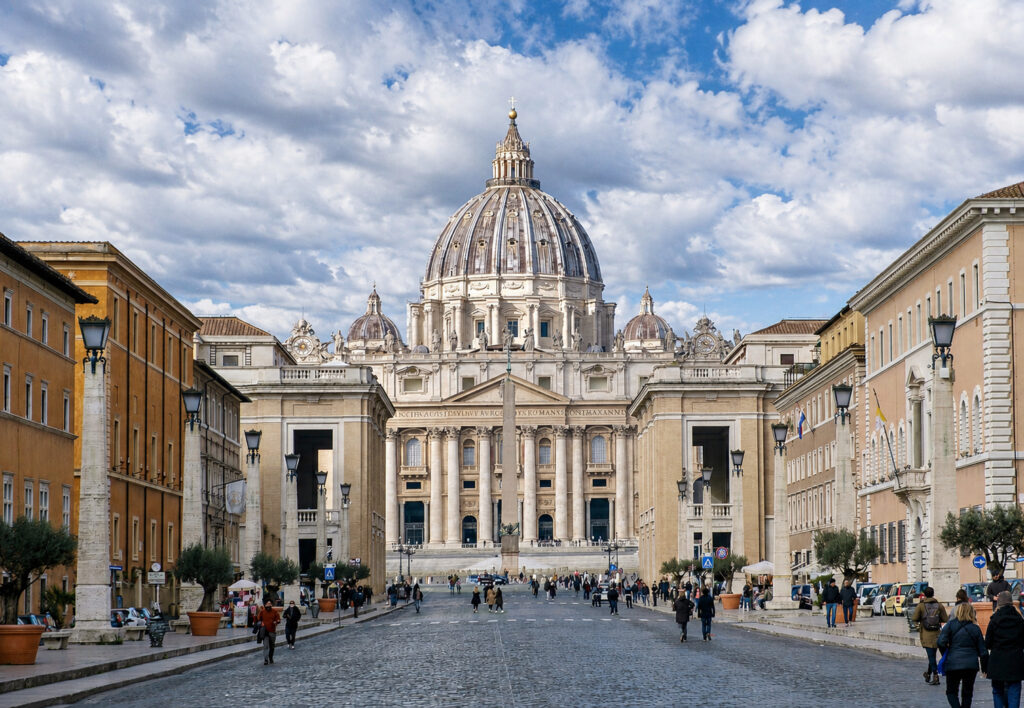
Although located within Vatican City, St. Peter’s Basilica is closely associated with Rome’s UNESCO designation through the Holy See’s extraterritorial properties. Designed by renowned architects including Donato Bramante and Michelangelo, it is one of the largest and most important churches in the world.
Architecture
Rome presents an extraordinary blend of architectural styles, including Ancient Roman, Early Christian, Romanesque, Renaissance, Baroque, and Neoclassical. Visitors can admire massive domes, marble columns, triumphal arches, amphitheaters, basilicas, grand public squares, aqueducts, and decorative fountains. The city’s architectural innovations have influenced urban design around the world for more than two thousand years.
Art and Culture
For centuries, Rome has played a central role in the development of law, government, engineering, literature, religion, architecture, sculpture, and painting. The city is home to masterpieces by legendary artists such as Michelangelo, Raphael, and Gian Lorenzo Bernini, whose works continue to inspire millions of visitors every year. Today, Rome remains one of the world’s greatest centers of art, history, and culture.
Final Thoughts
Exploring UNESCO Cultural World Heritage Sites is like taking a journey through the story of human civilization. From the timeless Pyramids of Giza and the majestic temples of Angkor to the breathtaking mountain citadel of Machu Picchu and the stunning marble beauty of the Taj Mahal, each destination offers a unique glimpse into the history, creativity, and traditions that have shaped our world.
Whether you’re planning your next adventure or simply looking for travel inspiration, these 24 extraordinary sites deserve a spot on every travel bucket list. Their remarkable architecture, fascinating history, and lasting cultural significance continue to captivate millions of visitors each year.
These landmarks are more than just popular tourist attractions—they are living reminders of humanity’s shared heritage. By visiting, appreciating, and helping preserve them, we ensure that future generations can continue to experience their beauty and learn from the incredible civilizations that created them.