Africa is home to one of the world’s most diverse and fascinating food cultures. From the aromatic tagines of North Africa and spicy stews of West Africa to the hearty dishes of Southern Africa and the unique flavors of the Horn of Africa, every region has its own culinary traditions. African cuisine has been shaped by local ingredients, climate, history, Indigenous traditions, trade, migration, and cultural exchange.
Staples such as maize, millet, sorghum, cassava, yams, plantains, rice, beans, spices, and vegetables appear in countless dishes across the continent. In this ultimate guide, we’ll explore 25 traditional foods from different parts of Africa, featuring famous dishes from Morocco, Egypt, Ethiopia, Nigeria, Ghana, Senegal, Kenya, Tanzania, South Africa, and beyond.
If you enjoyed exploring global food traditions, you can also check out our other guide, “Ultimate Guide to Traditional Foods of North & South America,” for more delicious dishes, fascinating food traditions, and the stories behind them.
1. Tagine
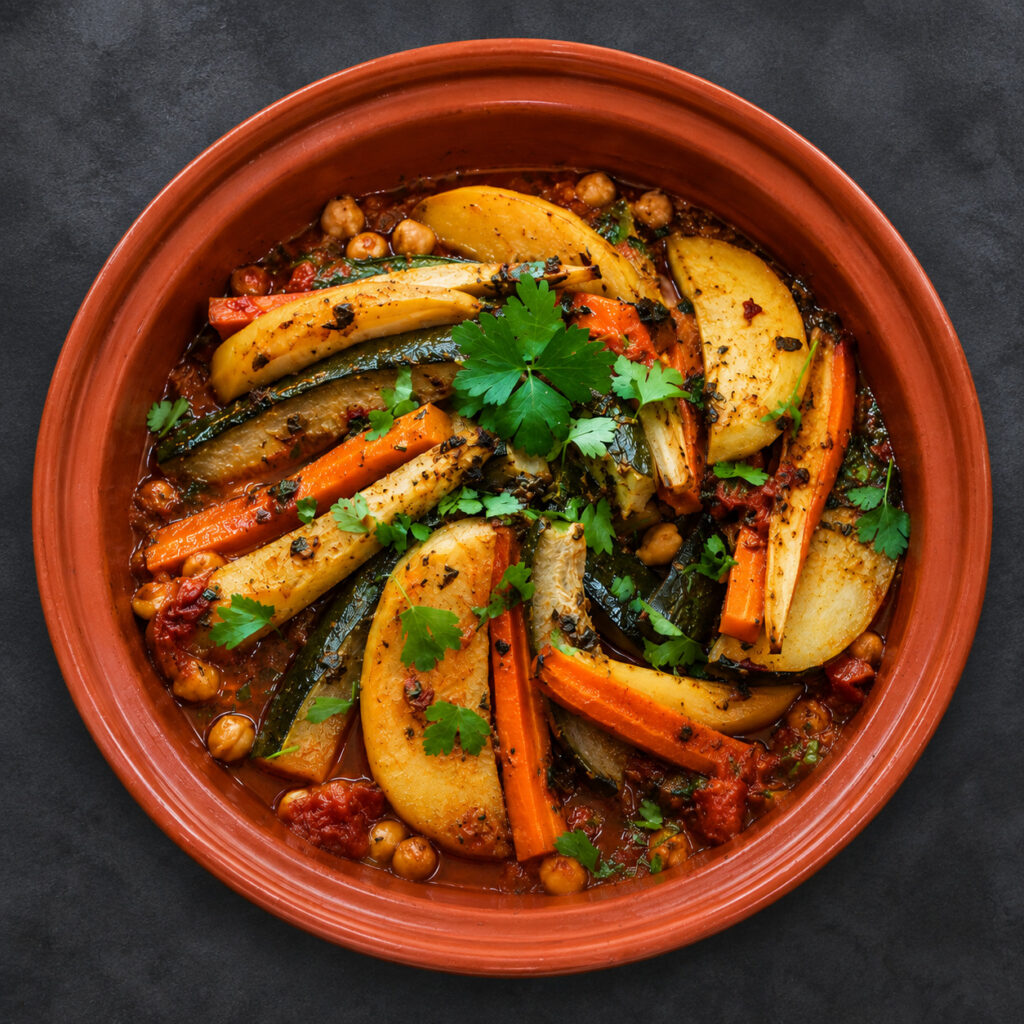
Tagine, also spelled tajine, is one of Morocco’s most famous dishes and one of the defining symbols of Moroccan cuisine. However, there’s an important distinction: tagine refers to both the traditional cooking vessel and the slow-cooked dishes prepared in it.
The Moroccan National Tourist Office describes tajine as one of Morocco’s emblematic dishes, with many versions made using fish, chicken, meat, vegetables, nuts, plums, and apricots.
Where Does Tagine Come From?
Tagine is strongly associated with Morocco and the wider Maghreb, with particularly deep roots in Amazigh (Berber) culinary traditions.
Moroccan cuisine has developed through many different cultural influences over the centuries. Morocco’s National Tourist Office highlights the combination of Amazigh, Arab-Andalusian, and Jewish culinary traditions, along with the country’s rich regional food cultures.
So, tagine isn’t really one fixed recipe. Instead, it represents a whole style of cooking that varies from region to region and even from one household to another. Depending on where you are and who’s cooking, you might find tagine made with tender meat, fresh vegetables, seafood, dried fruits, nuts, or a mix of aromatic Moroccan spices.
2. Couscous
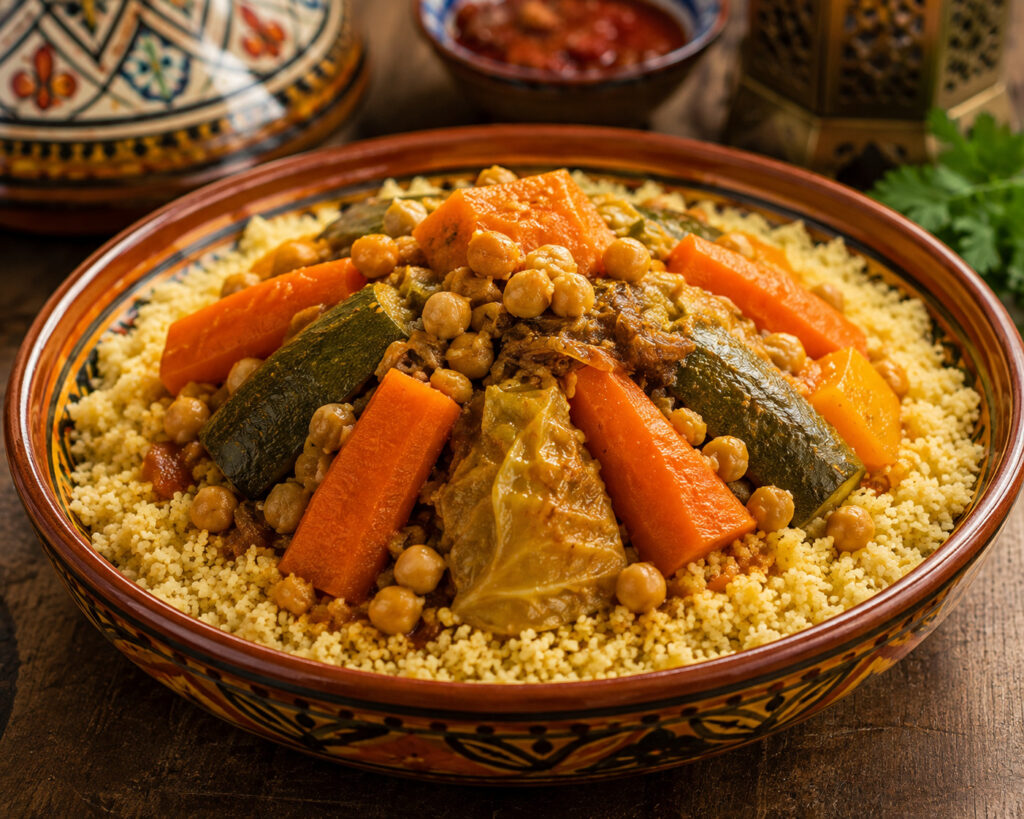
Couscous is one of the most important foods of Morocco and North Africa. Made from tiny grains of semolina, it is traditionally prepared by rolling and steaming the grains before serving them with vegetables, meat, fish, chickpeas, or a flavorful broth.
But couscous is much more than just a food. Across Morocco, Algeria, Tunisia, and Mauritania, the knowledge, techniques, utensils, and social traditions surrounding couscous were inscribed by UNESCO on the Representative List of the Intangible Cultural Heritage of Humanity in 2020.
Where Did Couscous Originate?
The history of couscous is closely connected to North Africa and Amazigh culinary traditions, although its exact origin and earliest development are difficult to trace.
Rather than assigning modern national ownership to an ancient food tradition, it’s more accurate to think of couscous as a shared North African heritage that has evolved across different communities and regions over centuries.
UNESCO’s multinational inscription recognizes this shared cultural heritage across Morocco, Algeria, Tunisia, and Mauritania, highlighting the traditions and knowledge surrounding the preparation and consumption of couscous.
3. Koshari
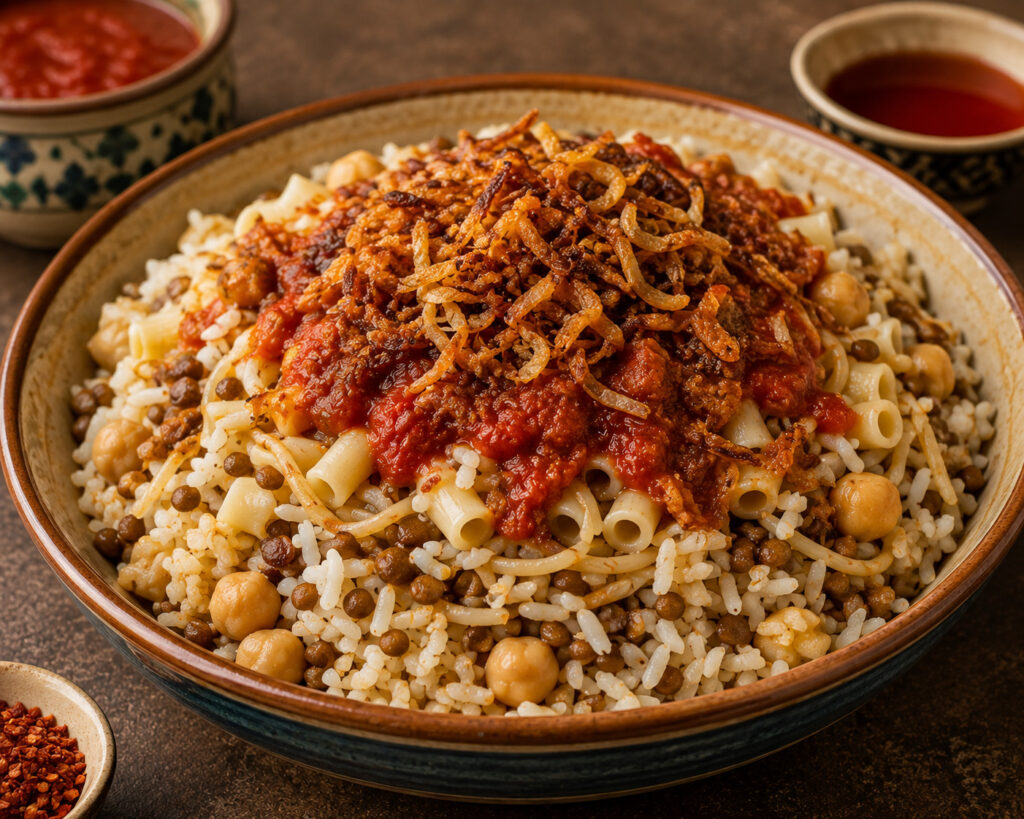
Koshari (also spelled Koshary or Kushari) is one of Egypt’s most famous and beloved dishes. It’s a hearty, inexpensive vegetarian meal made by combining rice, lentils, pasta, chickpeas, fried onions, and a spiced tomato sauce.
At first glance, the combination might seem unusual, but it all comes together surprisingly well, creating a satisfying mix of carbohydrates, protein, crunch, acidity, and spice.
Koshari is especially popular as Egyptian street food and everyday comfort food, and it has become one of the dishes most strongly associated with modern Egyptian cuisine.
Where Did Koshari Come From?
The history of koshari is a little more complicated than simply calling it an ancient Egyptian dish. The modern version developed in Egypt, but its ingredients and culinary influences reflect the movement of people, cultures, and foods across the region.
One commonly discussed theory connects koshari’s development to Indian khichdi, a rice-and-lentil dish that British colonial-era communities encountered and brought to Egypt, where it was eventually adapted and combined with local ingredients and cooking traditions.
However, there are different theories about exactly how the modern dish came together. So, rather than claiming one proven origin story, it’s more accurate to describe koshari as a distinctively Egyptian dish with a layered history shaped by different culinary influences.
4. Ful Medames
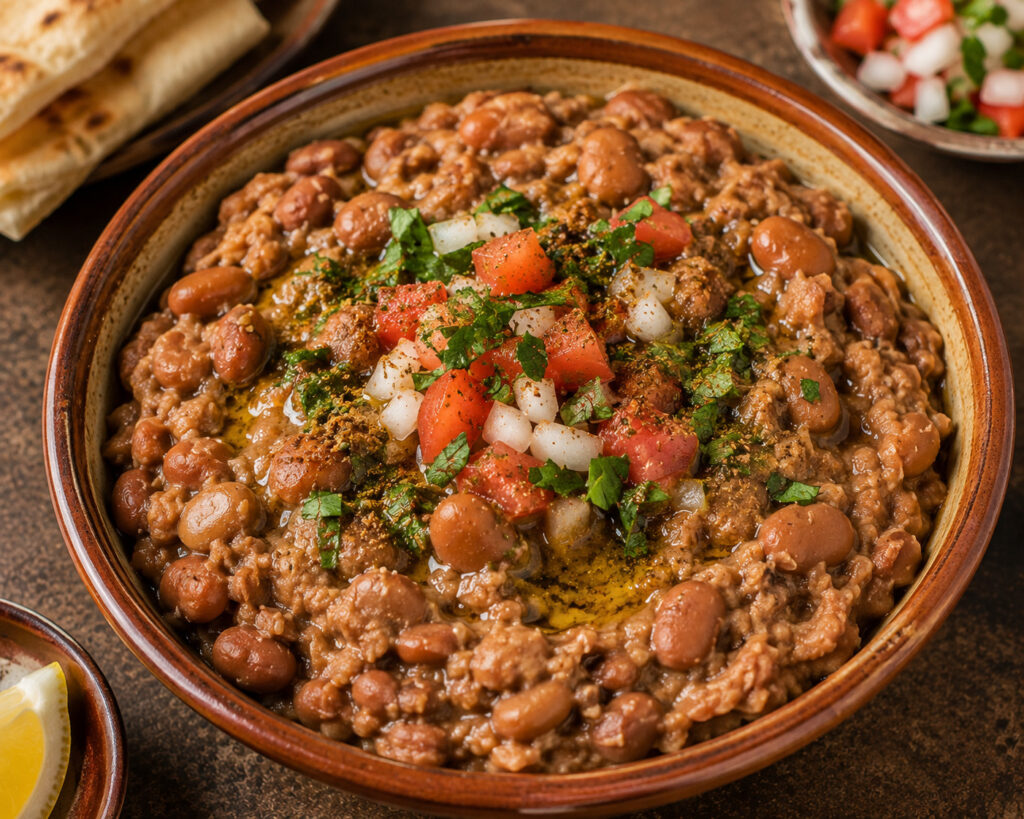
Ful Medames (فول مدمس), often simply called ful or foul, is one of Egypt’s most beloved traditional foods and a staple of Egyptian breakfast culture. It consists of slow-cooked fava beans seasoned with ingredients such as olive oil, cumin, lemon juice, garlic, and salt, then served with Egyptian bread and a variety of toppings.
Unlike koshari, which combines several different staples, ful is remarkably simple. Its appeal comes from slow cooking, good-quality beans, flavorful seasoning, and the toppings added just before serving.
How Old Is Ful Medames?
Ful has very deep roots in Egyptian food history, although claims that today’s exact recipe has been eaten unchanged since the time of the pharaohs should be treated with caution.
Fava beans were an important food crop in the ancient Mediterranean and Nile Valley, and the tradition of eating cooked fava beans has a long history in Egypt. Some culinary historians suggest that ful may have pre-Islamic, and possibly ancient Egyptian, roots, but the modern form of ful medames developed gradually over many centuries.
So, the safest way to describe it is: Ful medames is an ancient-rooted Egyptian bean tradition whose modern form has evolved over generations.
5. Jollof rice
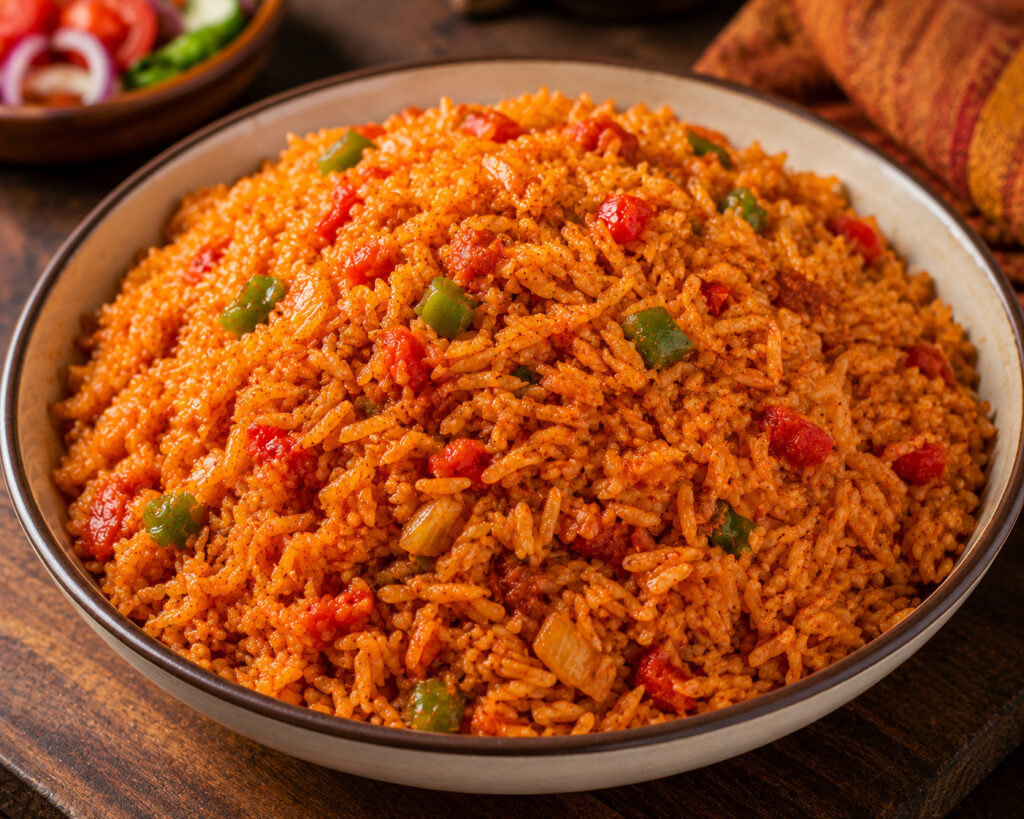
Jollof rice is one of the most famous dishes in West Africa and one of the region’s most passionately debated foods. It’s a one-pot rice dish cooked in a rich, seasoned tomato-and-pepper base, with different countries developing their own distinctive versions.
It’s especially associated with Nigeria, Ghana, Senegal, Gambia, Sierra Leone, Liberia, and Cameroon, although recipes, cooking methods, and even names can vary across West Africa.
At its heart, jollof is about rice, tomatoes, peppers, onions, spices, and slow cooking—but the details can differ dramatically from one country, region, and family to another.
The History of Jollof
Jollof’s deeper history is closely connected to the Wolof-speaking regions of Senegambia. The historic Jolof Empire existed in what is now Senegal and parts of neighboring areas, and the word “jollof” is generally associated with the Wolof/Jolof cultural sphere.
Over time, rice dishes connected to this culinary tradition spread across West Africa and evolved as different communities adapted them to their own local ingredients and cooking styles.
Trade, migration, and the movement of ingredients during the colonial era also influenced the development of modern versions. Today, jollof represents centuries of cultural exchange, migration, and regional adaptation, with each country putting its own spin on this much-loved West African dish.
6. Thieboudienne
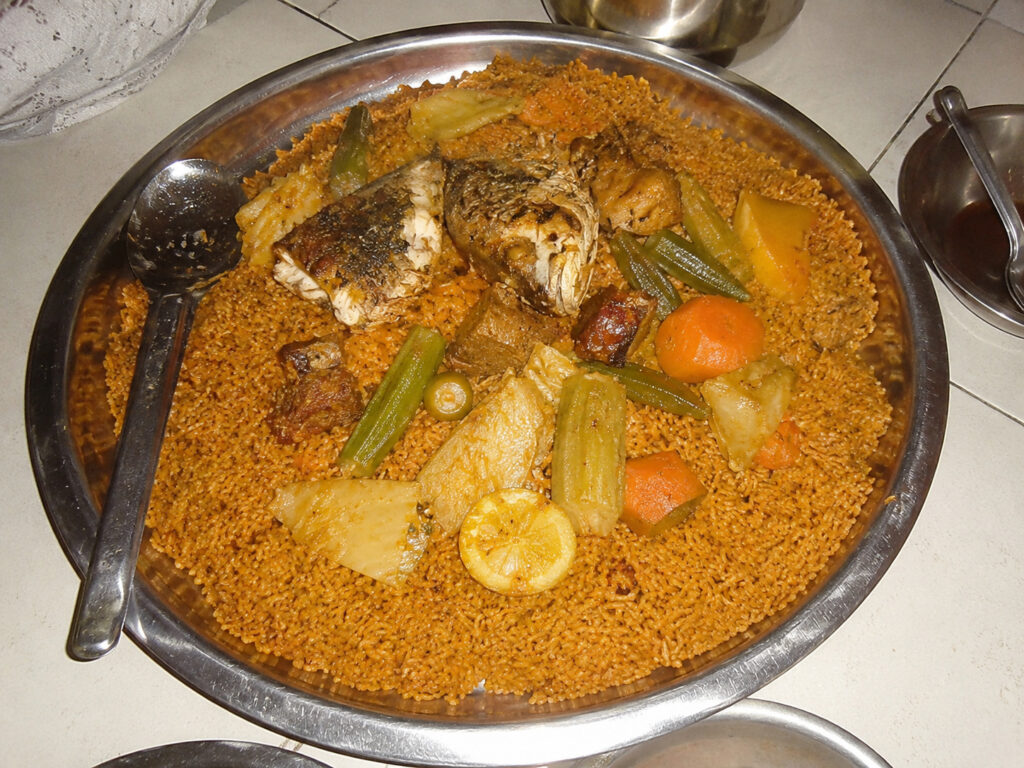
Thieboudienne (also written thiéboudienne, ceebu jën, or ceebu jen) is Senegal’s iconic national dish and one of the most important foods in West African cuisine. The name comes from Wolof, where ceebu jën essentially means “rice with fish.”
It’s a hearty dish made with fish, rice, tomatoes, and vegetables, with the ingredients cooked together so that the rice absorbs the rich flavors of the fish and tomato-based sauce.
In 2021, UNESCO inscribed the “Culinary art of Thiéboudienne” on the Representative List of the Intangible Cultural Heritage of Humanity, recognizing not only the dish itself but also the knowledge, techniques, and social practices associated with preparing and sharing it.
Where Did Thieboudienne Come From?
Thieboudienne is strongly associated with Senegal, particularly the coastal city of Saint-Louis. A widely told Senegalese tradition attributes its creation to Penda Mbaye, a cook associated with Saint-Louis who is said to have developed the dish in the 19th century.
However, the historical details surrounding her story are difficult to verify with complete certainty, so it’s best understood as an important culinary tradition and oral history rather than a fully documented biography.
What is clear is that ceebu jën became deeply rooted in Senegalese cuisine and eventually spread across West Africa, where different communities developed their own variations of the beloved rice-and-fish dish.
7. Fufu with soup
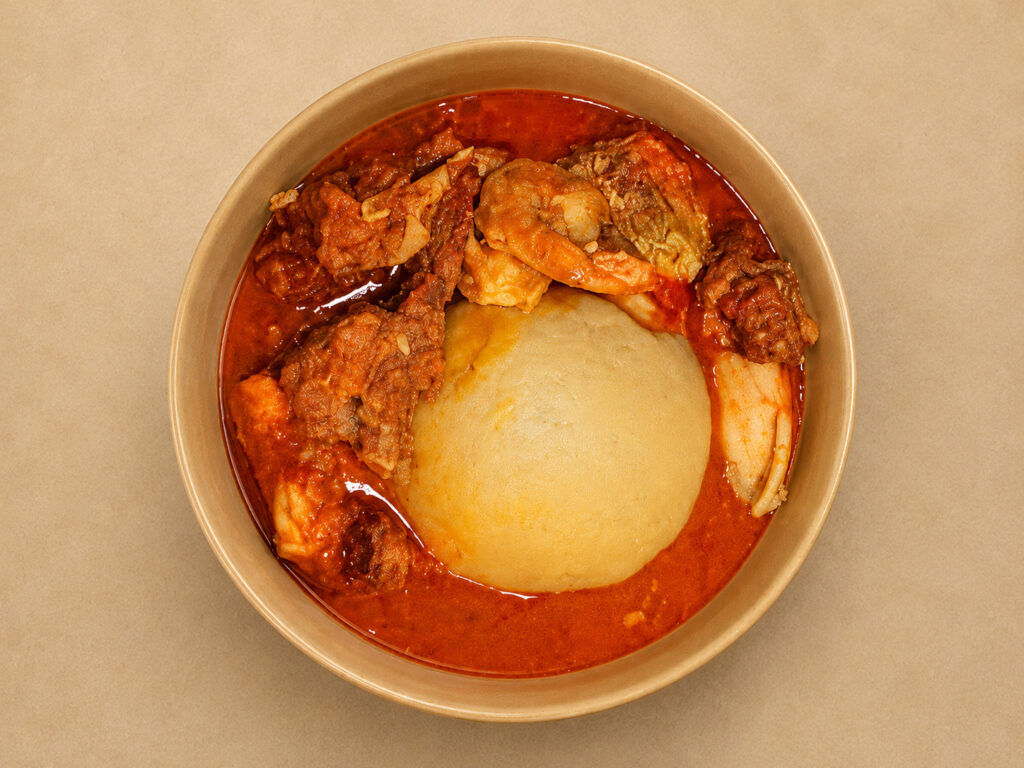
Fufu with soup is one of the most iconic traditional meals in Ghana and West Africa. Unlike dishes where rice, pasta, or grains form the main starch, fufu is a soft, stretchy, dough-like staple made by pounding cooked starchy foods such as cassava and plantain, then serving it alongside a flavorful soup.
The dish is particularly important in Ghana, but related forms of fufu are found throughout West and Central Africa, where the ingredients, names, preparation methods, and accompanying soups vary from country to country.
The basic combination is simple: fufu + rich soup + meat or fish + vegetables. But the variety is enormous, with different communities adding their own ingredients, flavors, and cooking traditions to create countless versions of this comforting African meal.
8. Egusi Soup
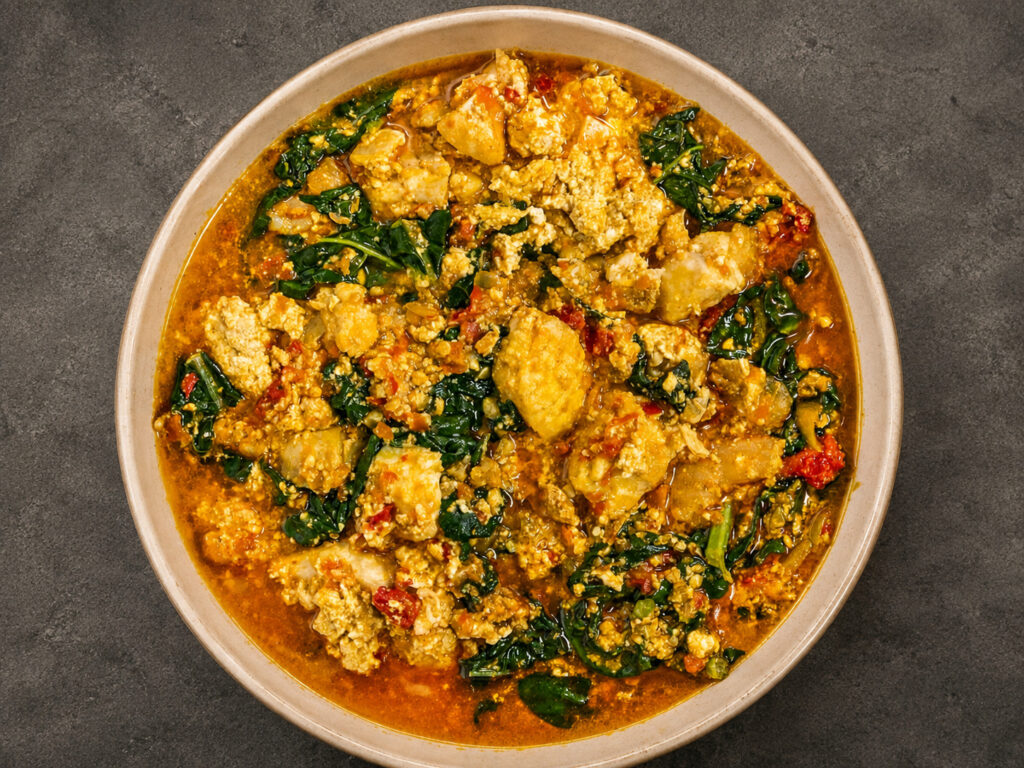
Egusi Soup is one of the most famous and widely loved dishes in Nigeria and an important part of West African cuisine. It’s a rich, savory soup or stew made mainly from ground egusi seeds, which come from certain varieties of melon plants.
These seeds give the dish its distinctive nutty flavor, thick texture, and rich appearance. Egusi soup is commonly prepared with leafy vegetables, palm oil, peppers, onions, and meat or fish, and is traditionally enjoyed with a starchy “swallow” such as pounded yam, fufu, eba, or amala.
9. Waakye
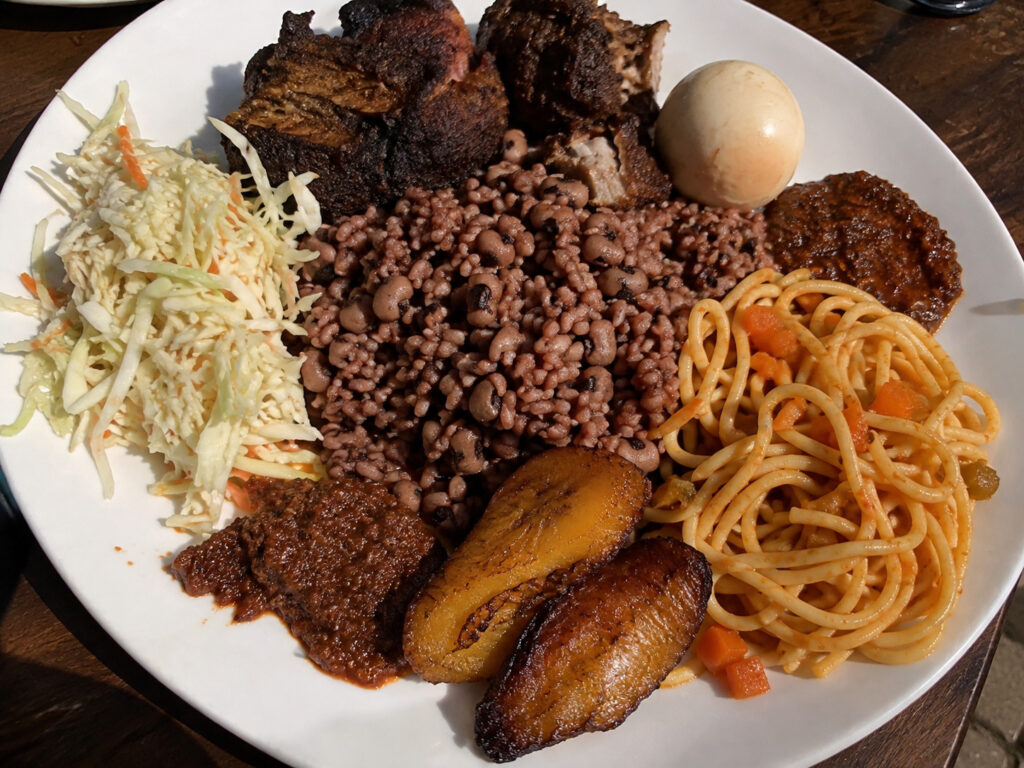
Waakye is one of Ghana’s most popular and recognizable traditional foods. Pronounced roughly “waa-chay,” it’s a flavorful dish of rice and beans cooked together, traditionally with dried sorghum leaves or other local leaves that can give the food its characteristic reddish-brown or purple color.
But waakye is much more than just rice and beans. In Ghana, it’s often served as a complete and highly customizable meal, with a variety of stews, sauces, proteins, and side dishes.
You might find a plate of waakye topped with shito, stew, gari, spaghetti, fried plantain, boiled egg, meat or fish, and salad. The result is one of Ghana’s ultimate street-food and comfort-food experiences.
What Does “Waakye” Mean?
The name waakye is associated with Ghana’s Ga-Dagbani linguistic and cultural traditions, and the dish has strong historical connections to northern Ghanaian food traditions as well as communities in southern Ghana.
The precise linguistic history of the name is more complicated than a simple direct translation, and different explanations exist.
Whatever its exact linguistic origins, waakye has become a distinctly Ghanaian national favorite, enjoyed across ethnic and regional boundaries and adapted to suit different tastes.
10. Injera with Doro Wat
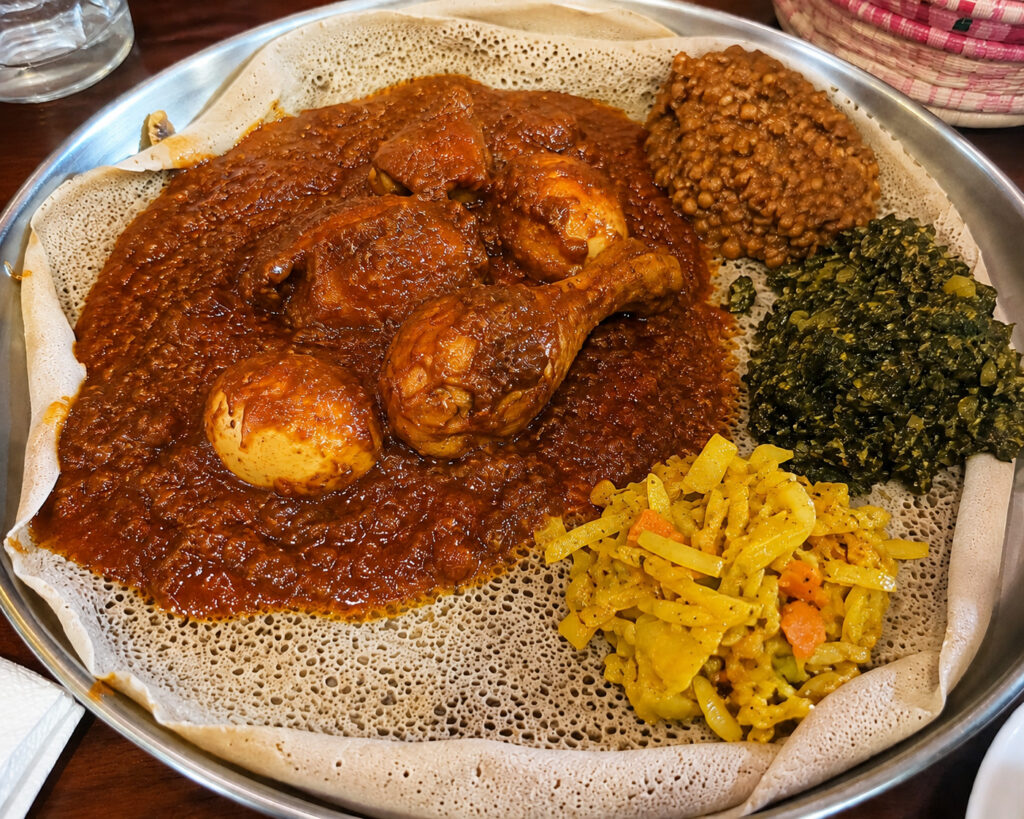
Injera with Doro Wat is one of the most iconic combinations in Ethiopian cuisine. It brings together injera, a soft, spongy, slightly sour flatbread made primarily from teff, and doro wat, a rich and spicy chicken stew traditionally prepared with onions, berbere, and clarified butter.
The dish is much more than just a meal. It’s closely connected to Ethiopian hospitality, communal dining, celebrations, and cultural identity. Injera is typically used as both the base and an edible utensil, with diners tearing off pieces to scoop up the stew and other dishes served alongside it.
If you want to understand Ethiopian food, injera with doro wat is one of the best places to start.
11. Ugali
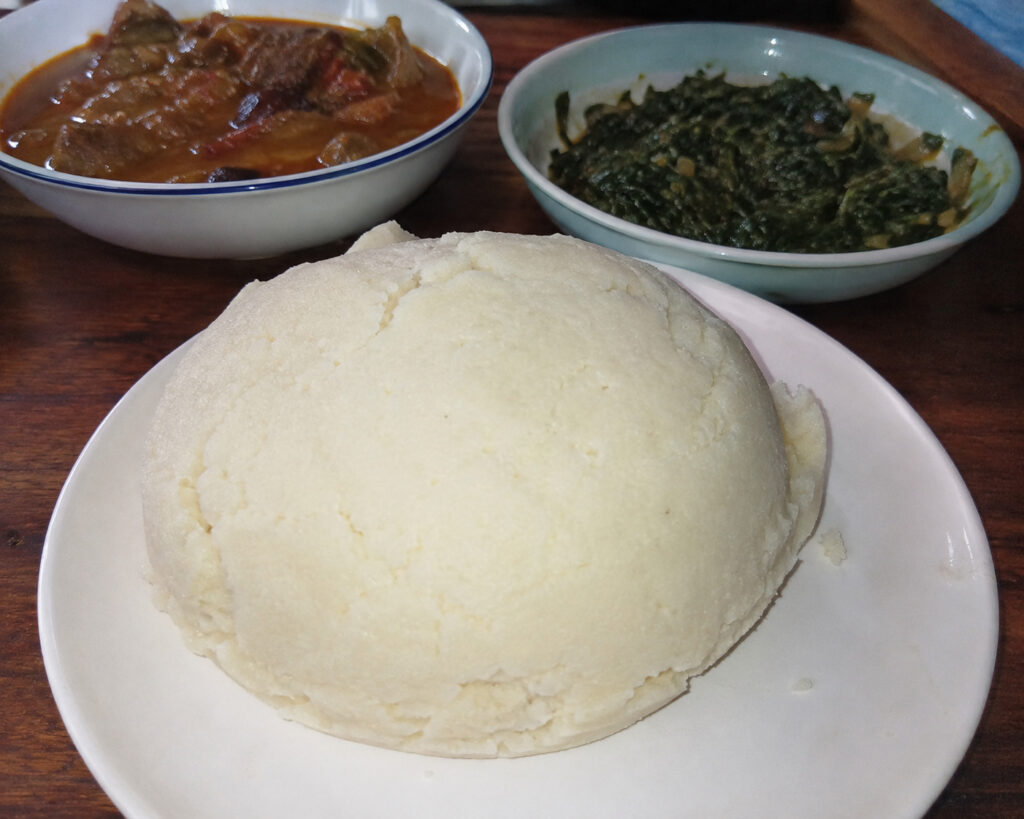
Ugali is one of the most important staple foods in Kenya and East Africa. It’s a firm, dough-like food made by cooking maize flour (cornmeal) with water until it becomes thick and cohesive.
Although ugali itself has a relatively mild flavor, it’s meant to be eaten with more flavorful foods such as sukuma wiki (collard greens), nyama (meat), fish, beans, vegetables, and stews.
In Kenya, ugali is not simply a side dish. It’s deeply embedded in everyday food culture and is widely regarded as one of the country’s defining traditional foods.
The History of Ugali
The history of ugali needs an important qualification: maize is not indigenous to Africa. Maize originated in the Americas and was introduced to Africa following the Columbian Exchange, after European contact with the Americas in the late 15th and 16th centuries.
This means the modern maize-based form of ugali is relatively recent in historical terms. However, the broader tradition of preparing firm, cooked starches from locally available grains and roots has much deeper roots across Africa. Over time, maize became an important staple in many parts of East Africa, and maize-based ugali developed into the familiar dish enjoyed today.
12. Nyama Choma
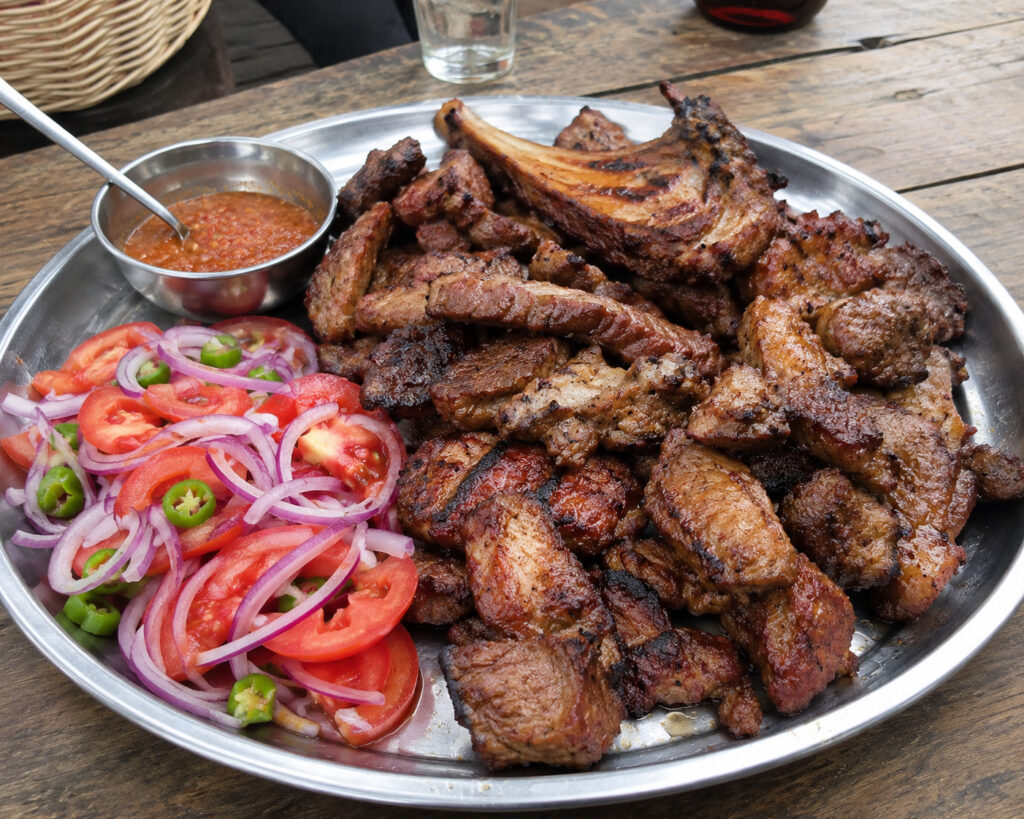
Nyama Choma is one of Kenya’s most beloved traditional foods and an important part of the country’s social and barbecue culture. The name comes from Swahili: nyama means meat, while choma refers to roasting or grilling. So, nyama choma essentially means “roasted meat.”
Traditionally, pieces or sections of meat—especially goat meat—are slowly roasted over charcoal or an open fire. The meat is often kept relatively simply seasoned, allowing its smoky, charred flavor to remain the star of the dish.
In Kenya, nyama choma is much more than just a meat dish. It’s strongly associated with friends getting together, family celebrations, restaurants, roadside grills, football matches, weekends, and socializing. Sharing a plate of freshly grilled meat is as much about the experience and company as it is about the food itself.
The History of Nyama Choma
Unlike dishes with well-documented ancient origins, nyama choma doesn’t have a single known inventor or precise creation date. Instead, its history is connected to several overlapping traditions and developments.
1. Indigenous livestock traditions: Pastoral and farming communities across East Africa have raised goats, cattle, and sheep for generations, making meat an important part of many local food cultures.
2. Traditional fire cooking: Roasting meat over an open fire is one of the oldest and simplest cooking techniques, practiced in many parts of the world long before modern restaurants existed.
3. Swahili culinary culture: The Swahili language and coastal trading networks helped spread food-related vocabulary and culinary influences across East Africa, although nyama choma itself is not limited to coastal Swahili cuisine.
4. Urbanization: As Kenyan towns and cities grew, grilled-meat restaurants and roadside spots became popular places for people to meet, eat, and socialize.
5. Modern restaurant culture: Over time, nyama choma became one of Kenya’s most recognizable social and restaurant foods, evolving from a simple method of roasting meat into an important part of Kenyan dining culture.
13. Pilau
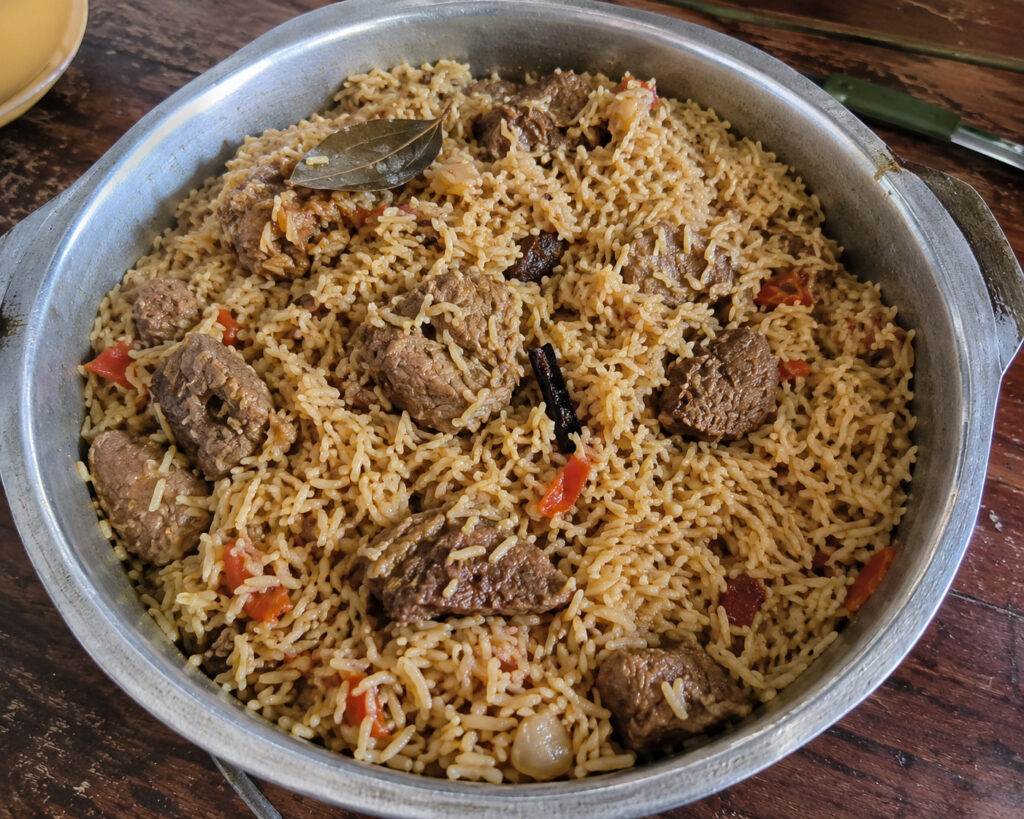
Pilau is a fragrant, spiced rice dish that is especially important in the Swahili coastal cuisine of Kenya and Tanzania. It’s commonly prepared with rice, meat, onions, garlic, and a distinctive blend of warm spices.
Unlike plain steamed rice, pilau is cooked together with its spices, meat, and seasoned broth, allowing the rice to absorb the rich flavors of the entire dish.
It’s closely connected to the culinary traditions of the East African coast, particularly the historic Swahili communities of places such as Zanzibar, Mombasa, Lamu, and Dar es Salaam.
The History of Pilau
The history of East African pilau is connected to the much older pilaf and pulao family of rice dishes, which can be found across a vast area stretching from the Middle East through Central and South Asia.
The word pilau belongs to this broader family of names, which includes pilaf, pulao, polow, pilav, and plov. The exact ancient origins of these dishes are debated, but the technique of cooking rice with seasoned broth and other ingredients has a long history across West and Central Asia.
East African pilau developed through centuries of Indian Ocean trade, migration, and cultural exchange, particularly along the Swahili coast. Arab, Persian, Indian, and African influences all contributed to the rich food culture of the region, helping shape the distinctive pilau enjoyed in Kenya and Tanzania today.
14. Matoke
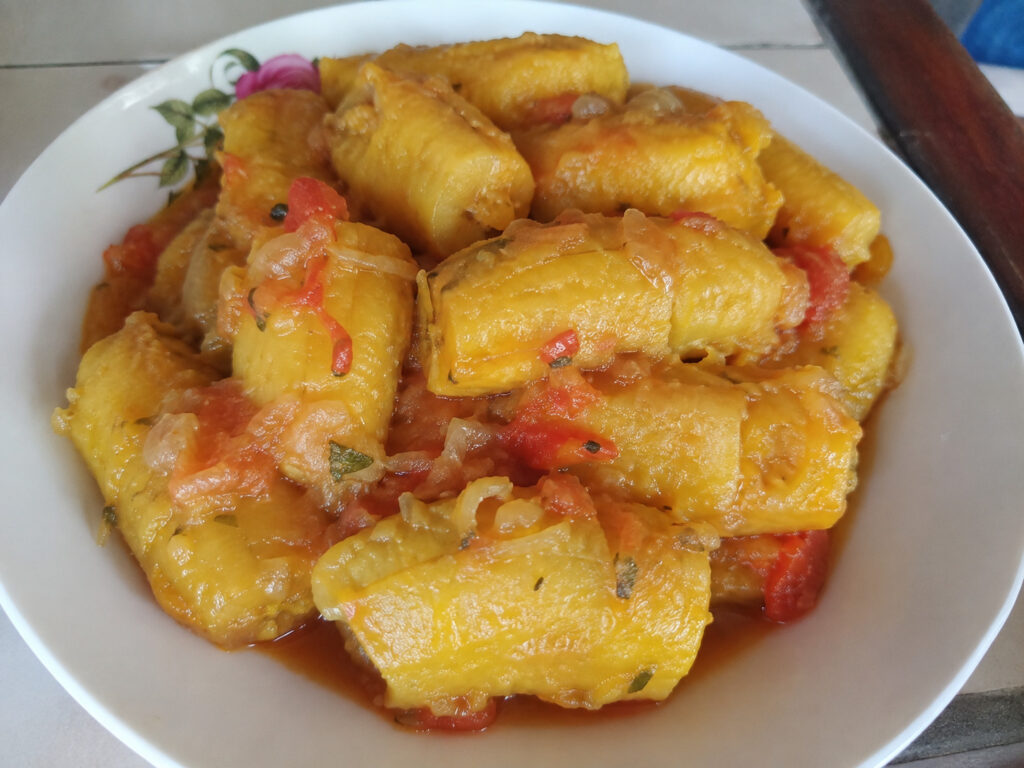
Matoke is one of Uganda’s most important traditional foods and a major staple of Ugandan cuisine. The word matoke generally refers to green cooking bananas or plantains, as well as dishes prepared from them.
In Uganda, one of the most iconic preparations involves steaming or cooking green bananas and mashing them into a soft, dense dish, often served with a rich sauce, meat, groundnut sauce, or beans.
Matoke is particularly associated with central and southern Uganda, where bananas have played an important role in agriculture, everyday cooking, and food culture for generations.
The History of Matoke
The history of matoke is closely connected to the much broader history of banana cultivation in Africa.
Bananas were not originally domesticated in Africa. Their earliest domestication took place in Southeast Asia and nearby regions of the Pacific, from where different banana varieties gradually spread to other parts of the world.
Over many centuries, bananas made their way westward through human migration, trade, and cultural exchange, eventually reaching the African continent.
Once established in Africa, bananas became especially important in parts of East and Central Africa, where farmers developed and cultivated varieties suited to local conditions. In Uganda, green cooking bananas became an important staple, giving rise to the many matoke dishes enjoyed today.
15. Ndolé
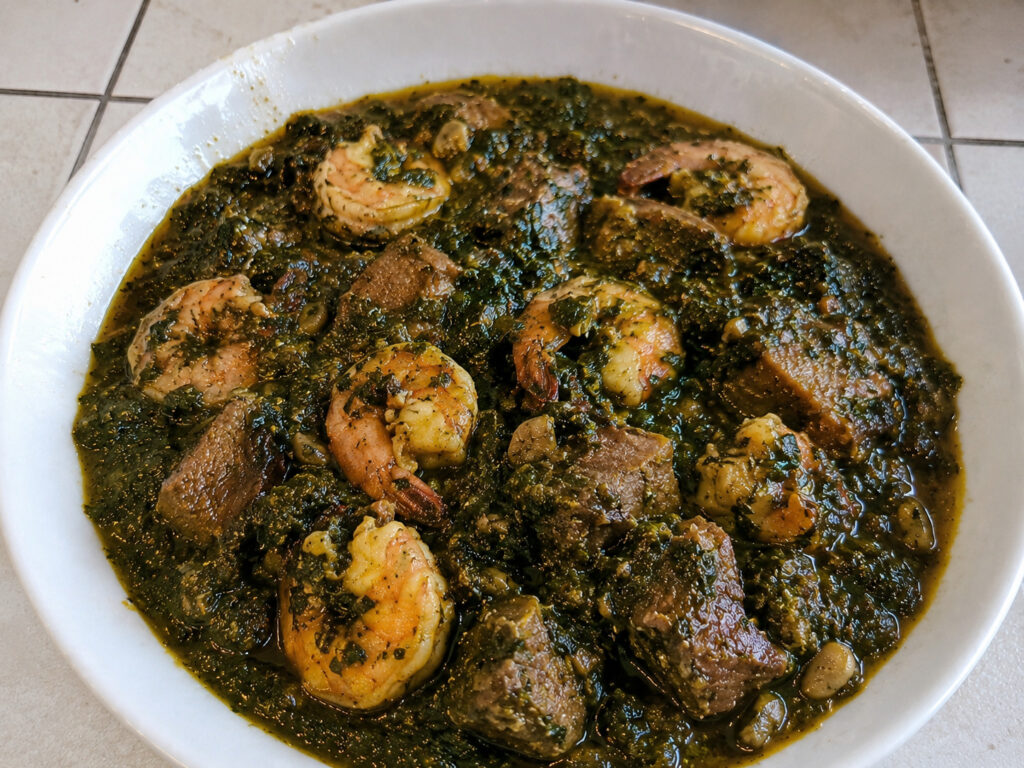
Ndolé is one of the most famous dishes of Cameroon and an important part of the country’s culinary identity. It’s a rich, flavorful stew made primarily with bitterleaf (ndolé leaves), ground peanuts, and meat or seafood.
The dish brings together the slightly bitter taste of leafy greens with the creamy richness of peanuts and the savory flavors of ingredients such as beef, shrimp, crayfish, or fish.
Ndolé is particularly associated with the Duala (Douala) people and the Littoral region of Cameroon, although it has become popular throughout the country and is now enjoyed by people from many different communities. It’s also commonly served at family gatherings, celebrations, and special occasions, making it more than just an everyday meal.
16. Saka saka
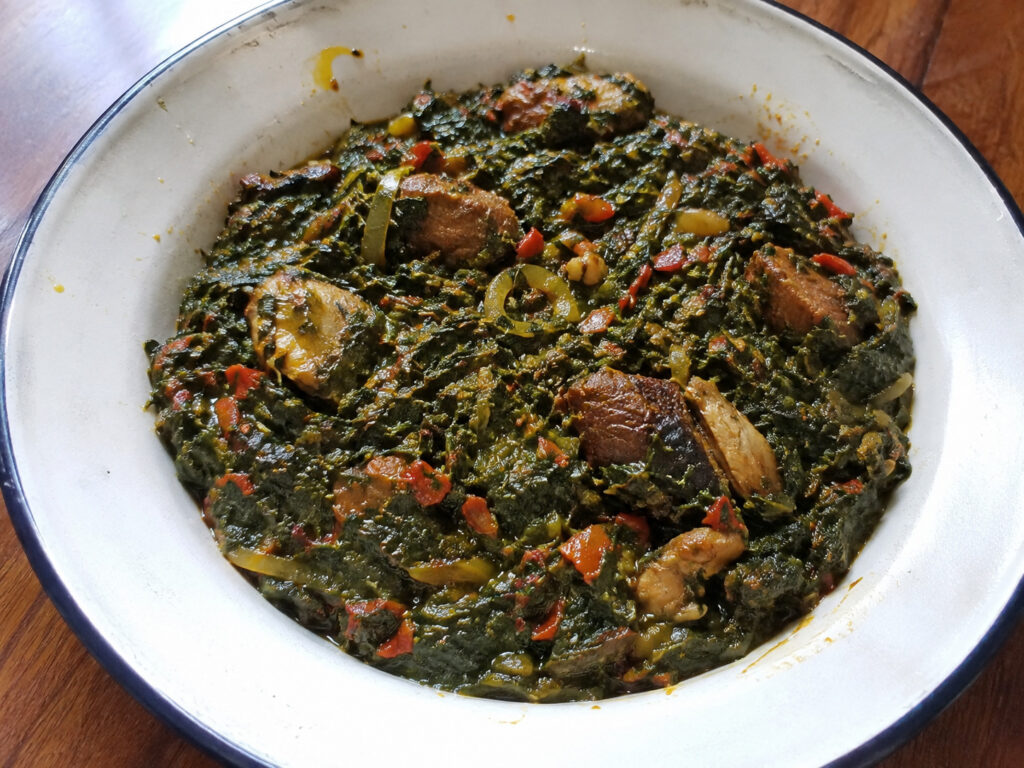
Saka saka is a beloved leafy-green dish from Central Africa, especially associated with the Democratic Republic of the Congo (DRC) and the wider Congo Basin. It’s made from cassava leaves, which are finely pounded or ground and then cooked into a thick, savory stew.
Depending on the region, it may also be known as pondu, sombé, or by other local names. The dish has a rich, earthy flavor and is commonly prepared with palm oil, onions, garlic, chili, peanuts, fish, meat, or other proteins.
Saka saka is particularly interesting because its main ingredient, cassava, is not originally African, yet it has become one of the most important staple crops in Central Africa.
The Surprising History of Cassava
This is one of the most fascinating parts of saka saka’s story: cassava is not originally African. Cassava was domesticated in South America, particularly in tropical regions of the Amazon Basin, where Indigenous peoples cultivated it for thousands of years.
Following European contact with the Americas, cassava crossed the Atlantic and was introduced to Africa during the period of European maritime expansion, likely during the 16th century. Portuguese traders played an important role in spreading the crop along parts of the African coast.
From coastal regions, cassava gradually spread inland. African farmers adopted and adapted it to local conditions, and its ability to tolerate relatively poor soils and periods of drought helped it become an important food crop across Central, West, and East Africa.
Over time, cassava became deeply integrated into local food cultures, eventually becoming the key ingredient in dishes such as saka saka and its many regional variations.
17. Bobotie
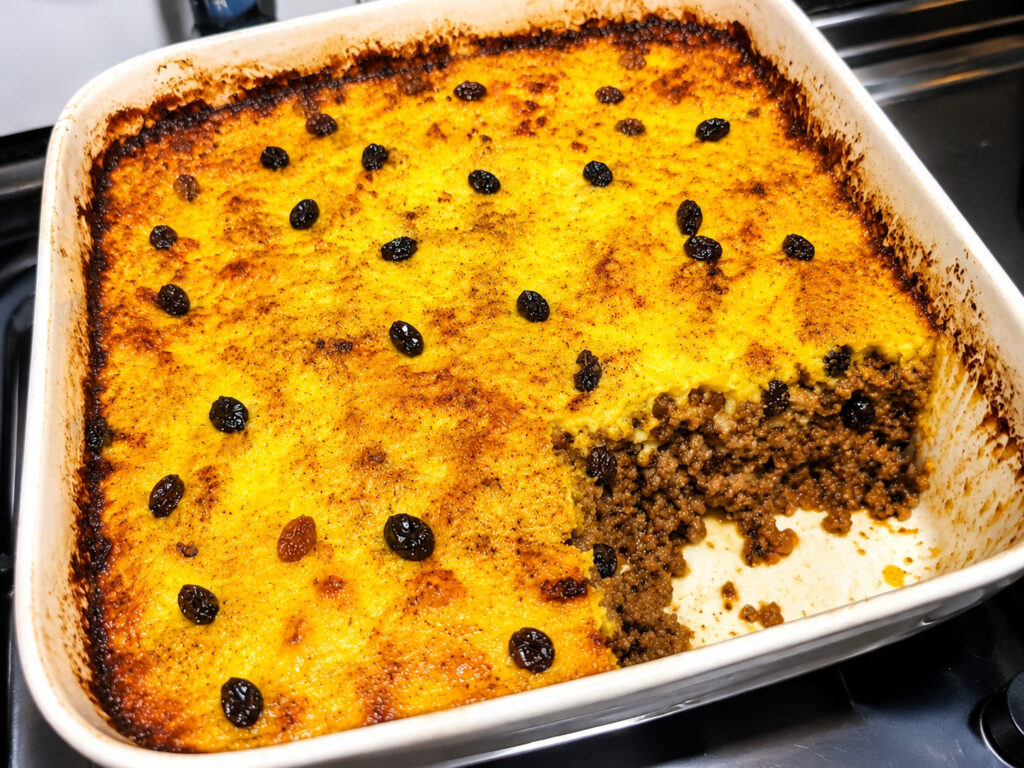
Bobotie is one of South Africa’s most distinctive traditional dishes: a fragrant spiced minced-meat casserole topped with an egg-and-milk custard and baked until the topping is set.
It’s particularly associated with Cape Malay cuisine and the Western Cape, especially Cape Town. The dish combines savory minced meat with aromatic spices and often dried fruit, while the creamy egg topping adds a contrasting texture. It’s commonly served with yellow rice, sambal, chutney, or other accompaniments.
Bobotie is much more than a casserole. It reflects the complicated history of the Cape, where African, Southeast Asian, South Asian, and European culinary traditions came together and influenced one another.
The History of Bobotie
The exact origins of bobotie are not completely settled.
Food historians generally associate its development with the Cape’s colonial and Cape Malay culinary history, particularly the interaction between Dutch colonial society and enslaved and displaced people brought to the Cape from different parts of Asia and Africa.
Several theories exist about the origins of both the name and the dish, but no single explanation can be treated as definitively proven. What is clear is that bobotie developed within the diverse food culture of the Cape and eventually became one of the dishes most closely associated with South African cuisine.
18. Bunny Chow
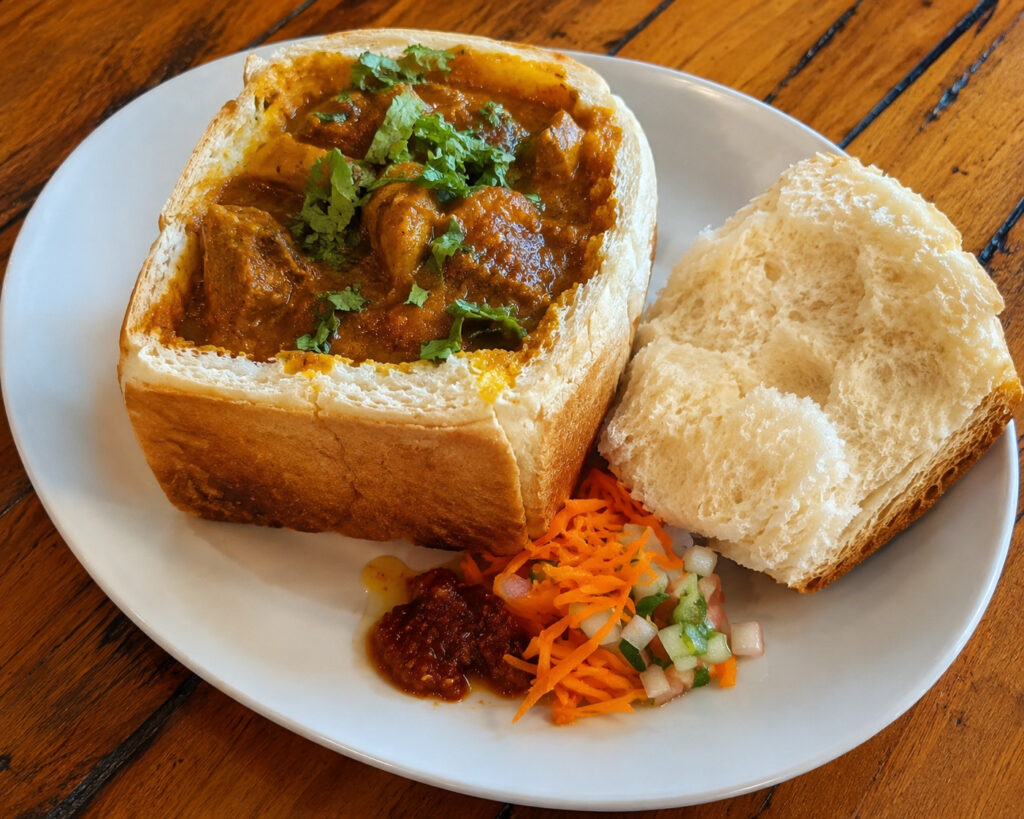
Bunny chow is one of South Africa’s most iconic street foods: a hollowed-out loaf of white bread filled with curry. It originated in Durban, KwaZulu-Natal, within the city’s Indian community, and has since become a beloved national culinary symbol.
Despite its name, there is no rabbit in bunny chow. The name is generally linked to “bania,” a term associated with an Indian merchant community, combined with “chow,” an informal English term for food.
The Origins of Bunny Chow
This is where things get fascinating. The exact origin of bunny chow remains disputed.
Most accounts place its emergence in Durban during the 1940s, but several competing stories explain how the dish may have come about. Some suggest it was created as a practical way for Indian workers to carry and eat curry, while others connect its development to Durban’s broader Indian food culture.
There is no universally accepted single inventor or definitive origin story. What is clear is that bunny chow grew out of Durban’s Indian community and the social conditions of the time, eventually becoming one of South Africa’s most recognizable and much-loved street foods.
19. Pap and Chakalaka
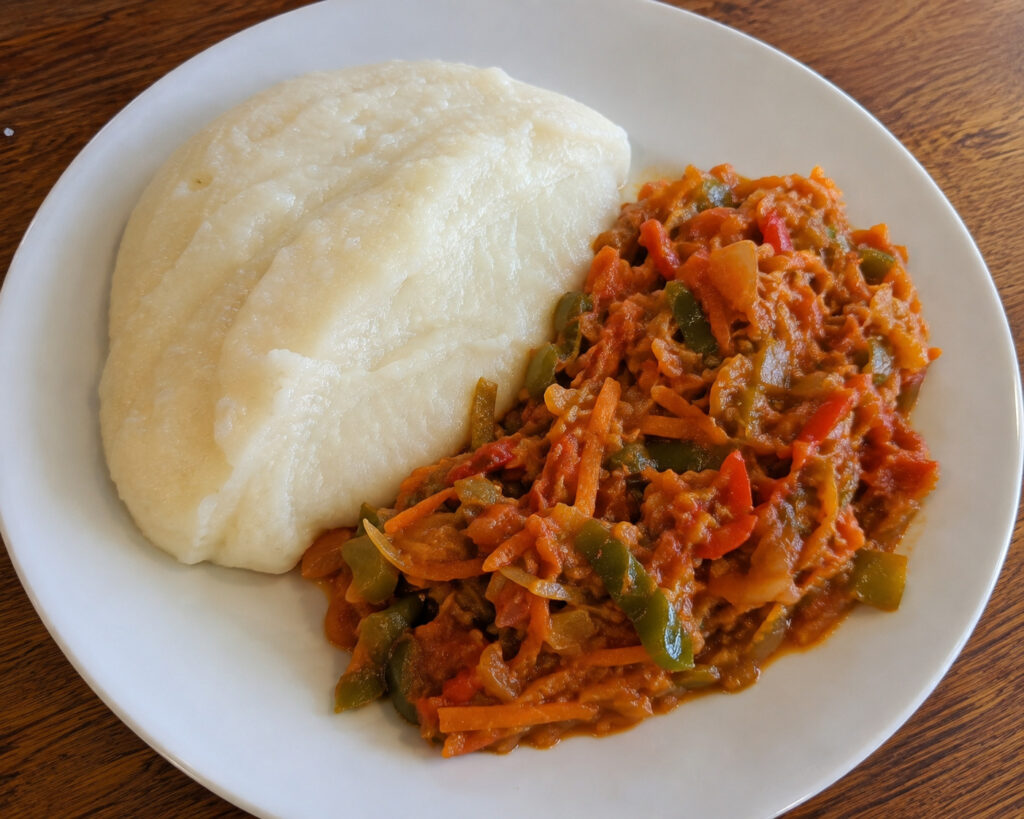
Pap and chakalaka is one of South Africa’s most recognizable everyday food combinations. It brings together pap, a thick porridge made from maize meal, and chakalaka, a spicy vegetable relish commonly prepared with ingredients such as tomatoes, onions, carrots, peppers, beans, and chili.
It’s especially popular alongside braai (barbecue), grilled meat, boerewors, and shisa nyama, but pap itself can be enjoyed at almost any meal. South African Tourism describes pap as a staple in many South African homes because it’s affordable and versatile, while chakalaka is commonly served as a spicy relish alongside meat and pap.
The History of Pap
Pap has deep roots in southern African maize-based food traditions, although maize itself originated in the Americas.
Maize arrived in Africa following the Columbian Exchange and gradually became an important crop in southern Africa. Over generations, African communities incorporated maize into their existing agricultural systems and food traditions, developing different types of maize-based porridges.
Today, maize meal is a foundational staple of South African cuisine, with pap enjoyed in homes, restaurants, gatherings, and traditional meals across the country.
The History of Chakalaka
The precise origins of chakalaka are not completely documented, and several stories circulate about how the dish developed.
What is clear is that it became strongly associated with South African township food culture, particularly during the 20th century. Its development reflects the country’s history of urbanization, working-class food traditions, and cultural exchange.
South African Tourism describes chakalaka as a township classic and notes the influence of Indian spices in the relish. Today, recipes vary widely from household to household, with some versions being mild and others packed with chili and spices.
20. Seswaa
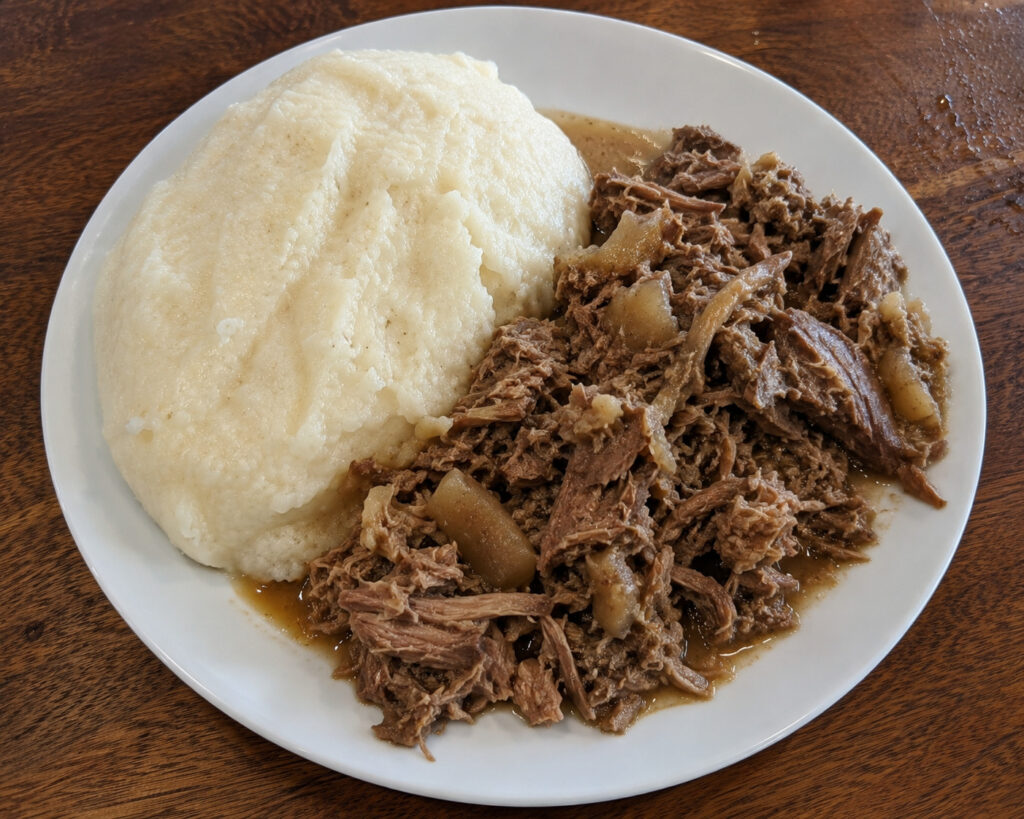
Seswaa is the national dish of Botswana and one of the country’s most important traditional foods. It’s a simple but deeply cultural dish of slow-cooked meat that is pounded or shredded until tender, traditionally seasoned with little more than salt and water. It’s most commonly made with beef, although goat and other meats can also be used.
Seswaa is especially associated with weddings, funerals, national celebrations, community gatherings, and other major occasions. It’s generally served with a thick maize or sorghum porridge such as bogobe or pap.
The History of Seswaa
The exact historical beginnings of seswaa aren’t known.
The dish is deeply rooted in Setswana food culture, and its development is closely connected to cattle keeping and communal food traditions.
One traditional explanation recorded in research links its origin to practical necessity. According to an account attributed to Bakwena Regent Kgosikwena Sebele, pounding the meat made it easier to chew and helped make it easier to share and serve among people of different ages.
The same account connects the dish with the slaughtering of older cattle, whose meat could become particularly flavorful and tender through prolonged cooking and pounding.
This story is best understood as a traditional historical explanation rather than a precisely documented invention date. Whatever its exact beginnings, seswaa has become an important part of Botswana’s food culture, hospitality, and communal traditions.
21. Kapana
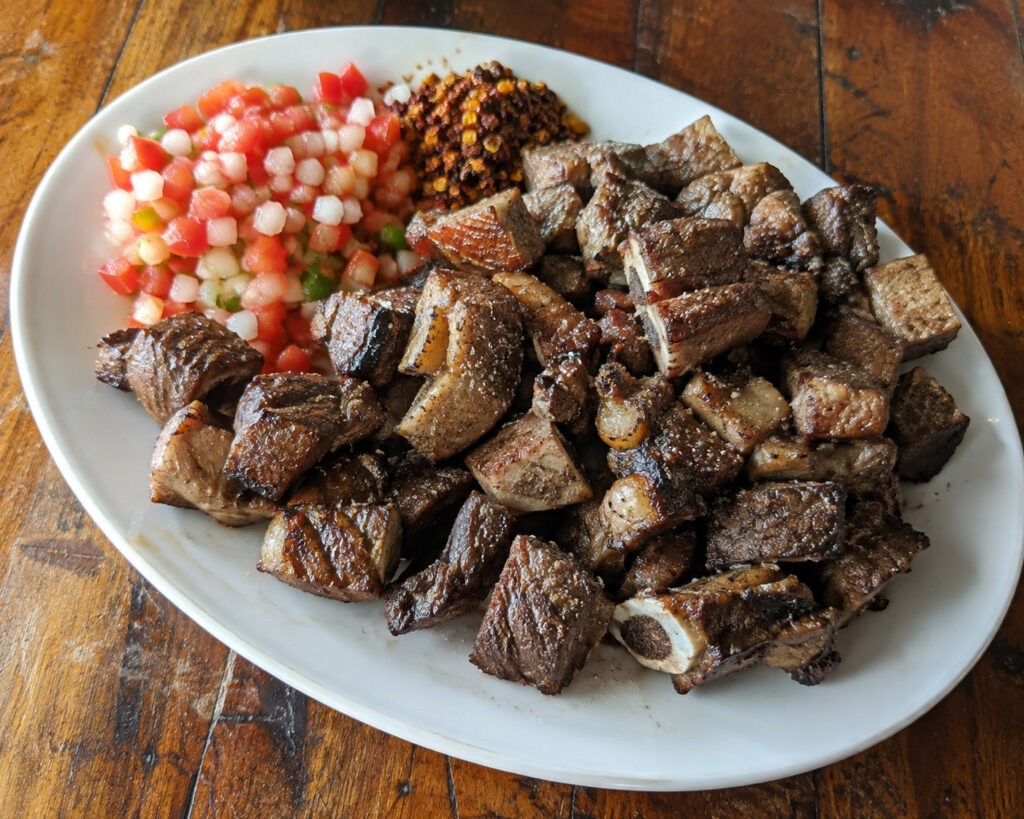
Kapana is one of Namibia’s most famous street foods: small pieces of beef grilled over an open flame and served hot, usually with chili-based sauces, spices, and fresh accompaniments.
It’s especially associated with Katutura in Windhoek, where kapana stalls and markets have become an important part of the city’s food culture.
Unlike many elaborate national dishes, kapana is deliberately straightforward: beef + open fire + spices + sauce + community.
But its importance goes far beyond the ingredients. Kapana represents Namibian urban culture, entrepreneurship, social life, and the country’s love of grilled meat. Buying kapana from a busy market stall is as much a social experience as it is a meal.
History of Kapana
Unlike dishes with a clearly documented royal or ancient origin, kapana’s history is much more closely tied to modern urban Namibia.
Its development is particularly associated with Windhoek, Katutura, township food culture, informal markets, and Namibia’s strong meat industry. Over time, vendors turned simple grilled beef into a popular street-food experience, often preparing the meat right in front of customers and serving it with spicy sauces and other accompaniments.
The exact origin of kapana, as well as the precise history of its name, isn’t as firmly documented as that of some older traditional foods. It’s therefore better to avoid claiming that one specific person or year “invented” it. Instead, kapana is best understood as a modern Namibian street-food tradition that grew through urban communities, local entrepreneurship, and everyday social life.
22. Dholl puri
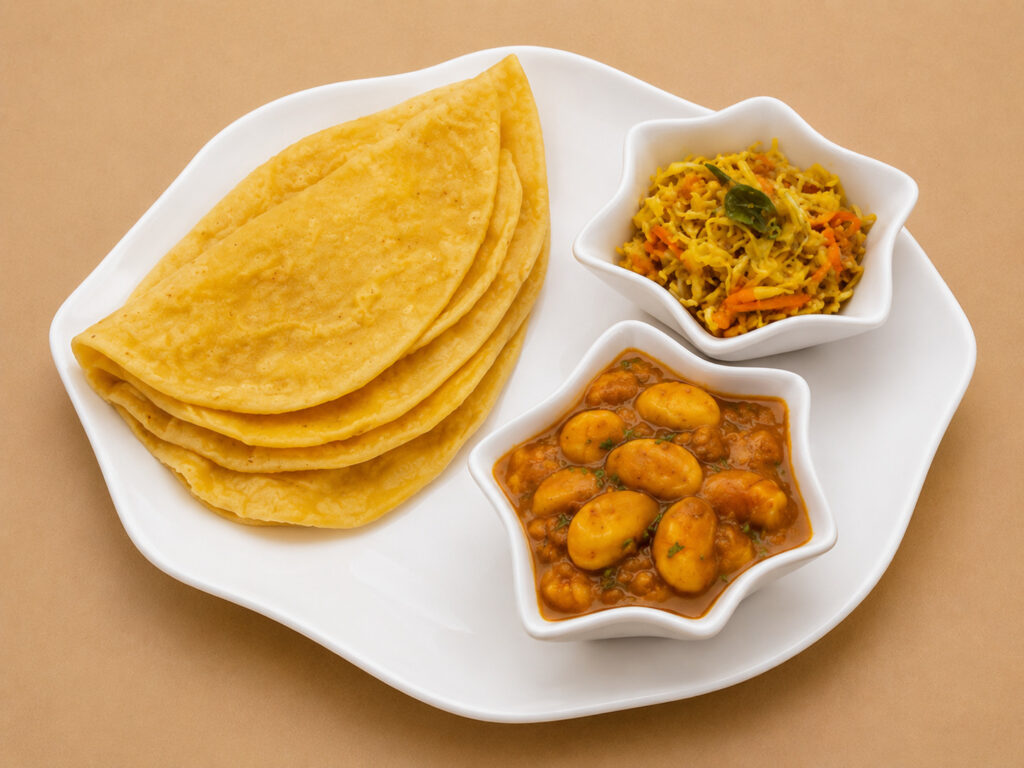
Dholl puri is one of the most iconic foods of Mauritius and is widely regarded as a symbol of the island’s multicultural culinary identity. It’s a thin, soft flatbread stuffed with seasoned split peas, traditionally served with bean curry, rougaille, pickles, chutneys, and other curries.
It’s particularly popular as street food, where freshly cooked dholl puri is often eaten rolled or folded around its accompaniments. The dish brings together influences from the Indian subcontinent, Africa, Europe, and the wider Indian Ocean, reflecting Mauritius’s long history of migration and cultural exchange.
The History of Dholl Puri
The history of dholl puri is closely connected to the arrival of Indian indentured laborers in Mauritius during the 19th century.
After the abolition of slavery in the British Empire, Mauritius faced a major labor shortage on its sugar plantations. Large numbers of workers were recruited from India, bringing their food traditions, cooking techniques, and ingredients with them.
Over generations, these culinary traditions adapted to Mauritian ingredients, local tastes, and changing social conditions. Dholl puri became one of the foods that grew from this history, eventually moving beyond its original communities to become a beloved part of Mauritian street food and national culinary culture.
23. Romazava
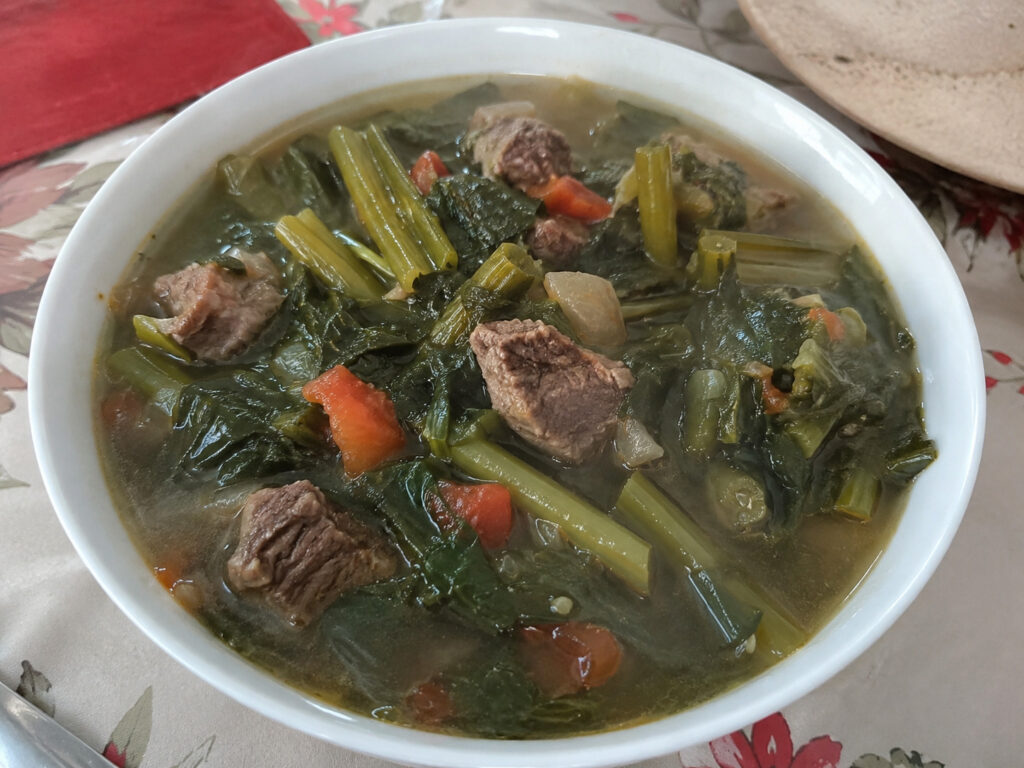
Romazava is one of the most important traditional dishes of Madagascar. It’s a fragrant meat-and-leafy-greens stew or broth, traditionally prepared with beef and a mixture of local greens and herbs. It’s usually served with a generous portion of plain white rice, which is a fundamental staple of Malagasy cuisine.
Romazava is particularly interesting because its flavor doesn’t come mainly from heavy spices. Instead, it’s characterized by fresh leafy greens, herbs, and the distinctive tingling sensation of certain Malagasy plants, especially brèdes mafana. This gives the dish a flavor that is quite different from many other African stews.
History of Romazava
Romazava has deep roots in Malagasy food traditions, but assigning it to one specific historical date or inventor would be misleading.
Its history is connected to the broader development of Malagasy cuisine, which itself reflects centuries of migration and cultural exchange. Madagascar’s population has ancestral connections to both Southeast Asia and East Africa, with later influences from Arab, European, and other communities.
These diverse influences helped shape the island’s food culture, but romazava remains firmly rooted in Madagascar’s local ingredients, agricultural traditions, and everyday cooking practices. Over generations, different communities developed their own variations while keeping the basic combination of meat, greens, herbs, and rice at the heart of the dish.
24. Fish Curry
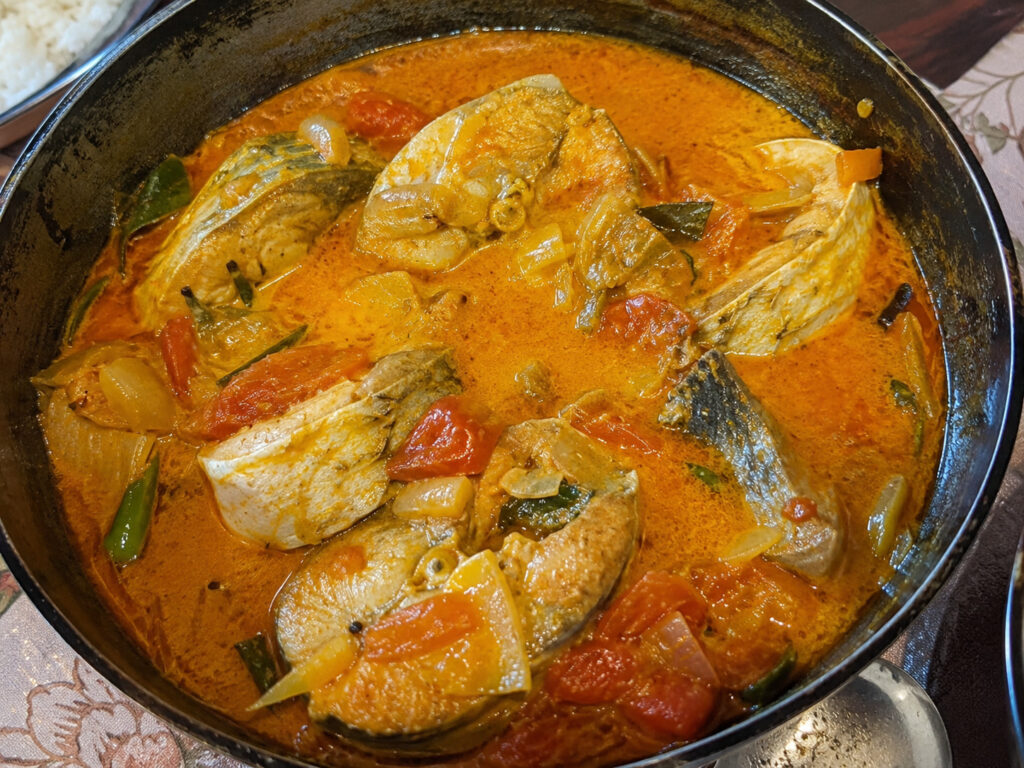
Fish curry is one of the most iconic dishes of Seychellois cuisine. It combines the Seychelles’ abundant tropical seafood with Indian-influenced spices, coconut, tomatoes, garlic, ginger, and local herbs.
It’s a great example of the islands’ Creole culinary identity, where African, Indian, French, and other Indian Ocean influences have come together with local ingredients to create something distinctly Seychellois.
Unlike some South Asian curries, Seychellois fish curry is often relatively light, aromatic, and fresh, allowing the natural flavor of the fish to remain prominent.
History of Fish Curry in Seychelles
The history of fish curry is closely connected to the population and cultural exchange that shaped the Seychelles.
The islands did not have a permanent indigenous population before European settlement. French settlers established a colony in the 18th century, bringing enslaved Africans and other people to the islands.
Later, workers and migrants from India, China, and other parts of the Indian Ocean world contributed to the population and brought their own cooking traditions with them. Over generations, these influences blended with French and African traditions and the abundant local seafood.
The result was a distinctive Seychellois Creole cuisine, in which dishes such as fish curry reflect the islands’ history of migration, trade, and cultural exchange while making use of local ingredients.
Final Thoughts
Traditional African food is far more diverse than many people realize. From Moroccan tagine and Egyptian koshari to Ethiopian injera, Nigerian jollof rice, Kenyan nyama choma, South African bobotie, and Malagasy romazava, every region offers something distinctive.
The continent’s cuisines showcase an incredible variety of grains, vegetables, fruits, spices, meats, seafood, and cooking traditions. More importantly, food is deeply connected to family, community, celebration, hospitality, and cultural identity.
Whether you’re planning a trip to Africa or simply exploring world cuisine from home, discovering traditional African foods is a delicious way to learn more about the continent’s diverse cultures, traditions, and history.
Which traditional African dish would you most like to try?