Nature never runs out of surprises. Most of us think of plants as just ordinary trees, flowers, and shrubs, but some look so strange that they seem like they belong in a sci-fi movie. From flowers that look like monkeys and skulls to trees that produce blood-red sap, these incredible plants prove that the natural world is far more fascinating than most of us realize.
Whether you’re a traveler, a photographer, or simply someone who loves discovering nature’s weird and wonderful creations, these extraordinary plants from around the world deserve a place on your bucket list.
If you enjoy places that look almost too strange to be real, don’t miss our blog, “10 Weird and Strange Lakes Around the Globe That Look Unreal.“ It’s packed with some of the most unusual and breathtaking lakes you’ll find anywhere on Earth.
1. Dragon’s Blood Tree
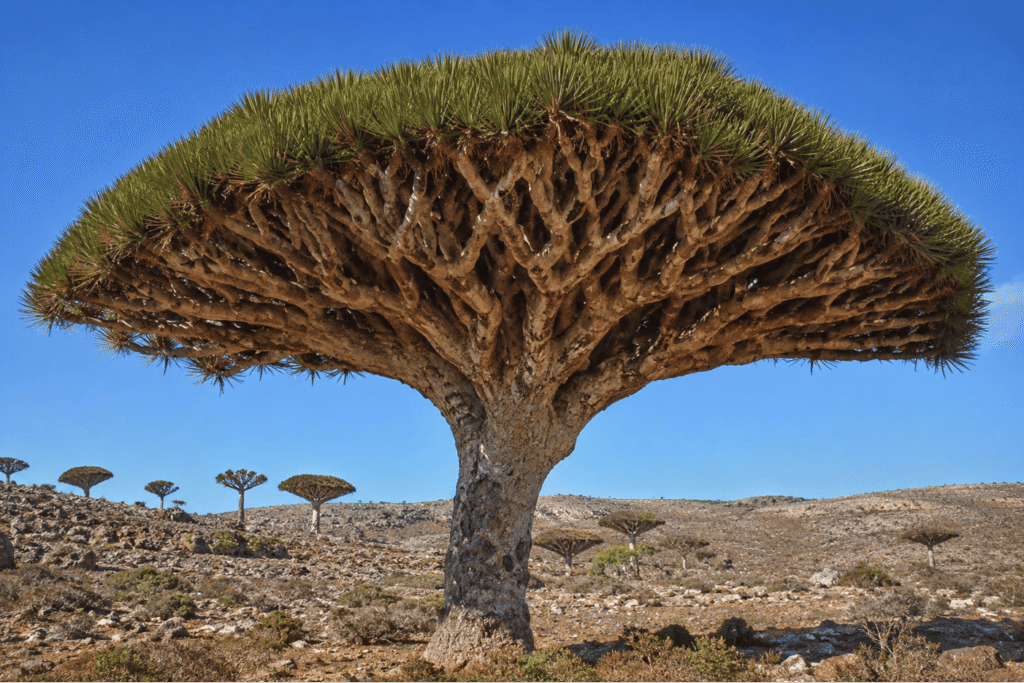
Dragon’s Blood Tree (Dracaena cinnabari) is one of the world’s most extraordinary trees. With its umbrella-shaped crown and blood-red resin, it looks like something straight out of a fantasy movie—but it’s completely real. This remarkable species grows almost exclusively on the remote Socotra Archipelago in Yemen, often called the “Galápagos of the Indian Ocean” because of its incredible number of unique plants and animals found nowhere else on Earth.
It belongs to the Asparagaceae family and is native to the Socotra Archipelago. Most Dragon’s Blood Trees grow between 16 and 40 feet (5–12 meters) tall, although some can grow even taller. They have an incredibly slow growth rate and can live for several hundred years.
Why Is It Called the Dragon’s Blood Tree?
The tree gets its name from the deep crimson-red resin it produces when its bark is cut or damaged. The resin looks strikingly like blood, giving rise to ancient legends that it came from the blood of dragons. While several unrelated plant species produce a substance known as “dragon’s blood,” Dracaena cinnabari is by far the most famous source.
Its Incredible Appearance
Dragon’s Blood Tree is instantly recognizable thanks to its unusual umbrella-shaped canopy, which resembles a giant upside-down umbrella or mushroom. This unique shape isn’t just beautiful—it plays an important role in the tree’s survival. The dense canopy shades the roots, reduces water loss, captures moisture from fog and mist, and protects young seedlings from the intense desert sun. These adaptations have helped the species survive in Socotra’s harsh environment for millions of years.
Where Does It Grow?
Dragon’s Blood Tree grows naturally only on Socotra, an island in the Arabian Sea that belongs to Yemen. The island became isolated from mainland Arabia millions of years ago, allowing its plants and animals to evolve independently. Today, around 37% of Socotra’s plant species are found nowhere else on Earth, making it one of the world’s most important biodiversity hotspots.
The Famous Red Resin
One of the tree’s most fascinating features is its bright red resin, often called “dragon’s blood.” When the bark is injured, the resin slowly oozes out and hardens after being exposed to air. It acts like a natural bandage by sealing wounds and helping protect the tree from fungi, insects, and diseases. Its rich red color comes from naturally occurring compounds that change when exposed to oxygen. Over the centuries, this unusual resin inspired countless myths, including stories that it grew where a dragon’s blood had fallen.
Traditional Uses of Dragon’s Blood
For thousands of years, people have collected the resin for a wide variety of purposes. In traditional medicine, it has been used to treat wounds, digestive problems, skin conditions, and mouth or gum issues. Modern laboratory studies suggest the resin may have antimicrobial, antioxidant, and anti-inflammatory properties, although many of its traditional medicinal uses still need stronger scientific evidence.
The resin has also been valued as a natural red dye for fabrics, leather, and paints. It has been used as a varnish for furniture, violins, and other wooden objects, and when burned as incense, it releases a pleasant aroma that has made it popular in religious rituals and traditional ceremonies for centuries.
Flowers and Fruits
Although the tree is best known for its unusual canopy, it also produces small white or greenish flowers, usually after seasonal rains. These flowers eventually develop into orange to red berries, whose seeds are mainly spread by birds.
How Does It Grow?
It has a fascinating growth pattern. Young trees look much like ordinary shrubs. As they mature, the trunk gradually thickens until the tree produces its first flowers. After flowering, each branch naturally splits into two, and this process repeats over many years. This repeated branching creates the tree’s iconic umbrella-shaped crown. Scientists refer to this growth pattern as dichotomous branching.
How Long Does It Live?
They are incredibly long-lived. Many are believed to survive for several centuries, and some mature specimens may be hundreds of years old. Determining their exact age is difficult because, unlike many temperate trees, they do not produce distinct annual growth rings.
Why Is It Endangered?
Although the Dragon’s Blood Tree has survived for millions of years, it now faces several serious threats. Climate change is reducing the fog and cloud moisture the trees rely on, while overgrazing by goats prevents young seedlings from growing into mature trees. Habitat degradation and poor natural regeneration have also contributed to the species’ decline. Many ancient trees still stand across Socotra, but in some areas there are far too few young trees replacing them. Because it is a surviving remnant of ancient subtropical forests, the Dragon’s Blood Tree is considered a relict species, making its conservation more important than ever.
2. Corpse Flower
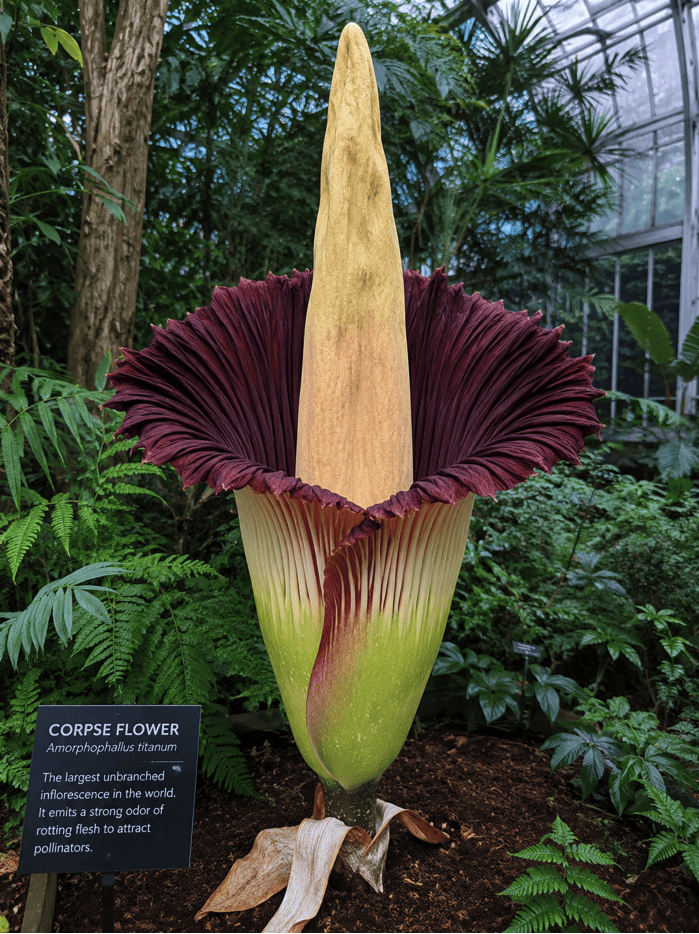
Corpse Flower (Amorphophallus titanum), also known as the Titan Arum, is one of the world’s most famous and unusual plants. It’s best known for producing the largest unbranched inflorescence (flowering structure) in the plant kingdom and for giving off a powerful smell that resembles rotting flesh. While the odor may be unpleasant to humans, it’s the perfect way to attract insects that feed on dead animals, helping the plant reproduce.
The Corpse Flower belongs to the Araceae family and is native to the tropical rainforests of Sumatra, Indonesia. It can grow between 6.5 and 11.5 feet (2–3.5 meters) tall, occasionally even taller, with a width of up to 5 feet (1.5 meters). Its massive underground corm can weigh more than 220 pounds (100 kilograms), and the plant can live for over 40 years. Because of its enormous size and rare blooms, flowering events often attract thousands of visitors to botanical gardens around the world.
Why Is It Called the Corpse Flower?
The plant gets its name from the strong odor it releases while blooming. Many people compare the smell to rotting meat, dead fish, garbage, dirty socks, or even sewage. Although the scent is unpleasant to us, it serves an important purpose. It attracts carrion beetles and flesh flies, which mistake the plant for a dead animal and unknowingly pollinate it.
Is It Really a Flower?
Surprisingly, no. The giant structure that most people call the “flower” is actually an inflorescence, a collection of hundreds of tiny flowers grouped together. The inflorescence has two main parts. The spathe is the large, burgundy, petal-like structure that surrounds the plant, while the spadix is the tall central spike that can grow over 10 feet (3 meters) high. The tiny male and female flowers are hidden at the base of the spadix.
Where Does It Grow?
In the wild, the Corpse Flower grows only in the tropical rainforests of Sumatra, Indonesia. It thrives in warm temperatures, high humidity, rich rainforest soil, and filtered sunlight beneath the dense forest canopy.
Why Does It Smell So Bad?
The plant’s foul odor is part of a clever survival strategy. During its brief bloom, it releases sulfur-containing compounds similar to those produced by decomposing animals. It can even warm the upper part of its spadix, helping the smell travel farther through the forest and making the illusion of a fresh carcass even more convincing to insects.
A Bloom That Happens Only Occasionally
One of the most fascinating things about the Corpse Flower is how rarely it blooms. It usually takes 7 to 10 years, and sometimes even longer, before producing its first bloom. After flowering, several more years may pass before it blooms again.
Each bloom lasts only 24 to 48 hours, with the strongest odor released during the first night. Because the flowering period is so short, botanical gardens often announce upcoming blooms in advance so visitors have a chance to witness this rare event.
What Happens the Rest of the Time?
For most of its life, the Corpse Flower doesn’t look nearly as dramatic. Instead of producing its famous bloom, it grows a single enormous leaf supported by a thick, tree-like stalk. Beneath the ground is a massive corm that stores the nutrients needed for future growth and flowering. The leaf itself can grow several meters tall and closely resembles a small tree.
Pollination
Corpse Flower relies on carrion beetles and flesh flies for pollination. Female flowers become receptive first, attracting insects into the bloom. Later, the male flowers release pollen, reducing the chance of self-pollination. The insects then carry the pollen to another blooming plant.
Because two Corpse Flowers rarely bloom at the same time in the wild, successful pollination is uncommon. If pollination does occur, the plant produces clusters of bright orange to red berries, each containing seeds that are later dispersed by birds and other rainforest animals.
Why Is It Endangered?
Corpse Flower is listed as Endangered because its natural habitat is disappearing. Illegal logging, deforestation, and climate change continue to threaten the rainforests of Sumatra, where the species grows naturally. Since it is found only in a limited part of Indonesia, the loss of its habitat has a major impact on its long-term survival, making conservation efforts more important than ever.
3. Monkey Face Orchid
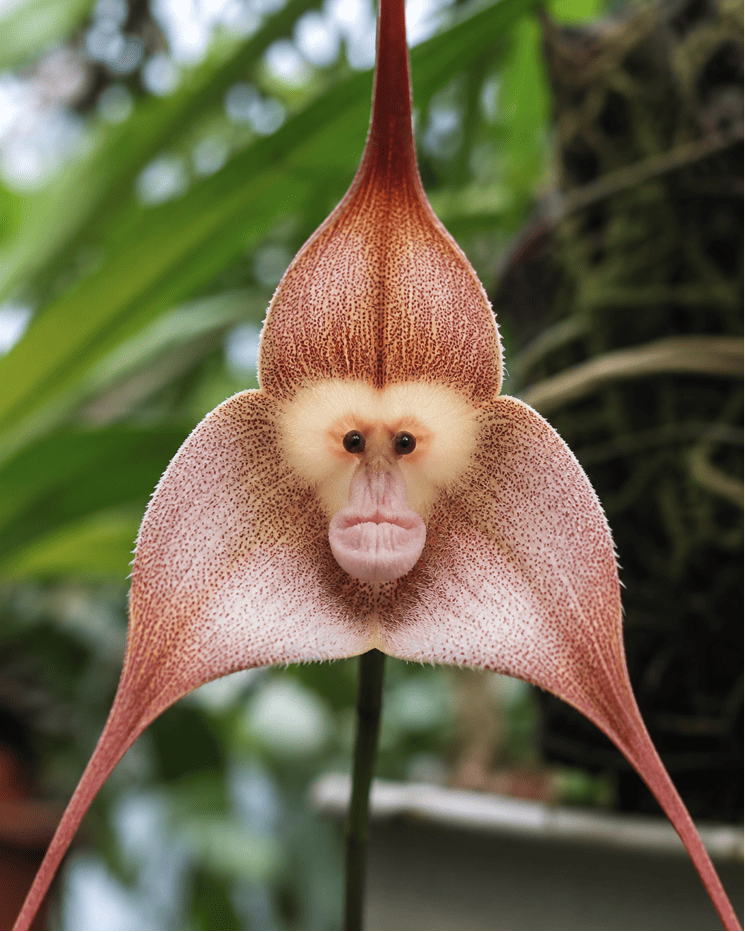
Monkey Face Orchid (Dracula simia) is one of the world’s most extraordinary orchids. Its flowers look remarkably like the face of a monkey, complete with what seem to be eyes, a nose, and a mouth. As if its appearance wasn’t unusual enough, it also gives off a pleasant citrus-like fragrance. This rare combination has made it one of the most fascinating flowers on Earth.
It belongs to the Orchidaceae family and is native to the cloud forests of Ecuador and Peru. The plant typically grows between 8 and 18 inches (20–45 cm) tall, while its flowers measure about 2 to 4 inches (5–10 cm) across.
Why Is It Called the Monkey Face Orchid?
The flower gets its name from the striking monkey-like face that naturally appears in its center. Most people can easily spot what look like two large eyes, a broad nose, and a small mouth. Of course, these aren’t actual facial features. The illusion is created by the flower’s petals, sepals, and lip, which are arranged in a way that our brains recognize as a face. This phenomenon is known as pareidolia, the tendency to see familiar patterns in random objects.
The Meaning Behind Its Scientific Name
The genus name Dracula comes from the Latin word meaning “little dragon.” It was chosen because the flowers have long, pointed sepals that resemble dragon tails, and many species in the genus have an unusual, mysterious appearance. The species name simia means “monkey,” so Dracula simia roughly translates to “little dragon monkey.”
A Truly Unique Appearance
Unlike most orchids, the Monkey Face Orchid has long, tail-like sepals, soft fuzzy petals, and beautiful shades of brown, burgundy, cream, and purple. At the center is its famous monkey-like face, which appears almost perfectly symmetrical. No two flowers are exactly alike, making each bloom unique.
Where Does It Grow?
Monkey Face Orchid grows naturally in the cool, misty cloud forests of Ecuador and Peru at elevations of about 3,300 to 6,600 feet (1,000–2,000 meters) above sea level. These forests are known for their frequent fog, high humidity, mild temperatures, and dense tree cover.
It is an epiphytic orchid, meaning it usually grows on tree trunks and branches instead of in soil. The trees simply provide support—the orchid doesn’t take nutrients from them.
Does It Really Smell Like Oranges?
Yes! One of the most surprising things about the Monkey Face Orchid is its fragrance. Many people describe the scent as similar to fresh oranges, sweet citrus fruits, or ripe fruit. The fragrance is usually strongest during the day, when it helps attract pollinating insects.
Flowers Throughout the Year
Unlike many orchids that bloom only once a year, the Monkey Face Orchid can flower several times throughout the year if conditions stay cool and humid. Each bloom usually lasts between one and three weeks, giving visitors plenty of time to admire its unusual appearance.
Pollination
Scientists are still studying exactly how Dracula simia is pollinated. However, many orchids in the Dracula genus are believed to rely on small flies attracted by their appearance and scent. Once the insects land on the flower, its unique shape helps guide them toward the reproductive structures, increasing the chances of successful pollination.
Why Is It Rare?
Monkey Face Orchid is considered rare because its natural habitat is limited to a small region of the Andes. Deforestation, habitat destruction, climate change, and illegal collection from the wild all threaten its survival. Although it is grown by specialist orchid collectors and botanical gardens, wild populations remain limited.
Why It Fascinates People
Monkey Face Orchid is one of nature’s most incredible optical illusions. With its monkey-like face, dragon-inspired flower shape, sweet citrus fragrance, and home in the misty cloud forests of the Andes, it’s easy to see why people around the world are fascinated by it. It may look almost too strange to be real, but this remarkable orchid is a perfect example of the amazing diversity found in nature.
4. Lithops
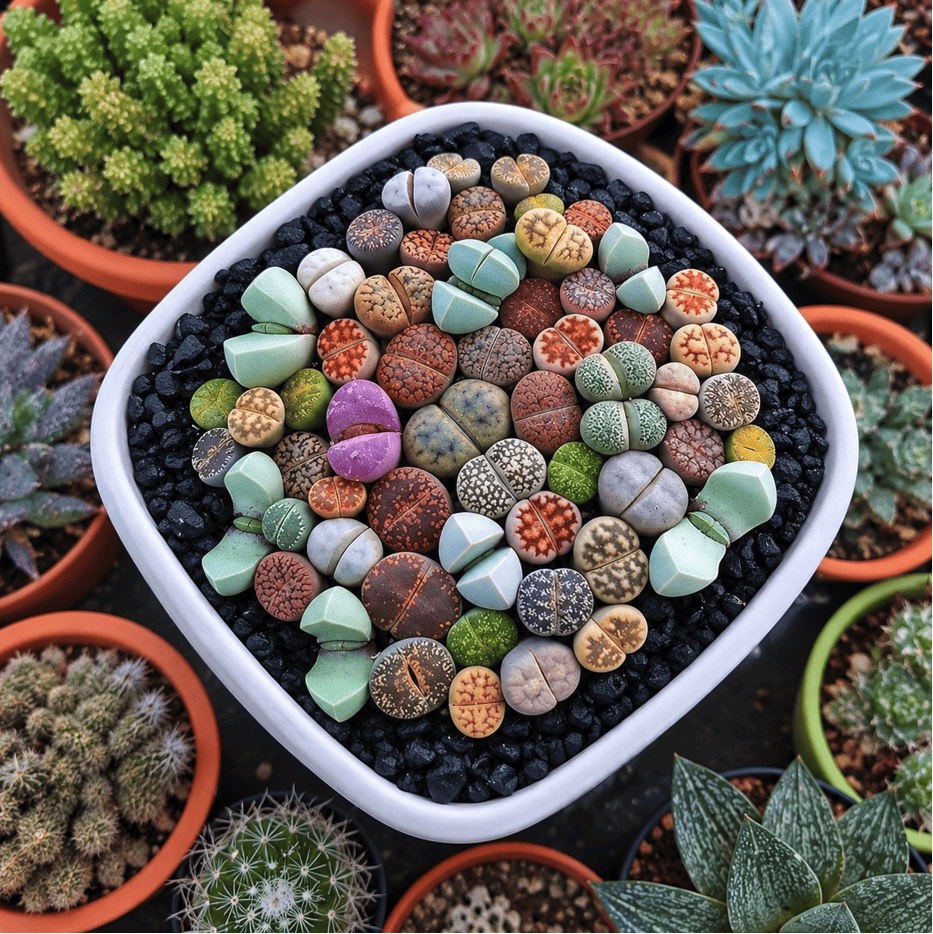
Lithops, commonly known as Living Stones, are among the world’s most unusual plants. These tiny succulents have evolved to look almost exactly like the pebbles and rocks around them, making them incredibly difficult for animals to spot. Their remarkable camouflage helps them survive in some of the harshest deserts on Earth.
Lithops belong to the Aizoaceae family and are native to Namibia and South Africa. Most plants grow only 0.4 to 2 inches (1–5 cm) tall and 0.8 to 2 inches (2–5 cm) wide. Despite their small size, they can live for 40 to 50 years or even longer with proper care. They also have an extremely slow growth rate, often producing just one new pair of leaves each year.
Why Are They Called Living Stones?
Lithops are called Living Stones because they look almost identical to the rocks surrounding them. Each plant is made up of two thick, fleshy leaves joined together by a narrow fissure in the middle. Their colors, markings, and textures closely match nearby stones, helping them avoid being eaten by grazing animals. This remarkable disguise is one of the best examples of camouflage (crypsis) in the plant kingdom.
Where Do They Grow?
Living Stones are native to the dry, arid regions of Namibia and South Africa. They thrive in rocky deserts, gravel plains, quartz fields, and dry hillsides where rainfall is extremely scarce. To survive these harsh conditions, they have evolved to store water efficiently and make the most of every drop of rain.
An Amazing Survival Strategy
Unlike most plants, nearly the entire body of a Lithops grows below the soil surface. Only the top of the leaves remains visible, exposing just enough surface to absorb sunlight while minimizing water loss in the scorching desert.
The tops of the leaves contain translucent “windows” that allow sunlight to pass into the plant’s interior, where photosynthesis takes place. This clever adaptation lets the plant stay mostly hidden while still producing the energy it needs to survive.
How Do They Store Water?
Like other succulents, Lithops store water inside their thick, fleshy leaves. Their compact shape, tiny exposed surface area, deep taproots, and slow growth all help conserve moisture. These adaptations allow the plants to survive for long periods without rainfall, making them perfectly suited to life in the desert.
A Fascinating Growth Cycle
Lithops have one of the most unusual growth cycles of any succulent. Every year, a new pair of leaves develops inside the old pair. As the new leaves grow, they gradually absorb the water and nutrients stored in the old leaves, causing them to shrivel and eventually disappear. Because the plant recycles its own moisture during this process, healthy Lithops often require little to no watering while the old leaves are being replaced.
Beautiful Flowers
Despite looking like ordinary stones, Lithops produce surprisingly large, daisy-like flowers. Depending on the species, the blooms may be white, yellow, or occasionally orange, and they’re often larger than the plant itself.
The flowers emerge from the central fissure between the two leaves, usually in late summer or autumn. They open during the afternoon, close at night, and can remain in bloom for several days.
Pollination
In the wild, Lithops are mainly pollinated by small insects such as bees and flies. After successful pollination, seed capsules begin to develop. These capsules stay tightly closed until they are soaked by rain. Once wet, they open and release their seeds, ensuring they are dispersed when conditions are favorable for germination.
Can You Grow Them?
Yes! Living Stones are popular houseplants, but they need very different care from most other succulents. They thrive in bright sunlight, fast-draining gritty soil, excellent drainage, and good airflow. They also require very little water.
The biggest mistake people make when growing Lithops is overwatering. Too much moisture can quickly cause the plant to rot, so it’s always better to underwater than overwater these remarkable desert survivors.
5. Venus Flytrap
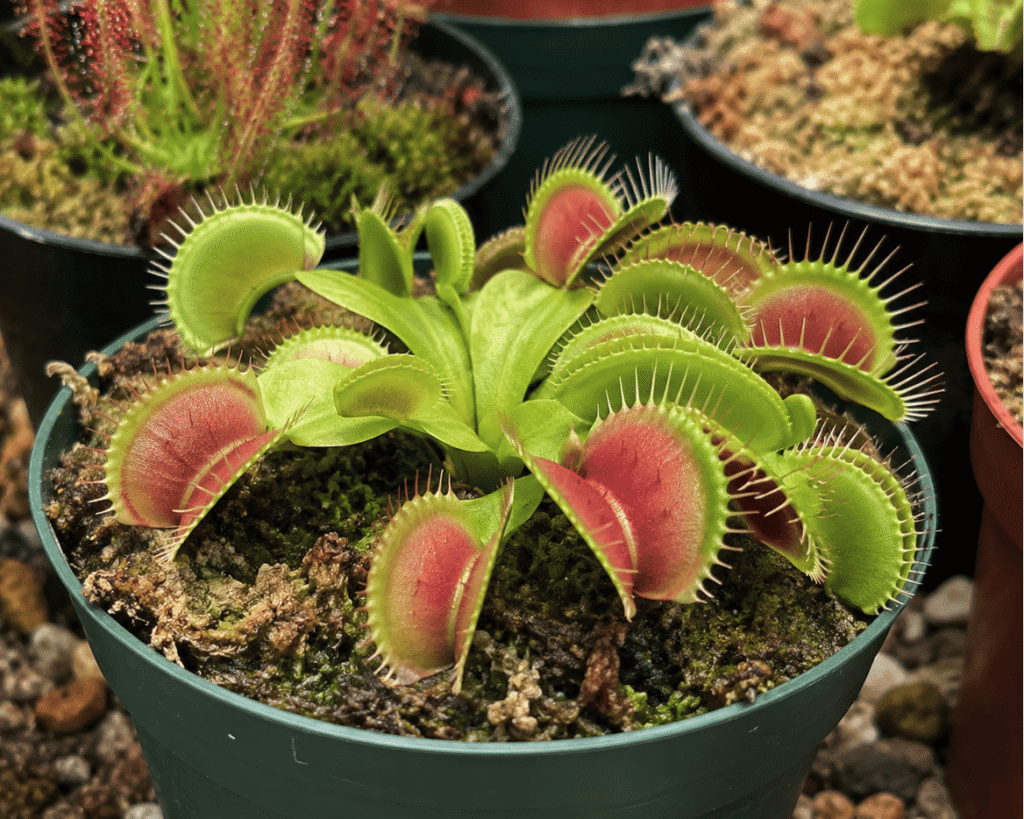
Venus Flytrap (Dionaea muscipula) is one of the world’s most famous carnivorous plants. Unlike most plants, it captures and digests insects to obtain nutrients, making it one of nature’s most fascinating predators. Despite its fearsome appearance, it’s completely harmless to humans.
The Venus Flytrap belongs to the Droseraceae family and is native to the coastal plains of North Carolina and South Carolina in the United States. It typically grows between 2 and 6 inches (5–15 cm) tall, while its traps measure about 1 to 2 inches (2.5–5 cm) across. With proper care, a Venus Flytrap can live for 20 to 30 years or even longer.
Why Is It Carnivorous?
Venus Flytrap grows in nutrient-poor, acidic bogs where the soil contains very little nitrogen and phosphorus. To make up for this shortage, it captures insects and spiders, digesting them to absorb the nutrients it can’t get from the soil. Even though it eats insects, the plant still gets its energy from sunlight through photosynthesis. The insects simply provide extra nutrients needed for healthy growth.
What Does It Eat?
A Venus Flytrap mainly feeds on small insects and spiders. Its typical prey includes flies, ants, beetles, small crickets, and spiders. The traps are designed for small animals, so larger insects may escape or even damage the trap while trying to get free.
How Does the Trap Work?
Venus Flytrap’s leaves are divided into two hinged lobes lined with tooth-like structures called cilia. Inside each trap are tiny trigger hairs and nectar glands that attract curious insects.
When an insect enters the trap, it usually brushes against one of the trigger hairs. However, the trap doesn’t close immediately. Instead, it follows what’s known as the two-touch rule. The insect must touch a trigger hair twice, or touch two different hairs, within about 20 to 30 seconds. Only then does the trap snap shut. This clever mechanism helps prevent the plant from wasting energy by closing in response to raindrops, wind, or falling debris.
Once triggered, the trap can close in about one-tenth of a second, making it one of the fastest movements in the plant kingdom. This rapid action is powered by sudden changes in water pressure and stored elastic energy within the leaves.
What Happens After the Trap Closes?
At first, the trap closes loosely. If the trapped insect continues to move, the trap seals tightly and begins releasing digestive enzymes. Over the next 5 to 12 days, the insect is gradually broken down, allowing the plant to absorb valuable nutrients. Once digestion is complete, the trap reopens, leaving behind only the insect’s hard outer shell, or exoskeleton.
Can It Eat Human Fingers?
No. Although the trap may gently close around a fingertip, it isn’t strong enough to break skin or cause pain. In fact, repeatedly triggering the traps for fun is discouraged because each closure uses energy that the plant could otherwise use for growth and future prey.
Why Is It Vulnerable?
Although the Venus Flytrap is famous around the world, wild populations face several serious threats. Habitat destruction, urban development, illegal poaching, climate change, and the suppression of natural wildfires have all contributed to its decline. Periodic fires are an important part of its ecosystem because they keep surrounding vegetation from overcrowding the open bogs where the plant thrives.
Today, conservation efforts focus on protecting its natural habitat, restoring wetland ecosystems, and enforcing laws against illegal collection to help ensure this remarkable carnivorous plant survives for future generations.
6. Bleeding Tooth Fungus
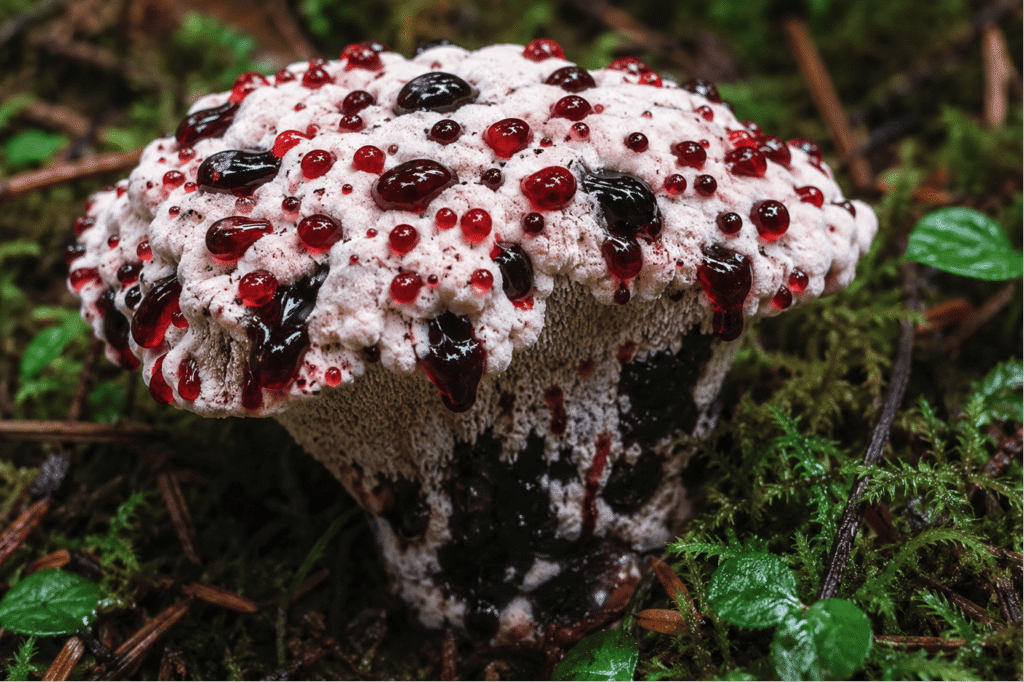
Bleeding Tooth Fungus (Hydnellum peckii) is one of the world’s most bizarre fungi. When it’s young, it produces bright red droplets that make it look like a strawberry covered in blood or a tooth dripping with blood. Despite its creepy appearance, it’s not poisonous. However, it’s considered inedible because of its extremely bitter taste and tough, woody texture.
This unusual fungus is also known by several other names, including Devil’s Tooth and Strawberries and Cream. It belongs to the Bankeraceae family in the kingdom Fungi and is found in parts of the United States, Canada, Europe, and Asia. Its fruiting body usually grows between 1.5 and 4 inches (4–10 cm) across and is most commonly found in cool coniferous forests.
Why Does It Look Like It’s Bleeding?
The famous red droplets are produced through a process called guttation. As the young fungus absorbs more water than it can use, it pushes the excess liquid out through tiny pores on its surface. These droplets contain water, natural pigments, dissolved minerals, and other compounds. Their vivid red color creates the striking illusion that the fungus is bleeding.
Is It Actually Blood?
No. The red liquid isn’t blood and contains no animal tissue. It’s simply a colored fluid produced by the fungus as part of its normal biological processes. As the fungus matures, the droplets gradually disappear, leaving behind a much less dramatic appearance.
Why Is It Called the Bleeding Tooth Fungus?
Its unusual name comes from two distinctive features. First are the blood-red droplets that appear on young specimens. Second is the underside of the cap, which is covered with hundreds of tiny, tooth-like spines instead of the gills or pores found on most mushrooms. These spines are where the fungus produces and releases its spores.
What Does It Look Like When Mature?
Young Bleeding Tooth Fungi are soft, white, and covered with bright red droplets. As they age, they gradually turn brown to dark brown and develop a hard, corky texture. By this stage, the dramatic “bleeding” effect has usually disappeared, making older specimens much less eye-catching.
Where Does It Grow?
Bleeding Tooth Fungus is most commonly found in cool, mossy conifer forests, especially among pine, spruce, and fir trees. It grows in parts of North America, Europe, and Asia and usually appears during late summer and autumn when conditions are cool and moist.
An Important Forest Partner
Although it may look strange, the Bleeding Tooth Fungus plays an important role in forest ecosystems. It forms a mycorrhizal relationship with tree roots, meaning both organisms benefit from the partnership.
The fungus helps trees absorb water and essential minerals from the soil, while the trees provide sugars produced through photosynthesis. This relationship supports healthier forests and improves the survival of both the fungus and its host trees.
Is It Poisonous?
Current evidence suggests that the Bleeding Tooth Fungus is not poisonous, but it isn’t considered edible either. Its flesh is extremely bitter, tough, and woody, making it unsuitable for cooking. Foraging experts generally recommend leaving it undisturbed in the wild.
Does It Have Medical Potential?
Scientists have discovered that Hydnellum peckii produces several natural compounds with interesting biological properties. Laboratory studies suggest some of these compounds may have antibacterial, antioxidant, and anticoagulant (blood-thinning) effects. However, this research is still in its early stages, and no approved medicines have been developed from the fungus so far.
How Does It Reproduce?
Like most fungi, the Bleeding Tooth Fungus reproduces by releasing microscopic spores from the tiny tooth-like spines beneath its cap. The wind carries these spores through the forest, and if they land in suitable soil near compatible tree roots, they can develop into new fungal networks called mycelium.
Most of the fungus actually lives underground as this vast network of microscopic threads. The familiar “mushroom” that appears above the ground is simply the fruiting body, produced when conditions are right for reproduction.
7. Baobab Tree
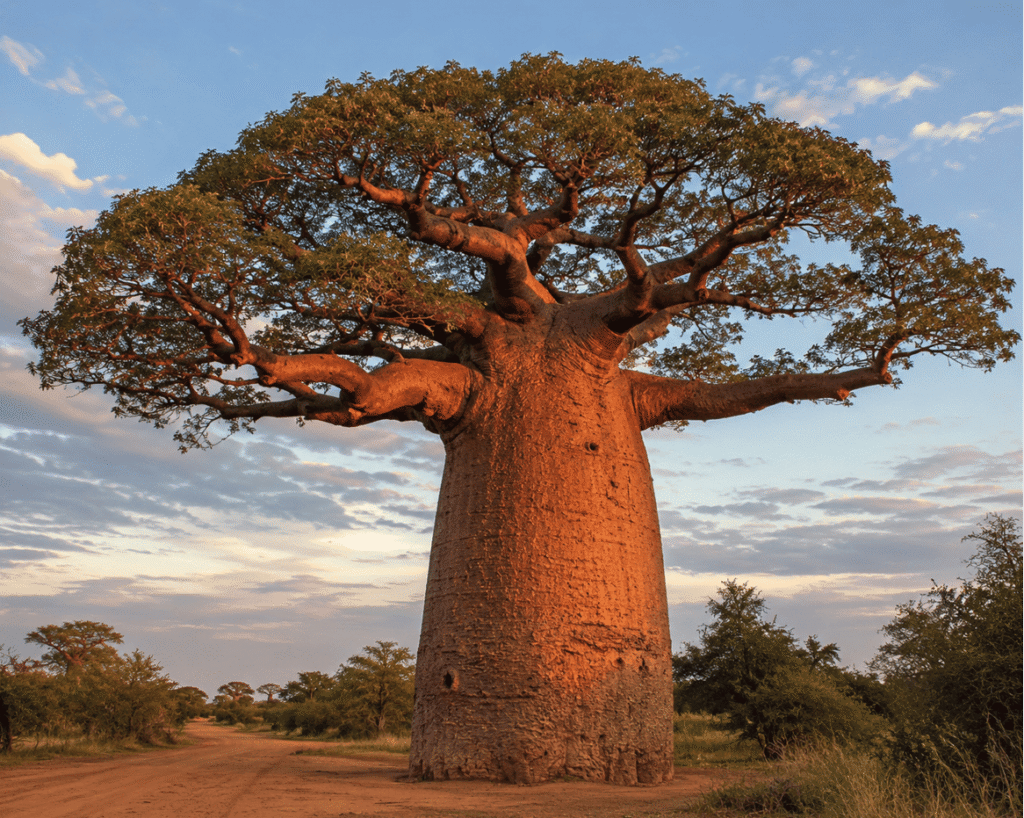
Baobab (Adansonia) is one of the world’s most iconic and unusual trees. Often called the “Tree of Life,” it’s famous for its enormous trunk, incredible ability to store water, and astonishingly long lifespan. Its unique shape has also earned it the nickname “upside-down tree” because its bare branches often look like roots reaching into the sky.
Baobabs belong to the Malvaceae family and are native to Africa, Madagascar, and Australia. Depending on the species, they can grow between 16 and 98 feet (5–30 meters) tall, with trunk diameters reaching up to 49 feet (15 meters) or even more. Many Baobabs live for over 1,000 years, and some are believed to be more than 2,000 years old, making them among the longest-living flowering trees on Earth.
Why Is It Called the “Upside-Down Tree”?
For much of the dry season, Baobabs shed all of their leaves. Their massive trunks and bare, twisted branches create the illusion that the tree has been planted upside down, with its roots growing toward the sky. According to African folklore, the gods were unhappy with the tree’s appearance and planted it upside down, giving rise to one of the Baobab’s most famous legends.
A Giant Natural Water Tank
One of the Baobab’s most remarkable adaptations is its enormous trunk, which acts like a natural water reservoir. The soft, spongy wood can store tens of thousands of liters of water, allowing the tree to survive months of drought in some of the hottest and driest parts of the world. This stored water also helps the tree recover once the rainy season returns, making it exceptionally well adapted to harsh environments.
Where Do Baobabs Grow?
Baobabs naturally grow across Africa, Madagascar, and parts of Australia. Madagascar is especially important because it’s home to six of the world’s eight recognized Baobab species. These remarkable trees thrive in dry savannas, open woodlands, semi-arid regions, and areas with seasonal rainfall.
Leaves, Flowers, and Fruit
During the rainy season, Baobabs produce bright green, hand-shaped leaves that are rich in nutrients and commonly eaten as vegetables in many African communities.
Their large white flowers are sweetly scented and usually bloom at night, lasting for only about 24 hours. Many Baobab species rely on fruit bats for pollination, although insects also play a role.
The tree’s fruit is oval-shaped and covered with a hard, velvety shell. Inside is a naturally dry, powdery pulp that’s packed with vitamin C, fiber, antioxidants, calcium, and potassium. Thanks to its impressive nutritional value, Baobab fruit is often considered a superfood.
Why Is It Called the “Tree of Life”?
The Baobab has earned the nickname “Tree of Life” because nearly every part of it is useful. Its leaves are eaten as food, the fruit is used in drinks and nutritional products, the seeds are processed into oil, and the bark is made into rope, baskets, mats, and cloth.
Some ancient Baobabs even develop hollow trunks that have been used as shelters, storage rooms, water reservoirs, and, in some regions, small chapels, shops, or meeting places. The tree provides valuable resources for both people and wildlife, making it one of the most important trees in many African landscapes.
An Incredible Lifespan
Baobabs are among the longest-living flowering trees on Earth. Many survive for well over 1,000 years, and scientific studies suggest that some famous specimens have lived for more than 2,000 years.
Unlike many other trees, Baobabs don’t produce clear annual growth rings, so scientists usually estimate their age using radiocarbon dating rather than counting rings.
Threats
Although many Baobab species remain widespread, some—particularly those found only in Madagascar—face growing threats from habitat destruction, agricultural expansion, climate change, prolonged drought, and wildfires.
In recent decades, scientists have also observed the unexplained decline and collapse of several ancient African Baobabs. While the exact cause is still being studied, climate-related stress is considered one of the most likely contributing factors, highlighting the importance of protecting these remarkable giants for future generations.
8. Doll’s Eyes Plant
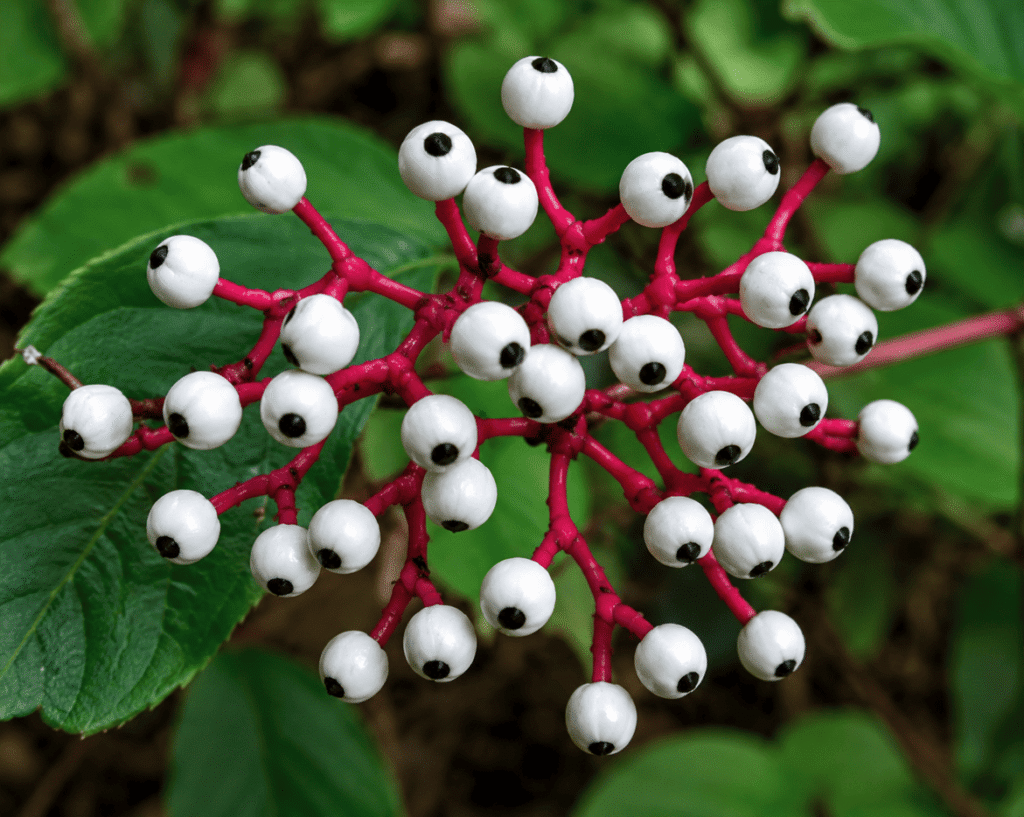
Doll’s Eyes Plant (Actaea pachypoda) is one of the world’s eeriest-looking plants. It’s best known for its bright white berries with black dots that look uncannily like tiny doll’s eyes staring back at you. As beautiful as it may seem, this plant is highly poisonous, especially its berries.
The Doll’s Eyes Plant belongs to the Ranunculaceae family and is native to Canada and the eastern regions of the United States. It typically grows between 1 and 2.5 feet (30–75 cm) tall. During early summer, it produces clusters of small, fragrant white flowers, which later develop into its distinctive white berries with black “pupils.”
Why Is It Called the Doll’s Eyes Plant?
The plant gets its unusual name from its striking berries. Each round, white berry has a dark black dot where it attaches to the stem, making it look remarkably like a tiny porcelain doll’s eye. The berries are often supported by bright red or pink stalks, creating an even more dramatic contrast that makes the plant hard to miss.
An Unforgettable Appearance
Doll’s Eyes Plant changes noticeably with the seasons. In spring, fresh green leaves emerge as the plant begins growing on the shady forest floor. By early summer, clusters of small, sweetly scented white flowers appear.
As late summer turns into autumn, those flowers transform into the plant’s famous white berries. The berries often remain on the plant for several weeks, giving it its unforgettable and slightly eerie appearance.
Where Does It Grow?
Doll’s Eyes Plant grows naturally in deciduous forests, moist woodlands, shaded hillsides, and other areas with rich, well-drained soil. It’s native to Canada and the eastern and central United States, where it thrives in cool, shaded environments beneath large trees.
Are the Berries Poisonous?
Yes. Nearly every part of the plant is poisonous, but the berries contain the highest concentration of toxic compounds. If eaten, they can cause severe stomach pain, nausea, vomiting, dizziness, and irregular heart rhythms. In serious cases, they may even lead to life-threatening heart complications. Fortunately, the berries have an extremely bitter taste, which usually discourages people from eating large amounts. Even so, they should never be consumed.
Why Aren’t Birds Harmed?
Interestingly, many birds can safely eat the berries without being affected by the toxins. After digesting the fruit, they disperse the seeds through their droppings, helping the plant spread throughout the forest. Scientists believe birds can tolerate compounds that are harmful to humans and many other mammals, making them important partners in the plant’s life cycle.
Flowers and Pollination
Before producing its famous berries, the Doll’s Eyes Plant blooms with clusters of tiny white flowers that have a pleasant fragrance. These flowers are mainly pollinated by bees, flies, and small beetles. Once pollination is complete, the flowers gradually develop into the distinctive white berries that give the plant its memorable name.
Ecological Importance
Although it’s poisonous to people and many animals, the Doll’s Eyes Plant plays an important role in forest ecosystems. Its flowers provide nectar and pollen for insects, while its berries serve as a food source for certain bird species. As birds spread the seeds, they help the plant grow in new areas, contributing to the health and diversity of woodland habitats.
9. Rainbow Eucalyptus
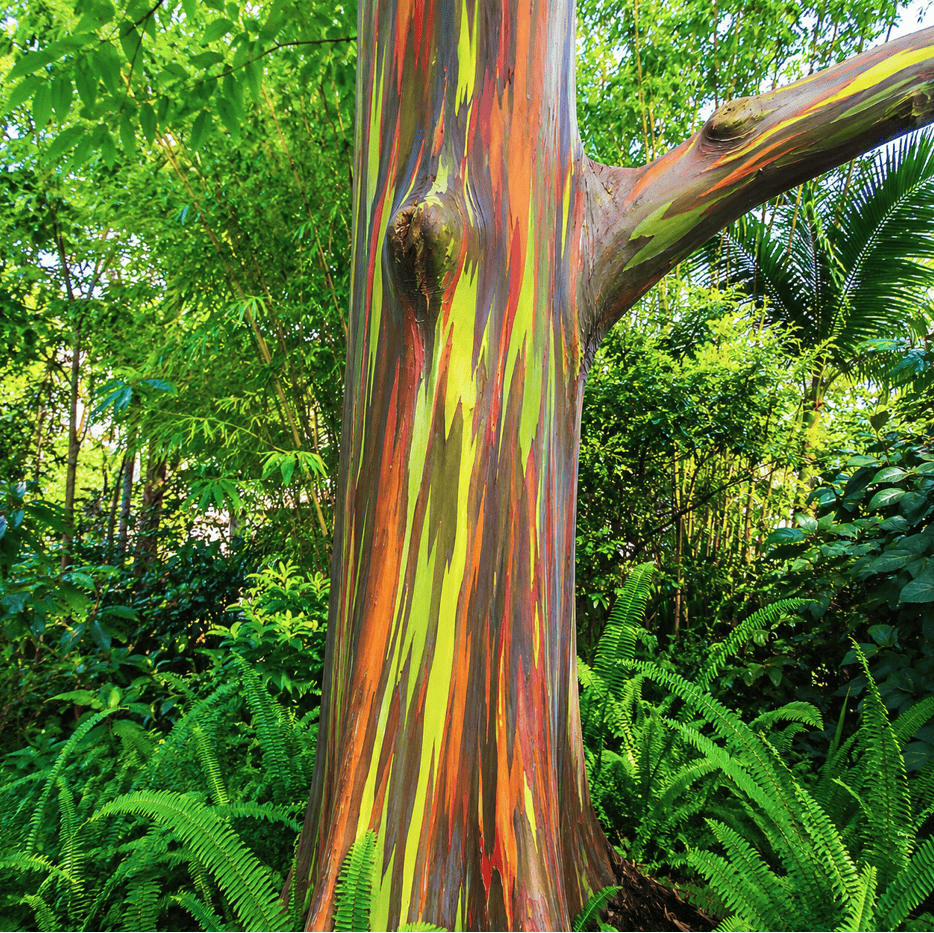
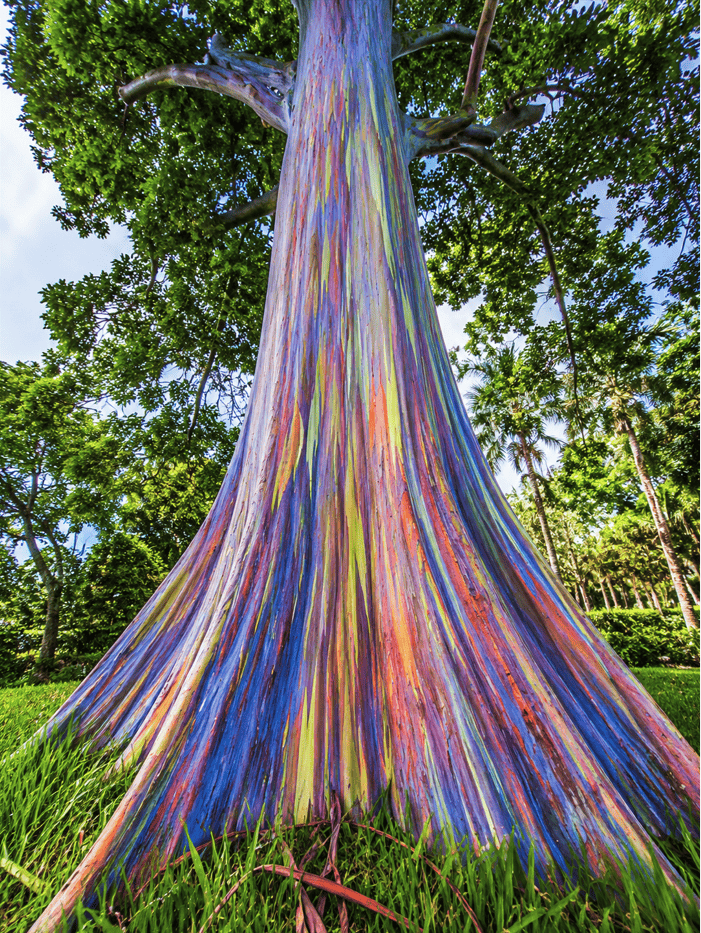
Rainbow Eucalyptus (Eucalyptus deglupta) is one of the most spectacular trees on Earth. It’s famous for its naturally multicolored bark, which peels away in thin strips to reveal vibrant shades of green, blue, purple, orange, red, and maroon. It may look like someone painted the trunk, but its incredible rainbow colors are completely natural.
The Rainbow Eucalyptus belongs to the Myrtaceae family and is native to the tropical rainforests of the Philippines, Indonesia, and Papua New Guinea. It typically grows between 200 and 250 feet (60–75 meters) tall, although some trees can grow even taller under ideal conditions. Its trunk can reach up to 8 feet (2.5 meters) in diameter, and it often lives for 50 to 150 years or more.
Why Is It Called the Rainbow Eucalyptus?
The tree gets its name from its extraordinary bark, which changes color as it ages. Unlike most trees that develop plain brown bark, the Rainbow Eucalyptus continuously sheds its outer bark throughout the year.
Freshly exposed bark starts out bright green because it contains chlorophyll. Over the following weeks and months, it gradually changes to shades of blue, purple, orange, red, and finally brown or maroon. Since different parts of the trunk peel at different times, multiple colors appear at once, creating the tree’s famous rainbow effect.
A Living Work of Art
No two Rainbow Eucalyptus trees look exactly alike. Each trunk has its own unique pattern because different sections of bark peel and age at different times. Sunlight, rainfall, and humidity also affect how vibrant the colors become. The result is a tree that often looks more like a painted work of art than something created by nature.
Where Does It Grow?
Rainbow Eucalyptus is the only eucalyptus species naturally found in the Northern Hemisphere. In the wild, it grows in the tropical rainforests of the Philippines, Indonesia, and Papua New Guinea.
Because of its beauty and rapid growth, it has also been planted in warm regions around the world, including Hawaii, parts of the southern United States, Central and South America, and other tropical and subtropical areas.
How Tall Can It Grow?
Rainbow Eucalyptus is one of the tallest species in the eucalyptus family. Most mature trees reach heights of 200 to 250 feet (60–75 meters), while exceptional specimens can grow even taller in their native rainforest habitat. Its long, straight trunk makes it valuable not only as an ornamental tree but also for commercial timber production.
Why Does the Bark Peel?
Unlike many trees, the Rainbow Eucalyptus naturally sheds its outer bark throughout the year. This process helps remove algae, mosses, fungi, and other organisms that may grow on the trunk while allowing fresh new bark to develop. It’s this continuous peeling and aging process that creates the tree’s stunning display of rainbow colors.
Uses
Rainbow Eucalyptus is valued for both its beauty and its practical uses. Its fast-growing wood is widely used to produce paper pulp, printing paper, and tissue products. The timber is also used in construction, plywood, and furniture manufacturing.
Outside its native range, the tree is a popular ornamental species and is often planted in parks, botanical gardens, and tropical landscapes, where its colorful trunk attracts visitors from around the world.
10. Baseball Plant
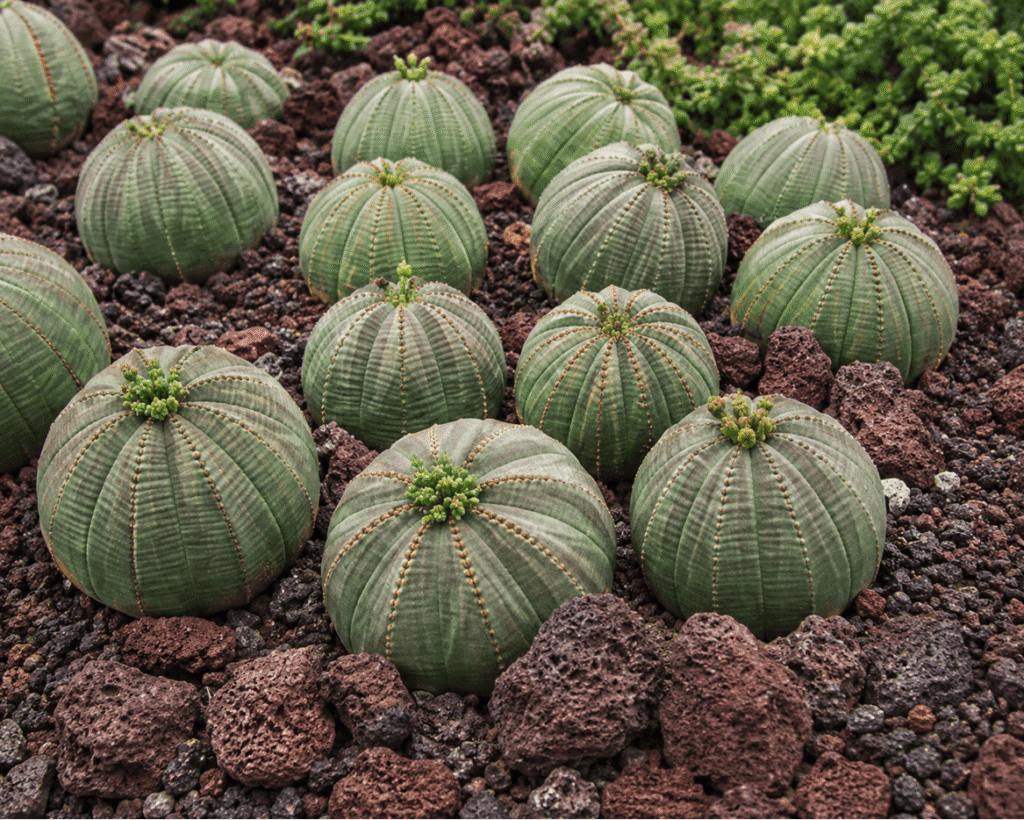
Baseball Plant (Euphorbia obesa) is one of the world’s most unusual succulents. It’s best known for its perfectly rounded shape and distinctive green-and-brown stripes, giving it an appearance that’s remarkably similar to a baseball. Although it looks a lot like a cactus, it actually belongs to the Euphorbiaceae (spurge) family.
Native to South Africa, the Baseball Plant typically grows between 3 and 8 inches (8–20 cm) tall and measures about 2.5 to 6 inches (6–15 cm) in diameter. It grows very slowly and, with proper care, can live for 50 years or even longer.
Why Is It Called the Baseball Plant?
The plant gets its name from its almost perfectly spherical shape and the vertical green-and-brown stripes that resemble the stitching pattern on a baseball. Young plants are nearly round, while older ones gradually become slightly more cylindrical.
Is It a Cactus?
No. Even though it looks like a cactus because of its thick, water-storing stem, the Baseball Plant isn’t a cactus at all. It belongs to the spurge family and evolved many cactus-like features independently, making it a great example of convergent evolution. Unlike most cacti, it has no true spines. Instead, it produces a milky white latex sap if the stem is damaged.
A Master of Water Storage
Like many succulents, the Baseball Plant stores water inside its thick, fleshy stem, allowing it to survive long periods without rain. Its compact shape, minimal leaf surface, thick waxy skin, and slow growth all help reduce water loss, making it perfectly adapted to dry environments.
Where Does It Grow?
Baseball Plant is native to the dry regions of South Africa, particularly the Great Karoo. It grows among rocks and gravel in areas with hot summers, low rainfall, bright sunshine, and well-drained soil. Its rounded shape blends surprisingly well with the surrounding stones, providing natural camouflage from grazing animals.
Flowers
Although the plant itself is small, it produces tiny yellow-green flowers at the top of its stem, usually during spring and summer. The Baseball Plant is dioecious, which means male and female flowers grow on separate plants. For seeds to develop, pollen from a male plant must be transferred to a female plant.
Is It Poisonous?
Yes. Like many members of the spurge family, the Baseball Plant contains a milky latex sap that can be irritating.
If the sap comes into contact with the skin or eyes, it may cause irritation, and swallowing any part of the plant can lead to stomach upset. When handling the plant, it’s a good idea to wear gloves if you’re cutting or repotting it, wash your hands afterward, and keep it out of reach of children and pets.
Why Is It Endangered?
Wild populations of the Baseball Plant have declined due to illegal collection, habitat loss, and its naturally slow rate of reproduction.
Fortunately, most Baseball Plants available today are grown in nurseries rather than collected from the wild. This helps reduce pressure on natural populations and supports the conservation of this remarkable succulent in its native habitat.
Final Thoughts
Nature never ceases to amaze. From trees that seem to bleed red sap and flowers that look like monkey faces to carnivorous plants that trap insects, these incredible species show just how creative and surprising the natural world can be. Some look like they belong in a fantasy movie, yet they all exist right here on Earth.
Whether you’re planning your next trip, love photography, or simply enjoy discovering nature’s hidden wonders, these extraordinary plants are a reminder that our planet is full of amazing life waiting to be explored. Sometimes, the strangest things in nature turn out to be the most unforgettable.